
West Hartford Board of Education Makes Cuts, Approves 2026-27 Budget

Audio By Carbonatix
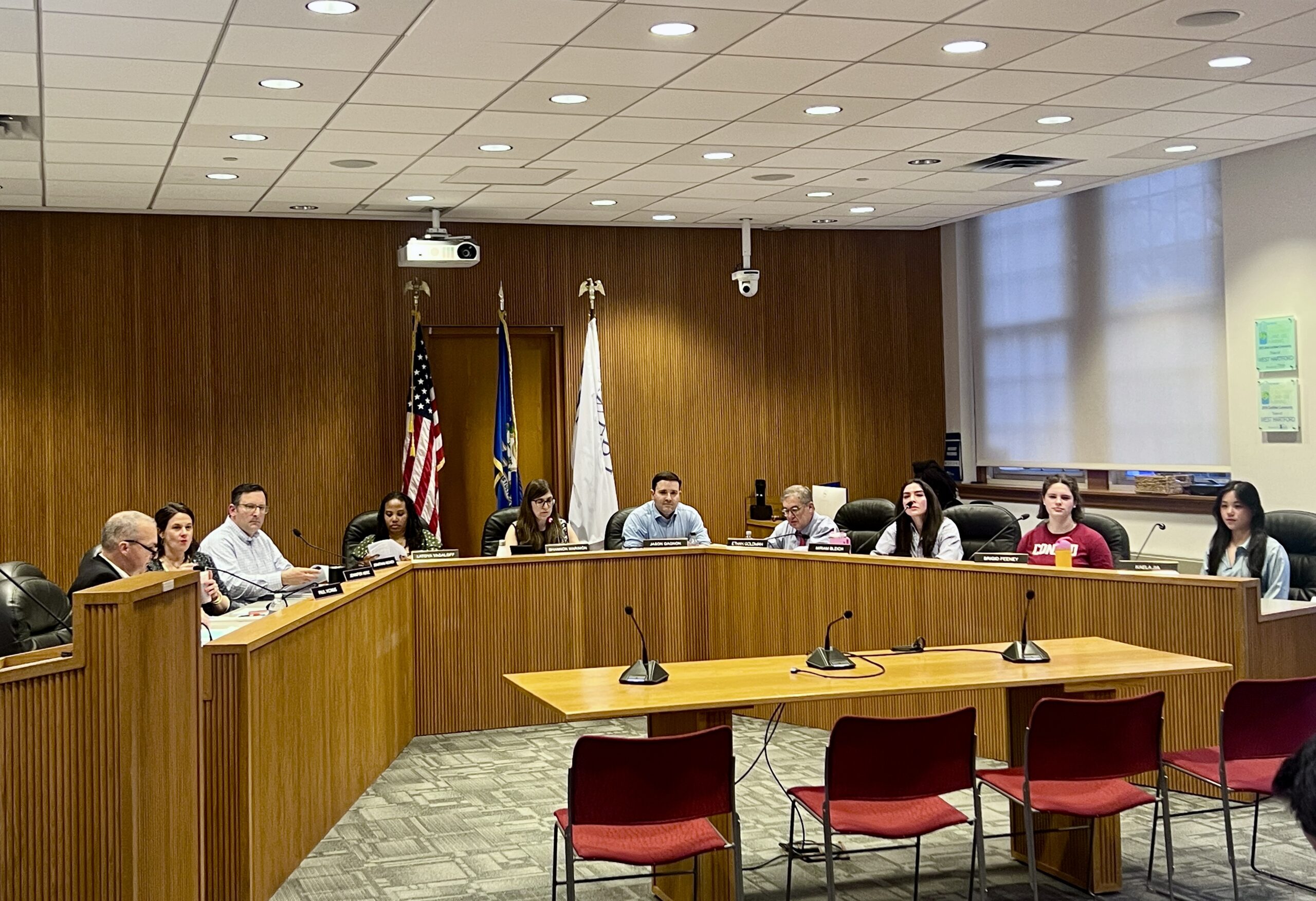
Board of Education budget adoption meeting. March 31, 2026. Photo credit: Ronni Newton





The West Hartford Board of Education made some adjustments to the original proposal by Superintendent Paul Vicinus before voting 5-2 to adopt the 2026-27 budget Tuesday night.
By Ronni Newton
The West Hartford Board of Education approved a dozen expenditure reductions to the 2026-27 budget that had been proposed by Superintendent of Schools Paul Vicinus on March 3, and after a lengthy public comment session and discussion, voted 5-2 along party lines late Tuesday night to approve a $226,856,566 spending plan, an increase of 6.0% over the current $214,051,800 budget adopted for the 2026-27 academic year.
The original budget proposal was for an increase closer to 7%, before the Board voted Tuesday to trim more than $1.3 million.
Board Chair Shannon Marimón, Vice Chair LaToya Yagaloff, Jason Gagnon, Jonathan Weiner, and Jennifer Herz – all Democrats – voted in favor of the amended budget while Republicans Ethan Goldman and Miriam Bleich cast the votes against the budget.
Prior to the discussion of the budget Tuesday night, there were 28 members of the public who addressed the Board during the public comment session. In addition, Marimón said the Board had received at least 40 to 50 emails on Tuesday alone and that the final vote would be taken after “weeks of review, candid conversations, and most importantly, deep and committed community engagement.”
Approving the budget is one of the Board’s most important responsibilities, she said, noting that input has focused on fiscal concerns during these economic times, as well as the “passionate advocacy of parents and educators who see every day the direct impact that class sizes, enrichment programs, specialized supports, and instructional resources have on our children’s lives,” Marimón said. Comments from the public recognize that the “educational system is the foundational strength of West Hartford,” she said, and the reason the town has become a destination. The Board’s complex challenge as guardians of the students’ futures is to find a middle ground, identifying “efficiencies that respect the financial reality of our residents” without compromising excellence.
The Board’s core mission, Marimón said, “is to make sure that every student who walks through our doors is prepared to thrive and succeed in a rapidly changing world.”
“Education is unquestionably our town brand,” said Vicinus. He said his original budget proposal was a “maintenance budget,” and noted that he was not surprised to hear from so many speakers – during public comment session, public hearings, and community conversations – who indicated they moved to West Hartford specifically for the schools. “Without question, that’s the major reason for accolades received by our community,” he said, including West Hartford’s ranking as the top town in the state and region and the No. 19 best place to live nationally by U.S. News & World Report and both Conard – just named the top school in the state by CAS – and Hall are consistently rated in the top 2-3% of schools in the country.
In looking to make the budget as lean as possible, Vicinus said the administration and Board have done their due diligence with the goal of keeping the impact away from classrooms and maintaining core values with the understanding that decisions have impact for years to come.
Vicinus also noted that drivers of the budget continue to be spiraling health costs, higher salaries negotiated through contractual commitments, transportation, and utility costs. In addition, budgetary decisions at the state level have created historical burdens – which impact all districts. He said while he is hopeful that the town may receive additional Education Cost Sharing (ECS) money from the state this year, there may be additional unfunded mandates. “The over-reliance on property taxes does place an unfair burden on towns and taxpayers ultimately endangering the quality of services that we can provide as a school system and at the larger level at the town.”
Since the initial budget presentation, some estimates have been refined, and Vicinus shared that information as well as other recommended reductions that were discussed during budget workshops.
Director of Finance and Planning Barbara Rua indicated the impact of the adjustments identified by Vicinus:
- $550,000 reduction in the State Partnership Plan medical insurance cost because the actual premium rate increase was 11.5% rather than the initial projection of 12.5%.
- Application of savings from a reduction in out of district tuition expenses that will be amortized over five years, generating a savings of $125,000 each year applied to eh risk management fund.
- Reduction in workers’ compensation costs of $55,557 based on new data.
- Filling available seats in the district’s Intensive Behavioral program with students from out of district will bring in $100,000 additional revenue.
- Reduction of an additional FTE at the high school level determined following course enrollment requests for a savings of $100,000. Vicinus said this update takes into account the new block scheduling.
The above suggested budget amendments were approved unanimously, 7-0, and resulted in a total savings of $931,755.
Vicinus provided other suggested reductions, which the Board voted on following discussion. The first five suggestions were “as far away from the classroom as possible” while the other two would have more programmatic impact. Those items included:
- An additional $100,000 to be used from the retiree health reserve.
- Reducing of the allocation to Adult Education by $30,000. Vicinus said that this was “right-sizing” the allocation since there is generally a surplus of roughly that amount each year.
- Decreasing the appropriation to the Extended School Year (ESY) program for special education students by $25,000 through efficiencies in staffing. Director of Pupil Services Melissa Caballero said the programming for students would not be impacted.
- Increasing the “pay to play” for sports by $25 per student and $50 per family, to $200 per sport and $750 per family, to generate $50,000 additional revenue. While the fees were waived during the pandemic, once restored they have remained at levels set in 2017-18 and transportation costs for athletics have increased significantly since that time. Waivers will remain available for those with economic need.
- Reducing budgets for incidentals at each school by 5%, to generate a total savings of $100,000. The funds are not used for curriculum, Vicinus said.
- Eliminating a clerical position in the central office for a savings of $85,000. There are some planned retirements, so the reduction in force would not mean letting an employee go.
- Reducing the high school summer program from 28 days to 25 days for a savings of $25,000. The change would not reduce the number of credit hours. The Board committed to discussing a tuition increase in future years for students who are using the summer program for “get ahead” credits.
The second block of amendments also were approved, although the vote on each was not unanimous. Bleich voted against the ESY increase and change to the summer schedule, and both Bleich and Goldman voted against the pay to play increase and reduction to individual school budgets.
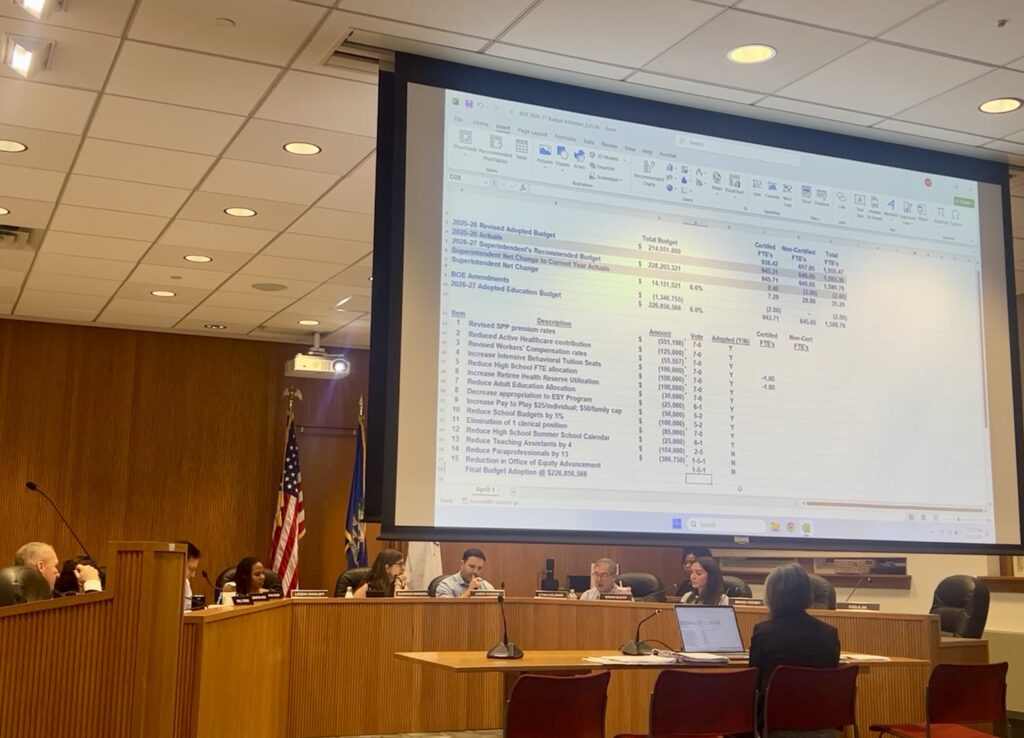
Director of Finance and Planning Barbara Rua updates a spreadsheet as the Board of Education votes on amendments, and then the entire West Hartford Public Schools budget on Tuesday, March 31, 2026. Photo credit: Ronni Newton
The second block of suggested changes trimmed another $415,000 from the budget, and combined for a reduction of $1,346,756 from Vicinus’ original proposal.
Several other amendments were proposed, including a suggestion by Goldman that the number of teaching assistants district-wide be reduced by four, for a savings of $104,000, and a reduction of 16 paraprofessionals in areas other than pupil services.
After Vicinus said eliminating a paraprofessional position at Duffy, Charter Oak, and Smith STEM “would be pretty dramatic impact,” Goldman revised his initial recommendation to a reduction of 13 positions.
Goldman’s suggestion to cut 13 paraprofessionals would have reduced the budget by $386,750, but several of the Democrats on the Board expressed deep concern. The paras fill in when teachers need to be out of the classroom, and Weiner said the savings could end up being offset by the cost of substitute teachers who are not familiar faces to the students. “It’s not a business, it’s a core public services,” Gagnon said about Goldman’s looking to keep the education budget increase in line with inflation.
Neither of Goldman’s suggested amendments were adopted, with all Democrats voting against them. Bleich abstained from the vote on the paraprofessionals.
Gagnon raised the idea of eliminating the middle school team structure in eighth grade as a possible way to reduce costs since some of the classes are well below guidelines, but after discussion the consensus was that it would be important to allow for public input in a decision of that nature. Bleich also noted that it would be “a lot of change given that the high schools are moving to block scheduling.”
Gagnon said he would not move the idea forward as an amendment to the budget.
Bleich proposed eliminating “non-mandatory” technology spending, including purchases of iPads, Chromebooks, and software that is not state-mandated. She also suggested a reduction in the IT workforce.
A group of West Hartford parents have formed a group called FOCUS (Fostering Optimal Connectivity, Understanding, and Safety) and has been lobbying for a reduction in technology use in the schools, particularly at the K-2 grade level. Parents have addressed the Board during public comment, and have written letters to the editor, noting the educational and mental health benefits of reduced screen time as well as the budgetary savings by purchasing less technology. “I appreciate the conversation emerging from the public,” Vicinus said, adding that he wants to work hard on reducing screen time but noting that this is a curricular not budget decision. He said technology costs have. been looked at “early and often” and there are not big savings.
Bleich did not formally propose an amendment to reduce technology costs in the budget, but did ask for the discussion to be continued.
She did, however, propose the “elimination of the Office of Equity Advancement going forward.” While she said she believes in equity “as it means equal opportunity for all students,” Bleich said she has not seen evidence that efforts have led to a reduction in equity gaps in test scores – a statement refuted by Vicinus who noted, as just one example, the district’s report on AP testing which is broken down by race shows extremely positive results. He also noted that for the second year in a row the district has set new records in performance on math assessments.
“That proposal would be the most significant departure from what has historically been our brand,” Vicinus said of Bleich’s suggestion.
As part of her lengthy and passionate response to the suggestion of eliminating the Office of Equity Advancement, Yagaloff said the idea is an “assault on Black women in these roles,” and while DEI may lead to uncomfortable discussions, it takes a long time to get people to open their minds.
Bleich did not propose a dollar amount for her suggested reduction or elimination of equity advancement efforts, but the concept itself was voted down by all five Democrats. Goldman abstained.
Courtesy of West Hartford Public Schools
Prior to the business portion of the Board of Education meeting, many of the 28 people – some of whom were young elementary school students – offered impassioned public comment advocating for the retention of the Quest (gifted and talented) program and elementary school Spanish language instruction. Changes to Quest had been suggested by Yagaloff during a workshop, but the idea was never officially raised as a budget amendment, and the elimination of Spanish language instruction was never even discussed as an option, district officials told We-Ha.com.
Members of the community also suggested the reduction of use and purchase of technology, and advocated for smaller class sizes.
Prior to voting, all Board members thanked their colleagues, administration, staff, and the public for their input on the budget, and all shared statements.
Yagaloff said she had proposed cutting Quest, and believes it needs a more cultural focus and greater diversity in the program. She also said it’s important for the community to direct its advocacy to the state to add pressure for better funding. We “need to put some fire to the state’s feet,” she said.
Gagnon agreed that what’s going on at the state level needs to be fixed, and said any mention of a state surplus is “fake” if education is not being fully funded. He said the Board’s charge is to support and maintain the district’s legacy and he appreciates the concerns that have been raised and pledged to look at technology and class sizes. “This is a difficult budget … I have struggled with it because of the legacy and the tax burden,” he said, and this budget strikes a balance.
Herz said reducing the budget is a major challenge when 80% of costs are tied up in salaries. “There’s not a lot of wiggle room in school budgets,” she said, and thinks the proposal is a good balance.
“A budget is a reflection of the community’s values,” said Weiner. “We have arrived at a maintenance budget that will allow us to keep providing an education – that is the religion of West Hartford.” He said there is a need to avoid cutting into programs that “make us who we are,” and added that the state needs to provide adequate funding. Weiner added that he was touched by many of the statements received about the budget, including one email that urged: “Don’t become Florida.”
Bleich said she has concerns which she believes she made clear during the evening’s discussion. “My overarching concern is for our students,” she said, adding that she agrees that a budget reflects values “and also how we implement those.” She said she would like to see more metrics and clarity about value and impact.
“I think our responsibility is to come up with the optimal increase,” Goldman said. “I think 6% is too high.”
As Board chair, Marimón spoke last, andsaid she was “really impressed by the thoughtfulness and the deliberations of tonight.”
She said the advocacy of those who testified has been heard and the engagement has pushed the board to dig deeper while recognizing the immense value of the district’s many unique programs. The budget being sent to the Town Council is a “reflection of a rigorous process” that “strikes a balance of fiscal responsibility and non-negotiable commitment to students,” she said. Marimón said the Board will be reviewing class size guidelines going forward.
“Any further cuts … would have been irresponsible at this point in time,” she said, and added that true sustainability will require commitment from the state to make good on its commitment.
“I believe this budget is a reflection of our shared values and our steadfast belief in the potential of each and every student,” Marimón said.
The Board held a roll call vote on the amended budget of $226,856,566, and it passed 5-2 along party lines and will be forwarded to the Town Council, which will adjust the education portion of the budget to reflect what was adopted.
More information about the 2026-27 budget, including details about the drivers and historical data, can be found here.
While the Board of Education decides what it would like to spend, it is ultimately up to the Town Council to allocate the funding. The Council, however, cannot alter specific line items but only the overall district budget. The Town Council plans to adopt the overall West Hartford general fund budget on Monday, April 20, with the meeting beginning at 7:30 p.m.
Comments regarding the general fund budget can be submitted in writing via email to [email protected].
Like what you see here? Click here to subscribe to We-Ha’s newsletter so you’ll always be in the know about what’s happening in West Hartford! Click the blue button below to become a supporter of We-Ha.com and our efforts to continue producing quality journalism.