
West Hartford Public Schools Planning Switch to Block Scheduling in High Schools

Audio By Carbonatix
Photo credit: Ronni Newton





At a presentation to the Board of Education administrators said the final decision will be made next month, but the district is actively planning for the conversion to block scheduling at Conard and Hall beginning in the fall of 2026.
By Ronni Newton
It’s highly likely that daily schedules at West Hartford’s Conard and Hall high schools will look very different at the start of the 2026-2027 school year, with plans well underway to implement a version of block scheduling that was outlined for Board of Education members at their most recent meeting.
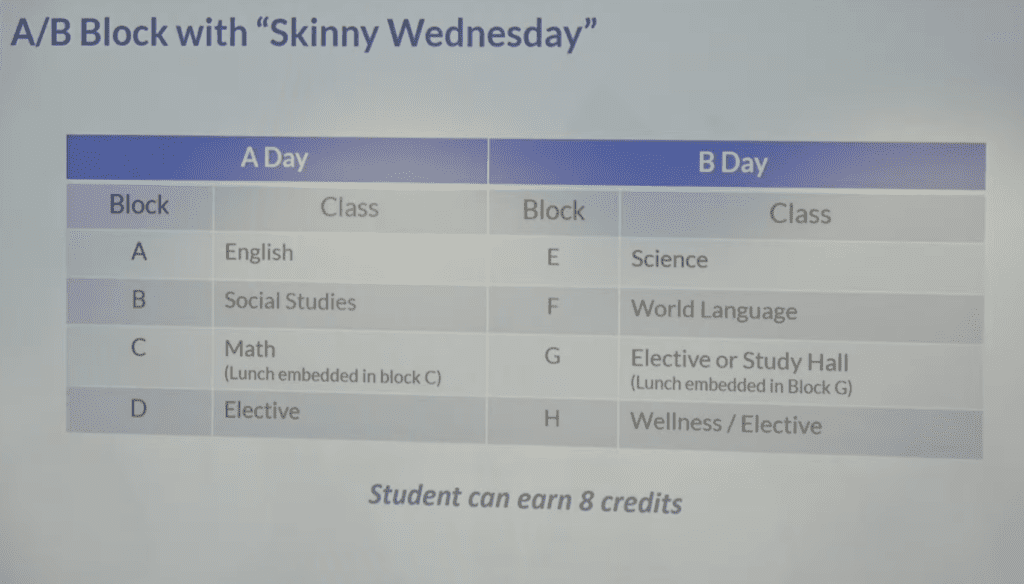
Under the proposed plan, high school students would have four classes of roughly 88 minutes on Mondays, Tuesdays, Thursdays, and Fridays, plus time for lunch, and eight shorter periods with all classes meeting on “Skinny Wednesday.”
“Our current schedule has some very real constraints in it, very real constraints for students, all types of students in our schools,” Assistant Superintendent for Curriculum & Instruction told Board members at the Feb. 3 meeting. McKernan, along with Director of Secondary Education Eileen Eustis, Conard Principal Jocelyn Tamborello-Noble, Hall Principal Sarah Isaacs, and School Counseling Department Supervisor Patty Pires, provided details of the study of block scheduling – a study which began in earnest in the late 2024. The team also highlighted why they advise the transition, and responded to questions.
PA 17-42, legislation enacted in Connecticut in 2017, increases the number of credits required to graduate from high school to 25. Previously, 21.75 credits were required by the state. The increased credit requirement became effective for the Class of 2023.
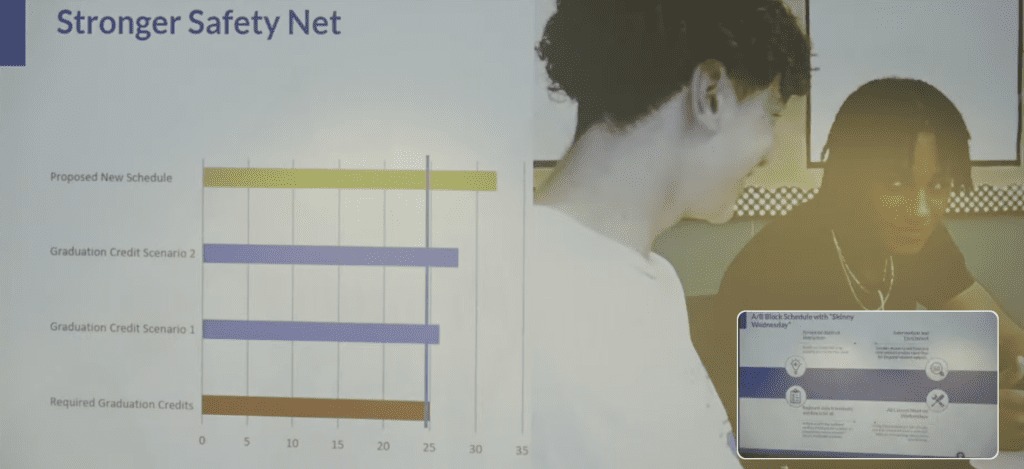
The increase in the number of required credits – which also includes requirements in various subject areas, including nine credits in STEM classes – was implemented within the same schedule system that the schools had for years. “That is not a small thing … and has put pressure on our students in different ways,” McKernan said, creating a “dangerously narrow” buffer for meeting graduation requirements since there are just seven class periods per day.
West Hartford Public Schools presentation on block scheduling. Feb. 3, 2026. Screenshot
The current model provides for a maximum of 26-28 credits, while block scheduling accommodates a maximum of 32 credits.
“For many students, failing just one course, just one, puts them at risk for not graduating,” said McKernan. Making up a class may mean no opportunity for taking any electives, or sacrificing lunch or attending summer school.
The state graduation rate target is 94%, and at both Conard and Hall, rates have been falling since COVID, and since the implementation of the new credit requirement. There is very little “wiggle room,” Tamborello-Noble said.
“This really expands the capacity and the safety nets,” said Isaacs. Health or family issues are among the reasons why students may need to have more ability to access course credits, and block scheduling also provides greater opportunity for students who require special services during the school day.
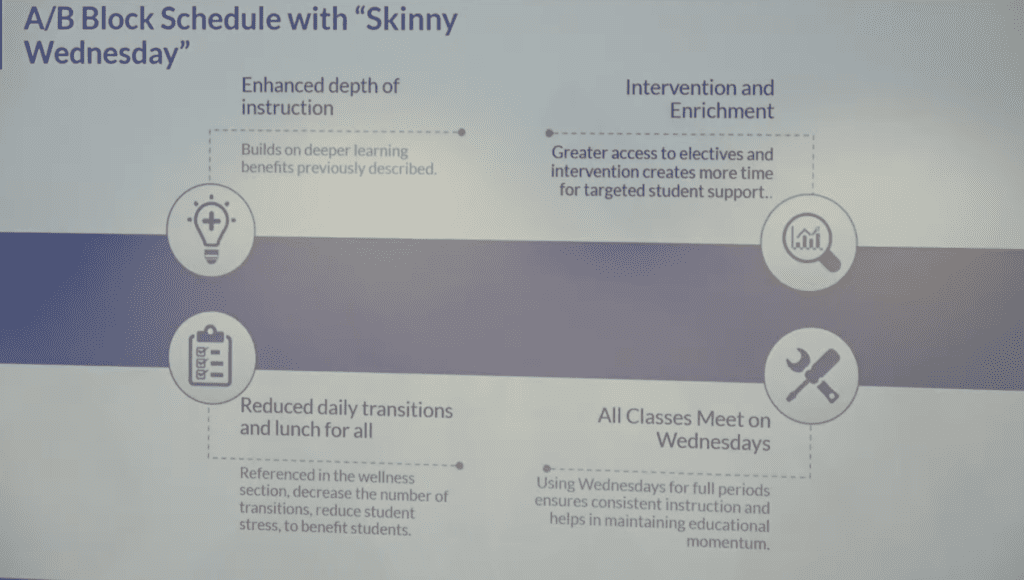
West Hartford Public Schools is planning for a 4-by-4 – also referred to as an A/B – schedule. It would provide the opportunity to earn up to 32 credits, although students are not expected to take that many. The proposed schedule also includes a “Skinny Wednesday” where students attend all of their weekly classes, and a 30-minute lunch period embedded in the third block of the day.
Proposed block schedule for West Hartford Public Schools. Screenshot
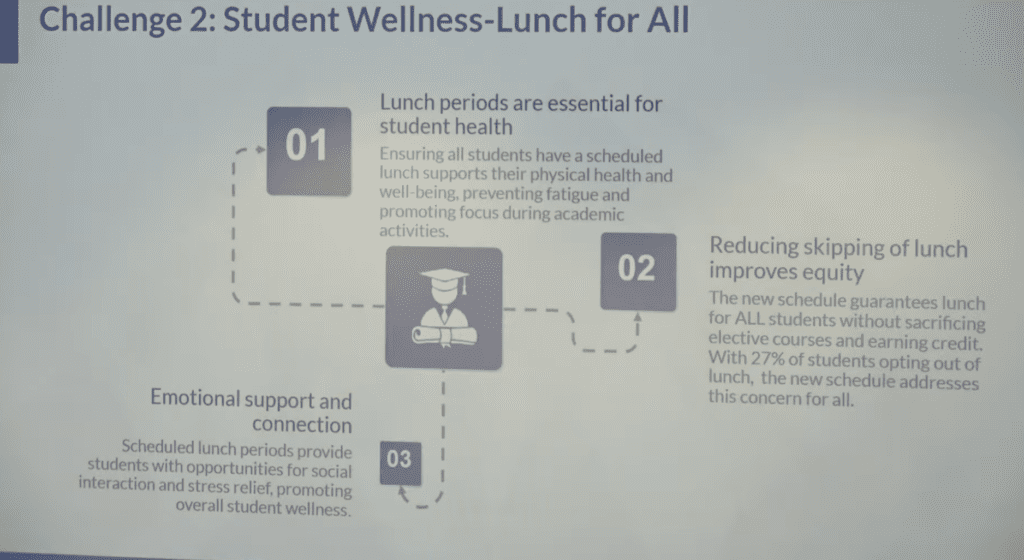
According to Eustis, currently “28% of students do not take lunch,” and the block schedule would require lunch, and allow all high schoolers to have the opportunity to eat lunch in the cafeteria.
Some students now forgo lunch because they want to take additional electives. “Electives are hugely important, not only for students to challenge themselves … but for those students who just have a passion and want to explore that during the school day,” she said, and some students, including those who receive special education services, end up with very little opportunity to take elective courses. In addition, “students are still growing in body and mind and we want them to have the nutrition they need,” she added.
West Hartford Public Schools presentation on block scheduling. Feb. 3, 2026. Screenshot
While some students are given permission to eat in their classrooms, those who qualify for free or reduced lunch need to at least get their food from the cafeteria.
Alternatives for those who do not want to eat in the cafeteria – including opportunities to go outside during nice weather or go to the library – will also be provided so students at least have a 30-minute break from class time.
Currently, some students miss lunch, and then go straight to sports or other after school activities, and then get home in the early evening and have homework in all of their classes.
“What we’re seeing is a huge uptick in the number of students who are saying, ‘I can’t do it, but I have to do it,” Eustis said.
West Hartford Public Schools presentation on block scheduling. Feb. 3, 2026. Screenshot
While the students have not necessarily come to the administration and asked for block scheduling, the level of anxiety many have been dealing with and the challenge of meeting the graduation requirements point to it as a solution to facilitate deeper learning, personalized attention, and a slowing down of the daily pace. Fewer transitions during the day could decrease the cognitive load and increase equity in access to programs and electives, the team noted.
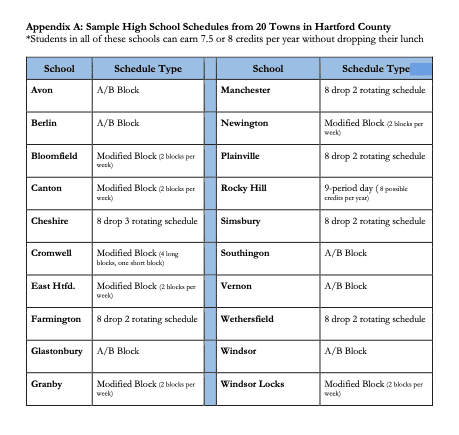
The team looked at the schedules of 20 area districts, and with the exception of Rocky Hill, all have some type of longer instructional block built into the schedule. Some transitioned to block scheduling right after COVID, and Avon actually implemented in back in 2016. They’ve spoken with administrators at some of the other districts, and among the questions asked was whether they would revert back to their previous schedules. “They all said no, they would not go back,” the team reported.
West Hartford Public Schools presentation on block scheduling. Feb. 3, 2026. Screenshot
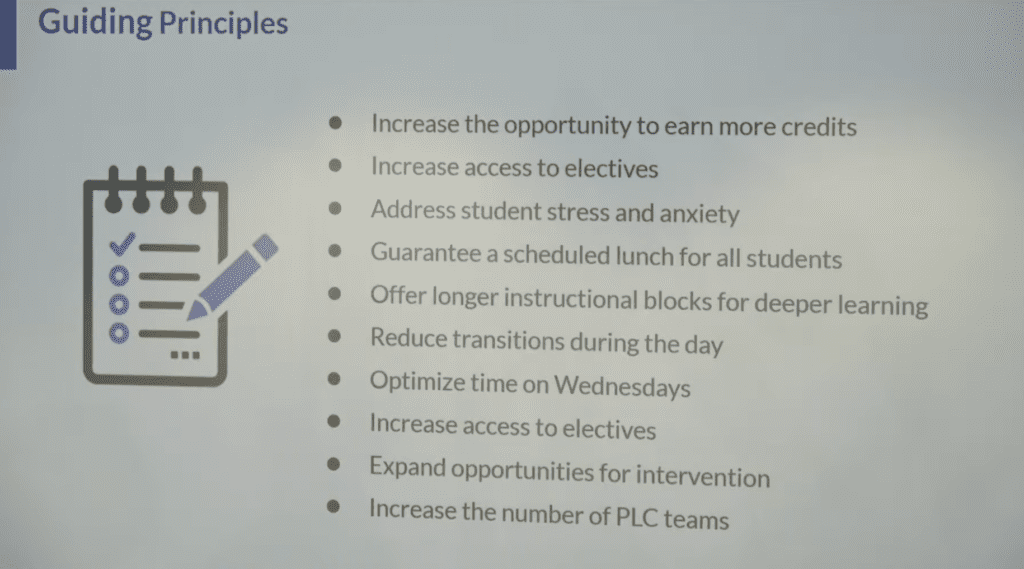
Eustis said that a list of guiding principles was developed to guide the consideration of the change. “You don’t want to make a change just for the sake of making a change. … You want to make sure that there is a true need to make a change.”
West Hartford Public Schools presentation on block scheduling. Feb. 3, 2026. Screenshot
There have been surveys, student focus groups, meetings with PTOs, and listening tours. A variety of schedules have been reviewed. There was a panel discussion with students from high schools that have block scheduling, who were very honest in sharing their opinions.
Some of the schedule options wouldn’t work in West Hartford, McKernan said, due to having roughly 1,300 students at each high school, which necessitates having four lunch waves for safety purposes. And while “Skinny Wednesday” doesn’t have to happen, many of the teachers indicated they liked it in order to have the third touchpoint with students each week. During weeks where there are holidays – many of which fall on Mondays – Wednesday would revert to a block schedule day, although the periods would be shorter since there are no plans to change the length of the school days, including early dismissal.
According to Eustis, they’ve been working on filling the “holes” – for example the challenge of taking a lab science along with two electives, and options for the “super music” students.
High school students are already in the midst of selecting courses for next year, but that process involves indicating the classes they want to take – not when they will take them. The scheduling is moving forward as if it will be on a block schedule, but there is a plan if it doesn’t move forward.
The opportunity to take more credits will be realized through recouping the transition time, and also having lunch as a set 30 minutes rather than a full class period.
“We think it is a really appropriate solution to a very constrained schedule,” McKernan said. Students will have the opportunity to take many more credits, expand the buffer to be able to take the courses required for graduation, and block scheduling will also provide more ability for intervention during the day.
The goal, McKernan said, is to crate a “stronger system that works for more students.”
West Hartford’s secondary schools used block scheduling during COVID, when it was needed to accommodate classes that were virtual or hybrid. “High school seniors at the time loved it,” said Superintendent of Schools Paul Vicinus, but the students who were in middle school – and are now high school seniors – hated it. The block scheduling will not be intended for middle schoolers, like it was during the pandemic.
Vicinus said they are trying to be responsive to all concerns, and commended the team for bringing in students from other districts who live with block scheduling. “This team has looked into this comprehensively and thoroughly,” he said.
According to Vicinus, “We will be making a decision on this by the time we present the budget,” which will be at the March 3 meeting.
Block scheduling is not supported by all teachers, and many of them are nervous, the team acknowledged. The district is in conversations with the WHEA, and if there is a major snag, the transition would be delayed for a year, McKernan said. If the block scheduling does move forward for the fall, teacher training will begin this spring during professional development time, and include guidance about how to break up the time during longer classes, and types of activities that work best.
In response to a question from a board member about whether other districts have seen increases in student performance due to block scheduling, McKernan said that’s hard to determine since many districts made the change coming out of COVID. “This is not being done at all for student achievement,” she said, adding that she does believe it can add more time for interventions.
In response to a question about the budget impact of block scheduling, McKernan said that even though there will be more credits available to students, “In our projections right now we don’t see a dramatic difference in FTE (full-time equivalent positions).
Like what you see here? Click here to subscribe to We-Ha’s newsletter so you’ll always be in the know about what’s happening in West Hartford! Click the blue button below to become a supporter of We-Ha.com and our efforts to continue producing quality journalism.



DON’T DO IT!! I currently work in a school system in CT with an A/B block schedule. There are times when teachers don’t see students for five days. There is a great deal of re-learning that needs to be done. Student attention drifts after 30 minutes. Almost 90 minutes is torture! (My district has 87 minutes blocks.) If a student is absent and there is a snow day, it is possible for that student to miss a class for an entire week. Despite the fact that administration will tell teachers that they have to be “more creative,” what happens is that there are either useless filler activities that are done to keep students engaged, or teachers give students the last ten to twenty minutes to do homework. This is a TERRIBLE plan in education. All high schools can figure out a traditional 8 period day that will fulfill the credit requirements. The block-system just makes it easy for administrators, but worse for students.