
West Hartford Town Council Gives Unanimous Approval to Speed Management Camera Plan

Audio By Carbonatix
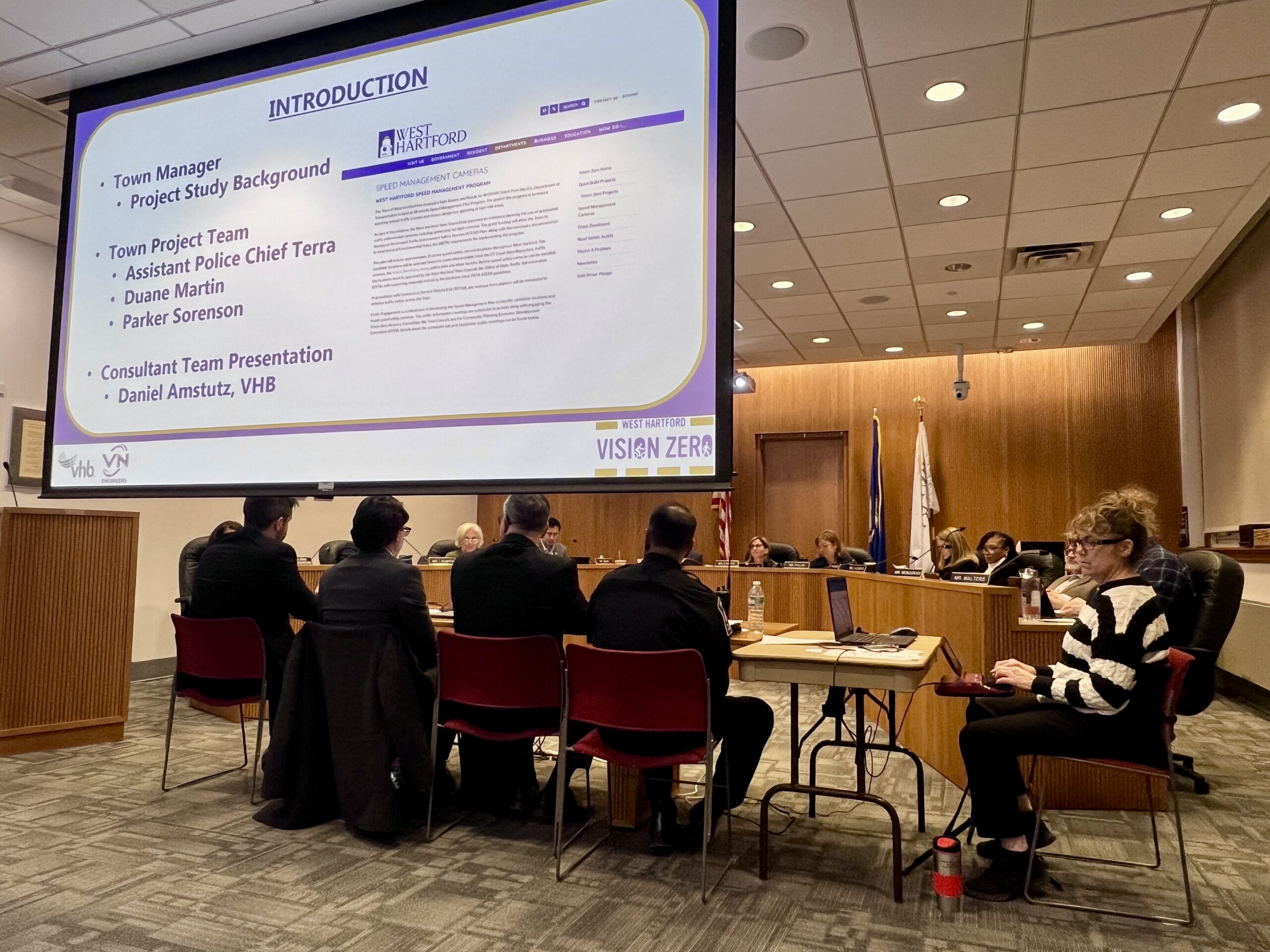
A public hearing was held before the West Hartford Town Council Council voted to approve a resolution to submit the town's Automated Traffic Enforcement Safety Device Plan to the state and FHA. Photo credit: Ronni Newton





West Hartford’s speed management camera plan will be submitted to the Connecticut Department of Transportation and the Federal Highway Administration and the program should be in place by the middle of 2026.
Town of West Hartford
By Ronni Newton
The West Hartford Town Council on Wednesday night gave unanimous approval, 9-0, for the next step in the implementation of an Automated Traffic Enforcement Safety Device (ATESD) plan in town, and pending approval by both the Connecticut Department of Transportation and the Federal Highway Administration, speed management cameras will be deployed in 15 locations by the middle of 2026.
“This program is a direct extension of the town’s Vision Zero commitment,” Town Manager Rick Ledwith said as he introduced the resolution authorizing submission of the plan at a public hearing prior to the vote. The hearing, as well as approval of the plan by the Town Council, are statutorily required steps in the process. With the goal of completely eliminating all fatalities and serious injuries on the town’s roadways by 2033, components of the Vision Zero Action Plan focus on “safer streets, safer speeds, and safer behaviors” that will protect drivers, pedestrians, and cyclists, Ledwith said.
“These devices are proven tools to encourage safer driving behavior,” said Ledwith, and data from the National Highway Traffic Safety Administration show a reduction in fatal and serious injury crashes of up to 40% due to a significant decrease in speeding.
What are the planned camera locations?
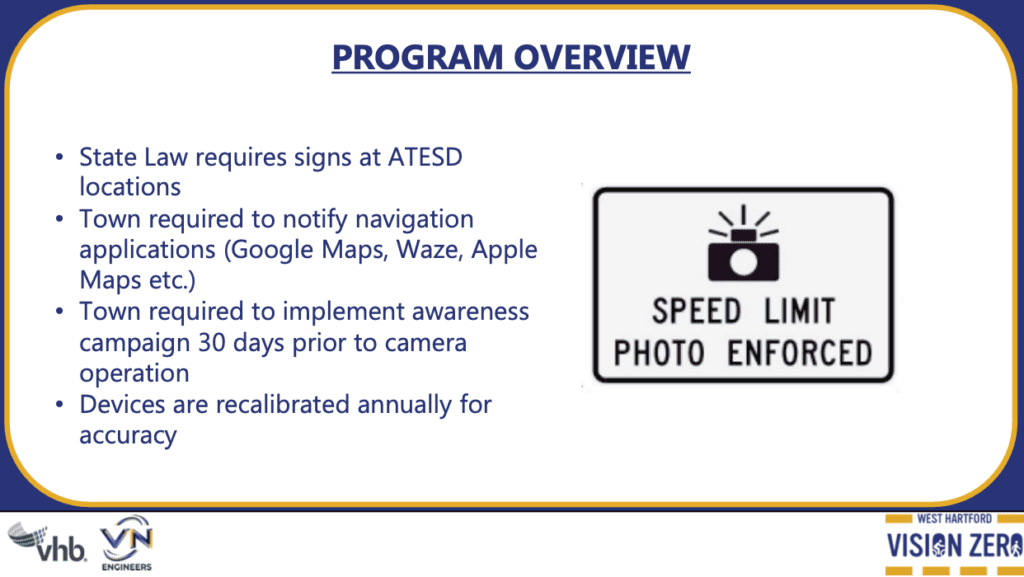
Through a highly data-driven process, 15 camera locations, plus five alternate backup locations, have been identified. Each location will actually have bi-directional cameras – one facing in each direction – and the state-required signage (in both directions) warning motorists of the cameras. Navigation applications such as Google Maps, Waze, and Apple Maps must also be notified of the cameras.
“We started by looking at all the roads in West Hartford,” said Daniel Amstutz of VHB, the consultant hired by the town to assist with the application process. Data regarding speeding-related crashes, traffic volumes, information from the police regarding speeding violations were also reviewed, and analysis also considered areas where there are vulnerable users, Vision Zero focus areas, and public input.
Both local and state roads are included.
Town of West Hartford
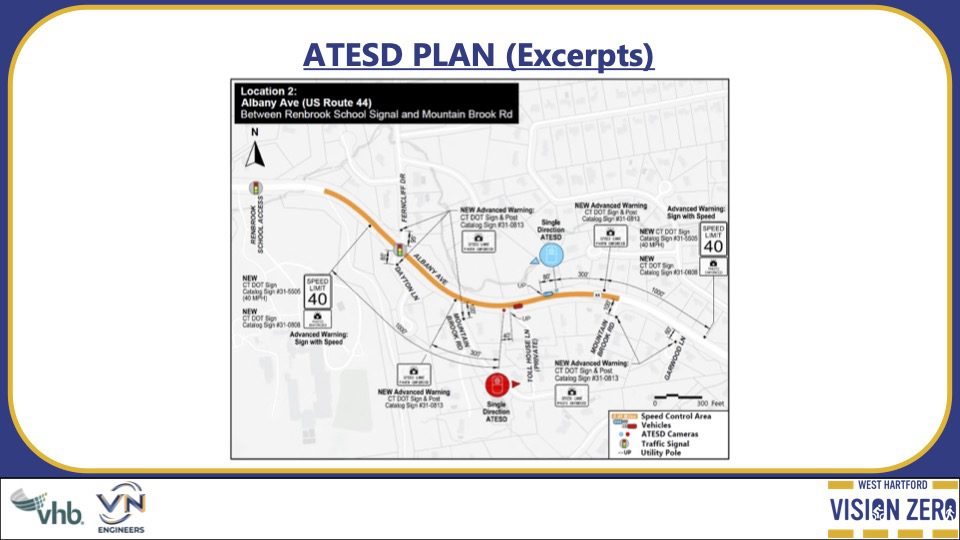
The full ATESD plan, which is 256 pages and can be found on the town website, devotes several pages to each chosen site providing the data that led to the choice of that location, as well as photos and maps.
The 15 primary locations, shown on the map in red, are:
- Albany Avenue (2 locations)
- Flatbush Avenue
- Mountain Road (2 locations)
- New Britain Avenue (2 locations)
- North Main Street (at Hall High School)
- King Philip Drive
- Bloomfield Avenue
- Fern Street
- Farmington Avenue (near Whiting Lane)
- South Main Street (near Webster Hill Boulevard)
- Trout Brook Drive (2 locations)
The five alternate locations, shown on the map in purple, are:
- Simsbury Road
- Farmington Avenue (west of Mountain Road)
- North Main Street (north of Fern Street)
- Prospect Avenue
- South Main Street (south of New Britain Avenue
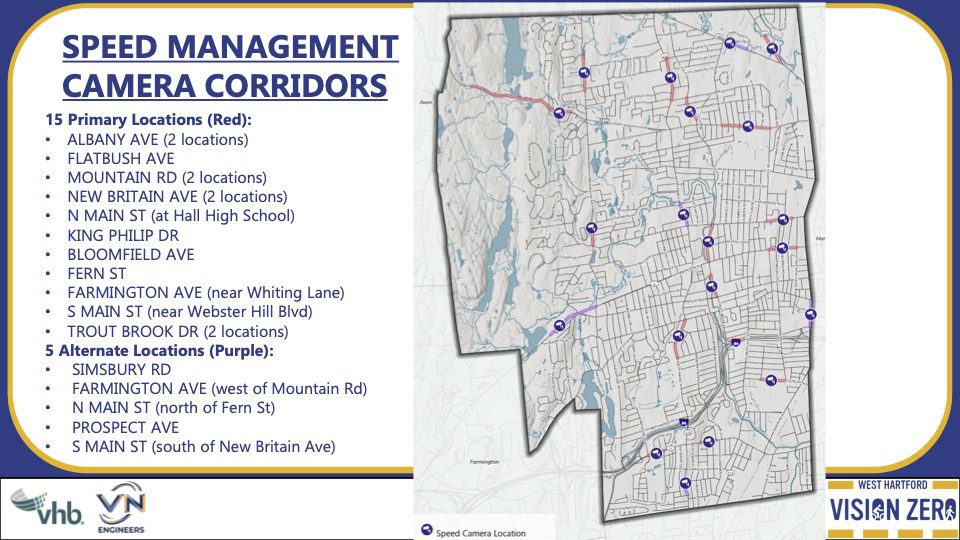
Planned corridors for installation of speed management cameras. Town of West Hartford
“This represents a significant step in really changing the way we move through our community safer,” said Ledwith, a step in changing the culture of drivers.
Steps in the process
West Hartford announced plans to implement an ATESD plan more than two years ago, and applied for and received a $669,007 federal Safe Streets and Roads for All (SS4A) grant in 2023 to support implementation of an 18-month pilot of the speed management program, as a component of its Vision Zero initiative, adopted in January 2023.
Before even submitting its plans for state and federal approval, the town had to adopt an ordinance to allow for the use of automated traffic enforcement devices, and that ordinance was adopted on April 8, 2025. Many of the parameters of the automated traffic enforcement device ordinance are dictated by state statute – as part of House Bill 5917, legislation passed by the general assembly in 2023 – allowing the use of such devices in Connecticut.
There were two public information sessions – held in July and September – and the public hearing held Wednesday was also required prior to submission of the plan.
Under the speed management program, it’s considered a violation subject to a citation when a driver exceeds the posted speed limit by 10mph or more.
As required by the state, there is a 30-day grace period after the program begins when violators will receive a warning. After that, first offenses within a one year period will result in a $50 fine, and subsequent violations will be $75. The amount of the fines are set by the state and they are municipal citations not moving violations – similar to a parking ticket – and are issued to the owner of the vehicle, not to the driver. A $15 per citation processing fee is also permitted.
Before citations are issued, the recorded images – which show the license plate only – are subject to review by a sworn West Hartford Police Department officer or designated town employee. Citations are mailed to the address of the owner of record as indicated by the DMV, and owners may appeal within 10 days of the date of citation, Ledwith said.
State law requires that funds from the fines – which are expected to be significant in the early stages of the program – be invested back into the community to support transportation safety and mobility improvements, infrastructure enhancements, or costs associated with the ATESD program. “What’s most important to us is improving the safety in our community,” Ledwith said, and the town will use the funds to directly support Vision Zero efforts.
While the town’s grant is just to get the pilot going, based on the results from other communities that have implemented speed camera programs, Ledwith said, in response to a question from a Town Council member, that estimates are the fines generated in the first year could be several million dollars. But while the revenues should definitely cover the cost of operating the program, the goal is not to generate funds. “Our goal is to change the culture of how folks move through our community,” he said.
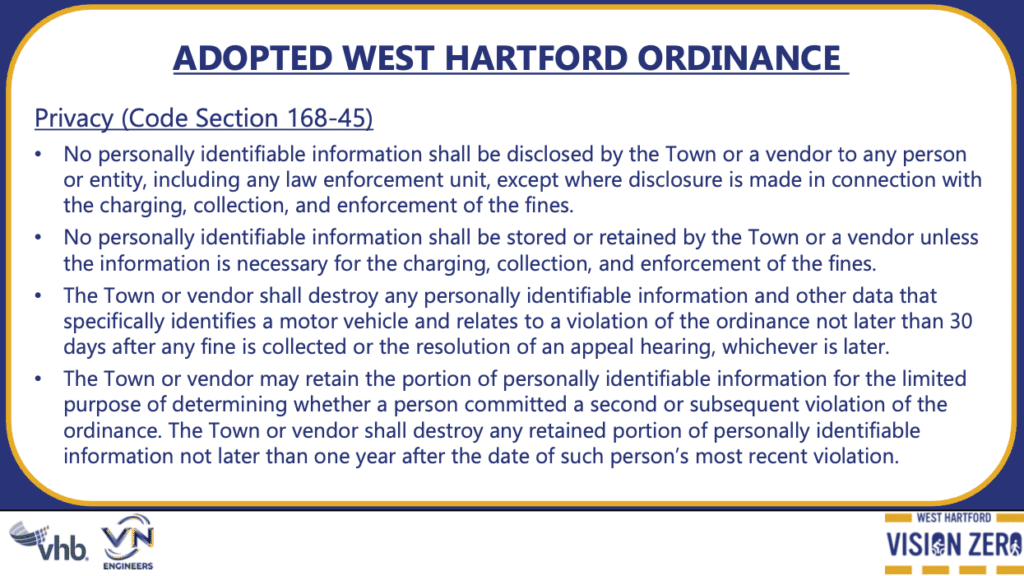
“The information obtained through this process can only be used to enforce the speeding violation,” Ledwith said, and there are strong regulations regarding privacy.
Town of West Hartford
If the program is successful, there is an option for an 18-month extension before a new application needs to be made to the state.
Data collection will continue to determine the effectiveness of the cameras at each location.
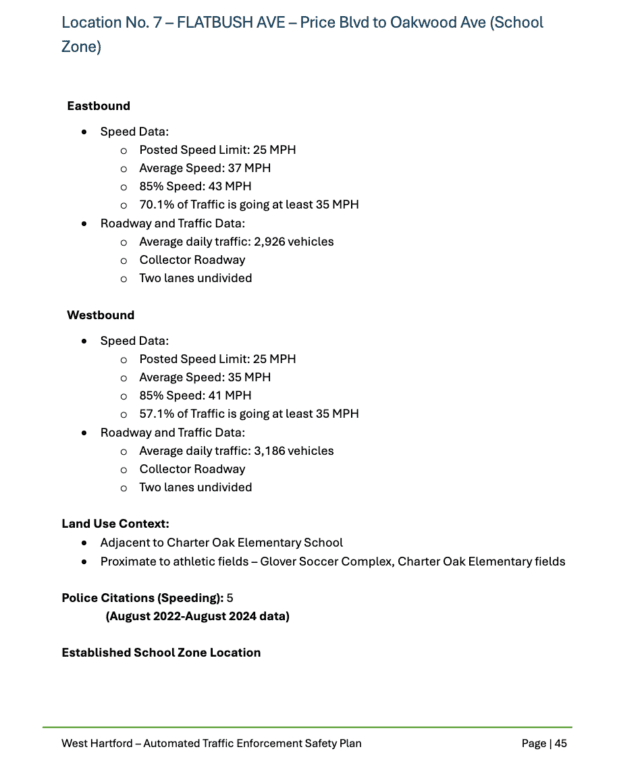
There were no speakers providing testimony at Wednesday’s public hearing, and no testimony submitted via email. There were some questions from Council members, including a concern raised by Republican Jason Wang about a camera at Flatbush Avenue between Price Boulevard and Oakwood Avenue, which is also a school zone. According to the data regarding speeders at that location, between 50% and 75% of drivers exceed the speed limit by more than 10mph and would get tickets. He was concerned that would be unfair, but West Hartford Police Department Assistant Chief Larry Terra said it’s a congested area, with lots of pedestrian traffic. “We have to do something,” he said, and expects having the cameras will lead to people slowing down.
Town of West Hartford
Ledwith said the DOT and FHA are each expected to take 30 days to approve West Hartford’s ATESD plan, and the town will look to begin the bid process for a vendor within the next month or so.
“We’ve talked about this a lot, and as part of Vision Zero we can do a lot of things with the roads but if people continue to speed we are going to have an issue,” said Democrat Tiffani McGinnis, who chairs the Council’s Community Planning and Economic Development Committee, where the plan has been extensively reviewed. “I hope that over tine the number of citations will significantly decrease,” she said, adding that the cameras are “good for the safety of everyone on the roads.”
“The work that’s gone into this from the town manager and staff is exemplary,” Minority Leader John Lyons said.
Democrat Barry Walters said this program is “but one tool in that [Vision Zero] toolbox to make our streets safer for everyone.”
Mayor Shari Cantor said this is one way to have greater control, to change the culture of driving in town and make motorists more aware. “Enforcement, education, engineering – they do all go hand in hand,” she said.
The town has also received a SS4A grant in 2024, for an automated red-light enforcement program, and while the resolution adopted Wednesday includes the framework for that program, those specific plans are still in the works and will be the subject of information sessions and a public hearing prior to applying for state and federal approval sometime next year.
Like what you see here? Click here to subscribe to We-Ha’s newsletter so you’ll always be in the know about what’s happening in West Hartford! Click the blue button below to become a supporter of We-Ha.com and our efforts to continue producing quality journalism.




This is awful. Computerized monitoring of the populace is evil. These horrible politicians should be shamed and runned out of office for this.
I do look forward to the town reducing the size of the PD in response to taking away many of their responsibilities with the computerized surveillance.
We should talk about the flock cameras around town too and how WeHa furthers the christo-fascist agenda of total govt surveillance. Think I’m exaggerating? Texas police use Flock constantly to find women in other states they suspect have gotten medical care.