
West Hartford Town Manager Proposes $392 Million FY27 Budget

Audio By Carbonatix

West Hartford Town Hall. Photo credit: Ronni Newton





West Hartford Town Manager Rick Ledwith proposed a $390 million budget Tuesday night that increases spending by 6.6% and would raise the mill rate for real and personal property by 6.5%.
By Ronni Newton
Town Manager Rick Ledwith presented the proposed Fiscal Year 2027 budget to the Town Council Tuesday night, noting that there are many discussions to be had and challenges to be met over the next six weeks prior to adoption of the spending plan. Council members will meet in committees to review each line item, receive testimony in writing and at public hearings, and leadership from the town, schools, Council, and Board of Education will be able to respond to questions during three scheduled community conversations.
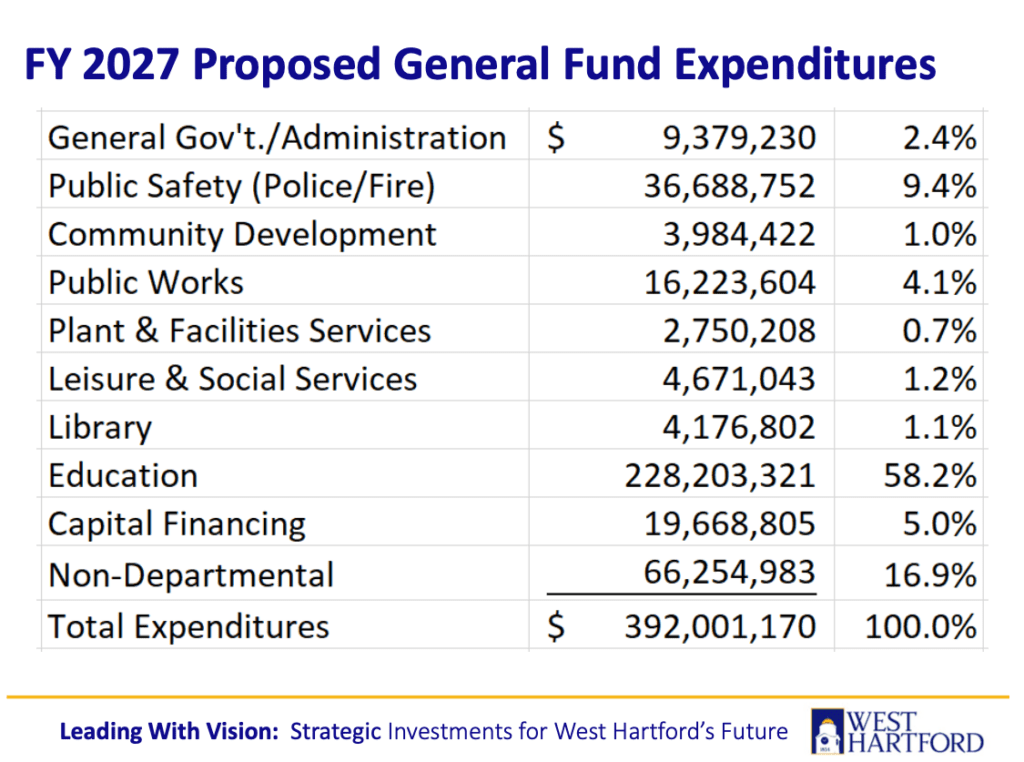
As presented Tuesday, the proposed $392,001,170 FY27 budget increases overall spending by 6.6% ($24,269,104) over the town’s FY26 budget.
Town services are projected to increase by $6,649,093 (4.8%), and Board of Education expenses, based on the proposal delivered by Superintendent of Schools Paul Vicinus on March 3, are estimated to increase by 7% over the adopted budget. (Please note that the Board of Education’s budget proposal includes $700,000 received from a non-lapsing fund as applied to last year’s budget, while the town manager’s exhibit has a different format.) Capital financing costs are estimated to increase in FY27 by $2,768,490 (16.4%). The Board of Education spending relative to the overall budget has not changed much from past years, and the category of town services is a slightly lower percentage for FY27 while capital financing is a greater piece of the pie.
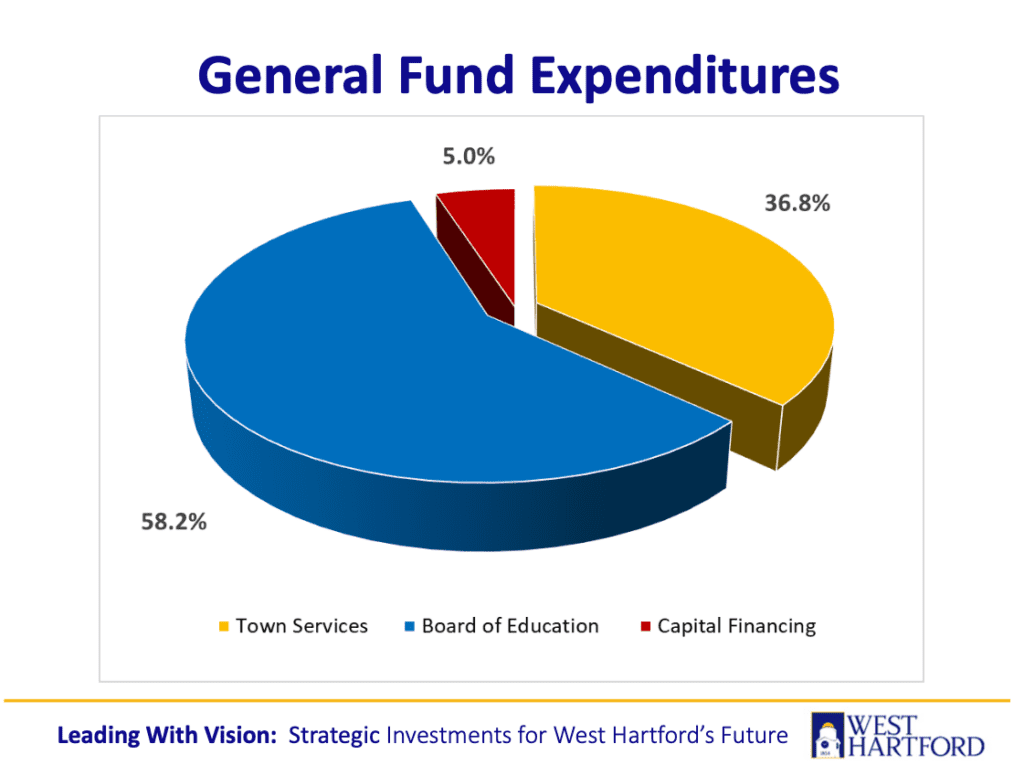
Proposed General Fund expenditure for FY27
Under the proposed FY27 budget, the current mill rate of 44.78 mills would increase to 47.69 mills, an increase of 2.91 mills (6.5%) while the motor vehicle mill rate, subject to a cap by state statute, will remain unchanged at 32.46 mills.
Looking ahead to 2027, the theme of the proposed budget is “Leading with Vision: Strategic Investments for West Hartford’s Future.” Ledwith said the budget recognizes that “West Hartford’s continued success depends on sound financial management and strategic investments that support strong infrastructure, a talented workforce, and a thriving and engaged community. Through responsible and thoughtful planning, the town is advancing initiatives that enhance services, expand housing opportunities, and strengthen community connections. By investing today, we are ensuring West Hartford remains resilient, vibrant, and well-positioned for the future.”
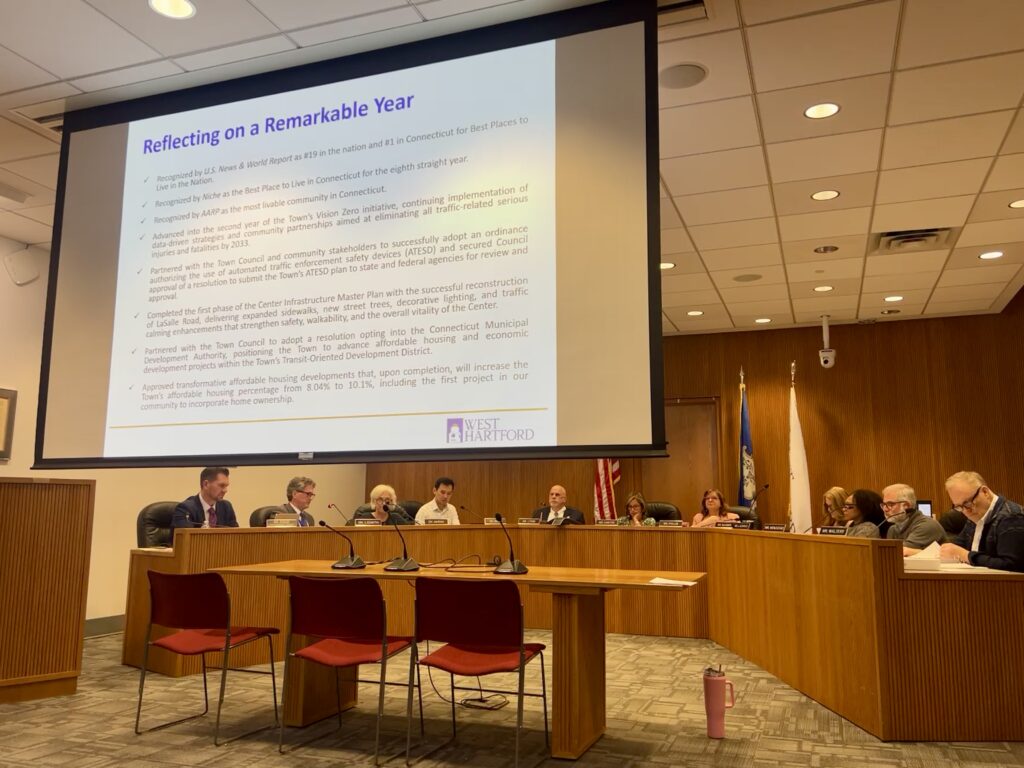
Town Manager Rick Ledwith presents the FY27 budget to the Town Council on March 10, 2026. Photo credit: Ronni Newton
That success, he said, “has always been built on a strong partnership between the Town Council, our directors and professional staff, community organizations, and engaged residents,” and the FY27 budget reflects that partnership and seeks to balance “financial stewardship with the strategic investments necessary to sustain the exceptional quality of life that our residents expect and deserve.”
While there will likely be refinement in the numbers over the next several weeks, Ledwith noted that the overall approach to the budget will maintain the following priorities:
- Maintain fiscal stability while making targeted strategic investment in critical infrastructure, including the new Elmwood Community Center and library, which is still in the planning stages.
- Preserve the town’s national leadership in “livability” rankings, “ensuring that our services, financial management, and quality-of-life initiatives remain among the very best in the state and country.”
- Enhance the West Hartford Center Infrastructure Plan and continue to support transit-oriented development.
- Continue to advance and implement Vision Zero initiatives, including the rollout of projects funded through the $3.2 million federal Safe Streets for All (SS4A) federal grant and implementation of automated safety enforcement once approved by the DOT.
- Expand housing opportunities “by supporting the development of approved affordable housing projects and monitoring state housing legislation to ensure West Hartford remains well positioned to access resources and maintain local planning authority.”
- Invest in the workforce and strengthen recruitment and professional development.
- Continue to “strengthen community engagement, expanding digital outreach, improving language accessibility, and creating new opportunities for residents to participate in shaping the future of our community.”
Expenses and drivers
Ledwith provided specific details about those challenges during his presentation, noting that while wages and salaries are increasing by 2.8% ($1.5 million), the largest increase on the town expense side in the FY27 budget is in the fringe benefits/insurance/pension liability line item, budgeted to increase by $3.6 million or 7% overall. A key driver, and the largest portion of the increase, is attributable to the risk fund, specifically to health care costs.
“As the Council knows, both the schools and the town – except our firefighters – participate in the Connecticut State Partnership Plan for Health Care, joining roughly 100 other cities or towns who have joined the plan, creating potential economies of scales in the plan to help mitigate year over year health care increases,” Ledwith said. “We joined the Plan back in 2019, saving a nearly combined $3 million at the time between the town and the schools. Heading into the budget this year we were advised to budget somewhere in between 12.5% to 14%.” Last year’s increase was 9.4%.
There is a bit of good news that’s not yet reflected in the budget presented Tuesday night – and will also positively affect the education budget. Ledwith said State Comptroller Sean Scanlon sent an email on Monday night, indicating that the health insurance increase came in a bit lower – at 11.5%.
Increases in health insurance costs are due to “both medical and pharmacy utilization, especially in in-patient hospital stays and speciality drug costs. Though we are not pleased with the increase, we have benefited overall over the last eight years, with our average year over year increase coming in at 5.5%. This year medical plan costs trends are projected to increase by a median of 9%, marking the highest annual projection in more than a decade,” Ledwith said.
Also included in this line item is a $400,000 increase to the retiree health care reserve fund to offset post retirement health care liability, “highlighting the Council’s commitment to prudent financial management,” Ledwith said.
A $1 million increase in the waste contract is included in the budget – which is a significant portion of the $1.5 million (4.8%) overall increase in operating expenses. “We are going out to bid as we speak and it would be our hope to reduce this increase between now and budget adoption later in April,” Ledwith said.
Medical expenses are a key driver on the Board of Education side, along with salaries, which are expected to increase by $7.5 million (5.6%) due to step and general wage increases negotiated as part of collective bargaining agreements for the roughly 1,600 employees.
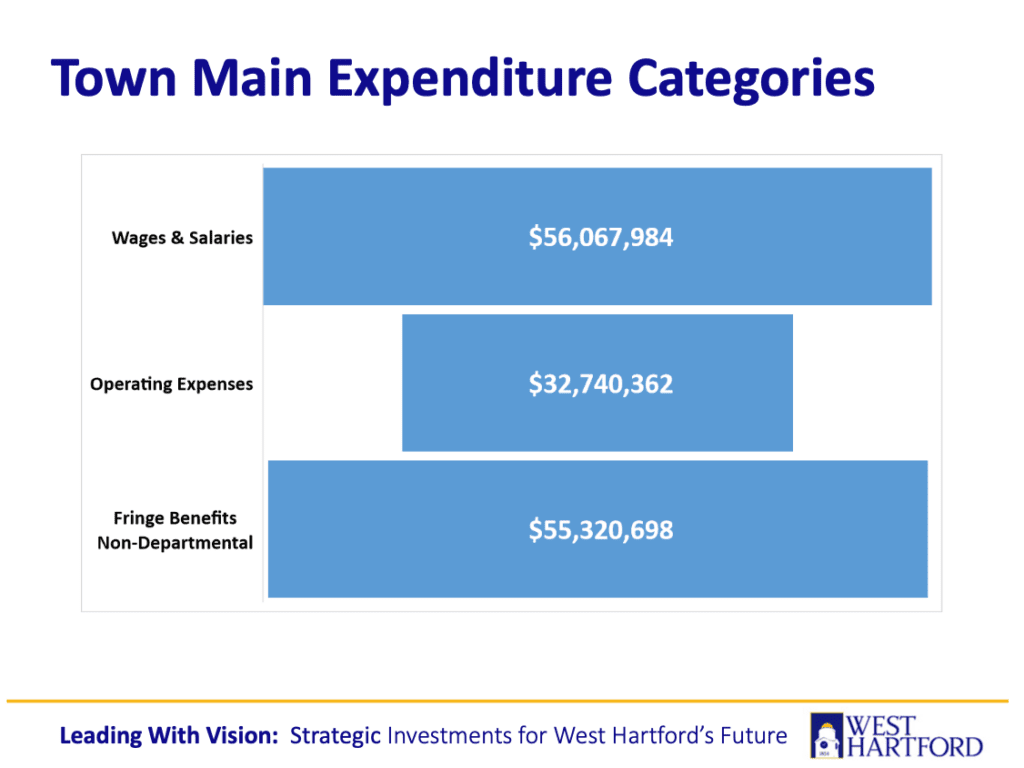
Expenditure categories for FY27. Courtesy Town of West Hartford
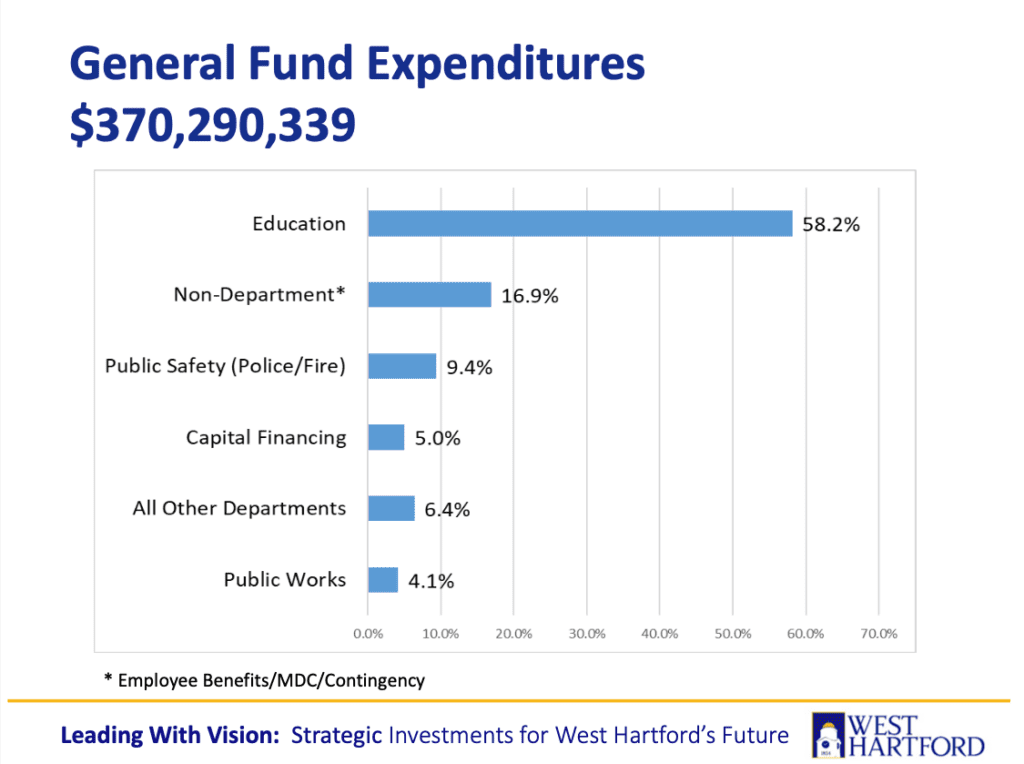
Wages, benefits, and salaries overall comprise 77% of expenses. And looking at expenses on a department basis, other than education (58.2%), the largest departments are public safety (police and fire) at 9.4% and public works at 4.1%
Courtesy Town of West Hartford
Pension liability was historically a major driver of the town budget, with the town’s ADEC (actuarially determined employer contribution) climbing by $1.5 to $2 million per year. The town’s issuance of Pension Obligation Bonds and establishment of a Pension Obligation Reserve Fund beginning in 2021 has leveled those costs and was a policy decision that had the positive impact of saving taxpayers more than $17 million thus far, Ledwith said.
Courtesy Town of West Hartford
Revenue
Property taxes are the primary source of revenue for cities and towns throughout Connecticut, and West Hartford is no different. An estimated 87% of the revenue for FY27 will come from local property taxes.
“Unlike many other states, Connecticut cities and towns have very limited revenue diversification options, which means the property tax remains the primary mechanism to fund essential services, such as education, public safety, infrastructure and programs,” Ledwith said.
He noted that the legislature is currently considering two bills which could have a positive impact on revenue – one which would amend the Education Cost Sharing (ECS) grant from the level of $11,500 per pupil, which has not been adjusted for inflation and. has remained unchanged since 2013. “The other bill we are watching closely is related to the additional 1% restaurant and hospitality tax that was implemented back in 2019 and appropriated to the state’s General Fund instead of the communities that need this offset to help fund services provided in town to restaurants.”
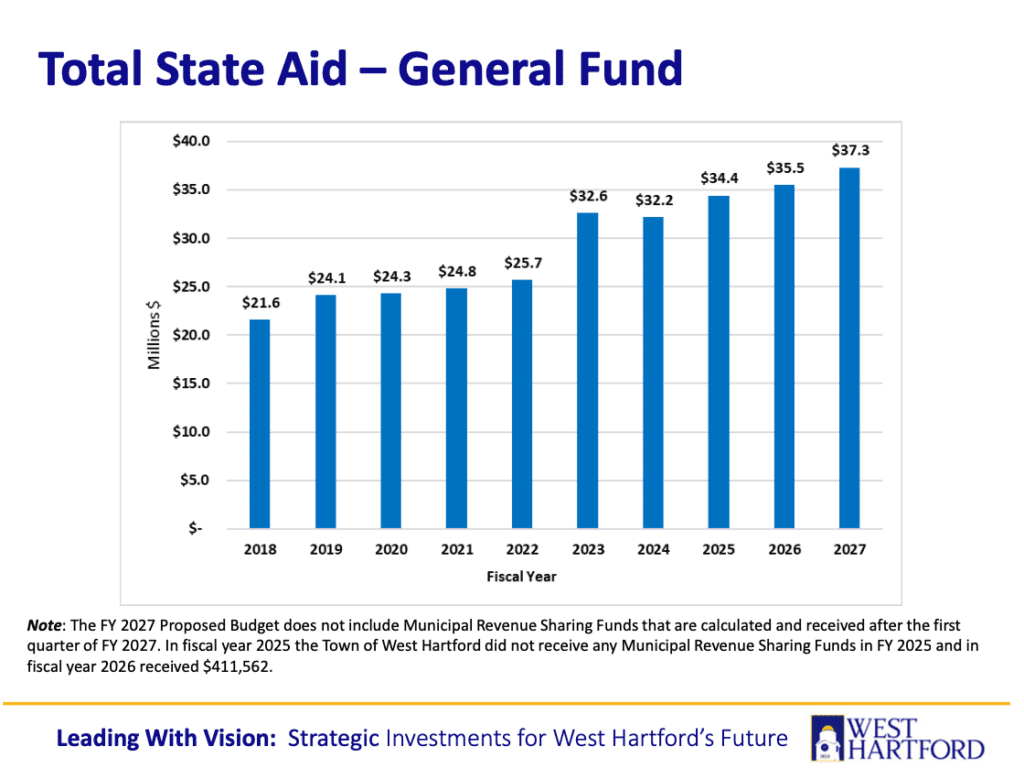
A large increase that appears on the revenue side is $1.8 million in additional intergovernmental transfers, and Ledwith noted that is attributable to the grant the town receives due to the capping of the motor vehicle mill rate. Other than that, state aid has been relatively unchanged.
Grand List growth of $81.5 million has brought some good news this year – an additional $3.46 million in revenue. Last year the town received $2.2 million in additional revenue attributable to Grand List growth. “Next year we expect to see even larger growth in this category,” Ledwith said, with significant projects reaching various stages of completion, including One West Hartford (950 Trout Brook Drive), Center Park Place and other West Hartford Center projets, and development of both portions of Heritage Park on the former UConn campus.
Next year will also be a scheduled revaluation year for the town, Ledwith noted.
Courtesy Town of West Hartford
CIP
The town’s 12-year Capital Improvement Plan, which totals nearly $578.6 million, is “our Town Council’s very important commitment to maintaining infrastructure” including town and school facilities, transportation and infrastructure, and flood mitigation. The CIP is primarily funded through the issuance of General Obligation Bonds and federal and state grants.
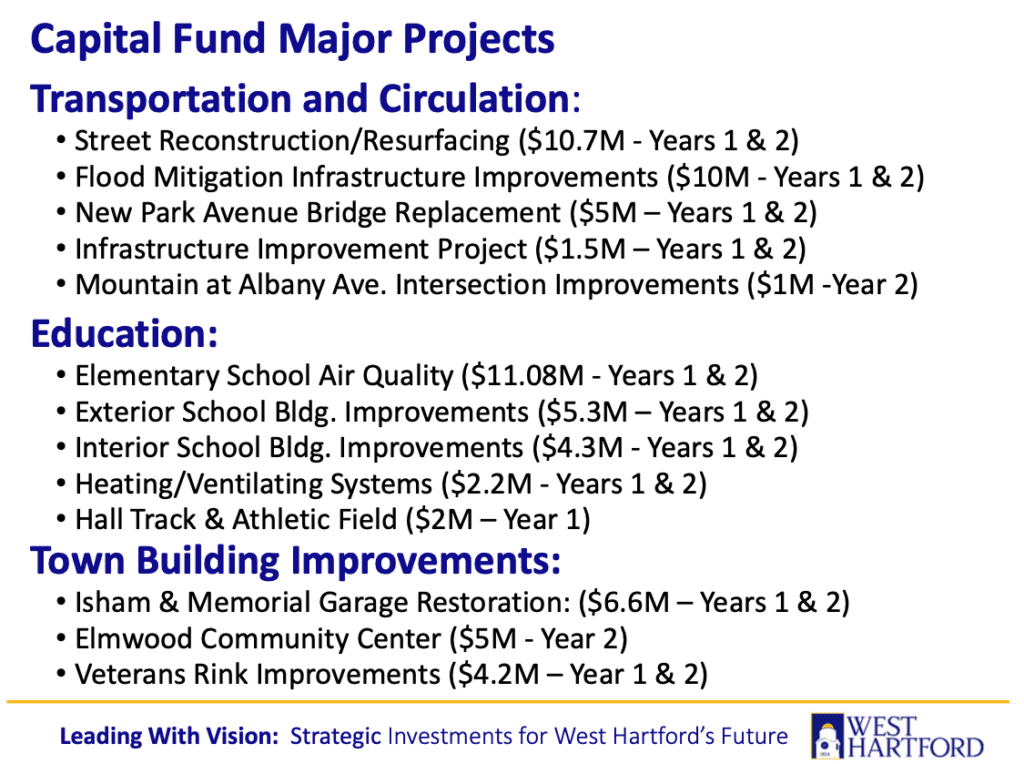
As part of the adoption of the FY27 budget, the Council will vote to approve years 1 and 2 of the CIP, proposed at $50.5 million and $58 million respectively.
The chart below shows some of the major planned capital fund investments in the next two years.
Courtesy Town of West Hartford
“The largest outlier here is the increase in town buildings as we see the construction of our new community center built into the plan,” Ledwith said. “However we will continue pursue grant opportunities, including the Congressionally Directed Spending Community Project Funding Grant to offset our overall costs.”
Accomplishments
Before outlining the budget itself, Ledwith also provided a brief overview of recent and remarkable accomplishments, noting that the West Hartford “has once again received national and statewide recognition as one of the most exceptional communities in the state and in the country. Our town was ranked No. 19 in the nation and No. 1 in Connecticut by U.S. News & World Report for Best Places to Live, was named the Best Place to Live in Connecticut for the eighth consecutive year by Niche, and was recognized by AARP as the most livable community in Connecticut.”
The town has continued to prioritize public safety and community well-being, including Vision Zero and moving forward with authorization of automated traffic enforcement devices.
“Infrastructure investments are essential to maintaining the vibrancy of our community and supporting economic growth,” Ledwith said, and in the past year the first phase of the West Hartford Center Infrastructure Master Plan was completed with the reconstruction of LaSalle Road. “The project transformed one of the Center’s most important corridors with expanded sidewalks, new street trees, decorative lighting, and traffic calming improvements. The result as we’ve seen is a more walkable, welcoming, and vibrant downtown environment that supports local businesses and strengthens community connections,” he said.
The town also opted to become part of the Connecticut Municipal Development Authority, which will provide opportunities to advance economic development and affordable housing in conjunction with transit-oriented development.
In addition, Ledwith said, “over the past year the Town Council approved several transformative housing developments that will increase West Hartford’s affordable housing percentage from 8.04% to 10.1% once completed. Importantly, these developments include the first affordable homeownership opportunity created through the town’s affordable housing initiatives.” Town staff has also successfully obtained brownfield remediation funding from the state to support several projects.
“As we look ahead to our nation’s 250th anniversary in 2026, West Hartford residents have stepped forward in extraordinary ways to help celebrate our shared history,” Ledwith said, with more than 40 volunteers joining town staff on the America 250 Committee. Several events have already occurred, and more to follow.
What’s next
“Before concluding tonight’s presentation, I want to acknowledge something that I am sure is on everyone’s mind.,” Ledwith said. “While this proposed budget reflects financial planning and important investments in West Hartford’s future, we also recognize that any budget increase has a real impact on our taxpayers. We understand that any potential increase in the tax burden is significant for many residents and families, and businesses, and we approach that responsibility with great care and seriousness.”
Ledwith said the proposed budget recommendations “are guided by our commitment to Leading With Vision: Strategic Investments for West Hartford’s Future—ensuring that we continue to maintain the high quality of services our residents expect, while also making thoughtful investments in infrastructure, public safety, housing, and community assets that will benefit West Hartford for decades to come.”
The process is just beginning, he said, and input is welcome from the Town Council and members of the community as priorities are reviewed, efficiencies are explored, and we “consider creative ways to mitigate the potential tax impact wherever possible,” Ledwith said.
The Town Council’s committees, as well as the Board of Education, will be working hard and reviewing the budget in detail over the upcoming weeks during virtual meetings and workshops that can be viewed by the public through West Hartford Community Interactive.
The public will have the opportunity to comment on the town’s General Fund budget at public hearings scheduled for Thursday, March 19, at 2 p.m. at Town Hall, and Tuesday, March 24, at 6 p.m. at Town Hall.
In addition to the workshops and public hearing listed above, the Town Council and Board of Education will again host a listening tour, as was introduced last year, providing an additional opportunity for community conversation regarding the budget. Those sessions are scheduled for Monday, March 16 from 2 to 4 p.m. at the Bishops Corner Senior Center; on Wednesday, March 18, from 6 to 8 p.m. at the Faxon Library; and on Monday, March 23, from 6 to 8 p.m. at the Noah Webster Library.
Upcoming public meetings related to the Board of Education budget include:
- Budget Workshop No. 1, Wednesday, March 11, 7 p.m.
- Board Public Hearing, Wednesday, March 25, 7 p.m.
- Budget Workshop No. 2, Wednesday, March 25, following Public Hearing
- Board Budget Adoption, Tuesday, March 31, 7 p.m.
Town Council committees will also meet virtually to discuss department budgets. The meeting schedule can be found online.
The Town Council plans to adopt the overall budget on Monday, April 20, with that meeting beginning at 7:30 p.m.
Comments regarding the general fund budget can be submitted in writing via email to [email protected]. Comments specifically regarding the West Hartford Public Schools budget can be sent to [email protected].
Setting the budget “is the hardest thing we do and the most important thing we do,” Mayor Shari Cantor said at the conclusion of the meeting. Council members are all taxpayers, too, and all wish taxes could have a zero increase or a decrease.
“We wanted to make sure the public had the opportunity to understand what is in these numbers” so that’s why established community conversations which allow for a Q&A approach, she said, noting that there are three scheduled – two in the early evening and one in the afternoon.
All budget documents, including the Budget in Brief, are posted on the town’s website for review.
Like what you see here? Click here to subscribe to We-Ha’s newsletter so you’ll always be in the know about what’s happening in West Hartford! Click the blue button below to become a supporter of We-Ha.com and our efforts to continue producing quality journalism.




Nothing a few more monstrous apt buildings and a few hundred idiot bollards won’t fix.