
Consumer Diary: Poached Eggs, Pesticides on Fruit and Vegetables

Audio By Carbonatix

Cut the poached egg and see that’s perfectly runny! Photo credit: Harlan Levy





Consumer columnist and West Hartford resident Harlan Levy has more than 20 years of experience writing stories about everyday experiences that anyone could encounter.

Harlan Levy. Courtesy photo
By Harlan Levy
I love our Sunday breakfasts, usually two poached eggs on a split English muffin, a half banana, some blueberries, raspberries, and strawberries, and a cup of coffee.
Sometimes the poached eggs are too hard, sometimes too runny. So I was curious when my wife told me she had found a recipe that made perfect poached eggs using Amazon Basics reusable non-stick, silicone baking cups. The recipe comes from Jeff & Lauren on Messenger as follows. See my photos for each step:
- Break eggs, and carefully pour them in each cup sitting in water in a large pan.
- Optional: Sprinkle shredded cheddar or other cheese on each egg.
- Cover pan and boil water for 5+ minutes on heat level 6 out of 10.
- Dump poached egg carefully right-side up on your half English muffin.
Result: Really perfect. Not too runny and not too hard!

Put eggs into non-stick silicone containers sitting in water. Photo credit: Harlan Levy

Optional: Sprinkle grated cheese on top. Photo credit: Harlan Levy
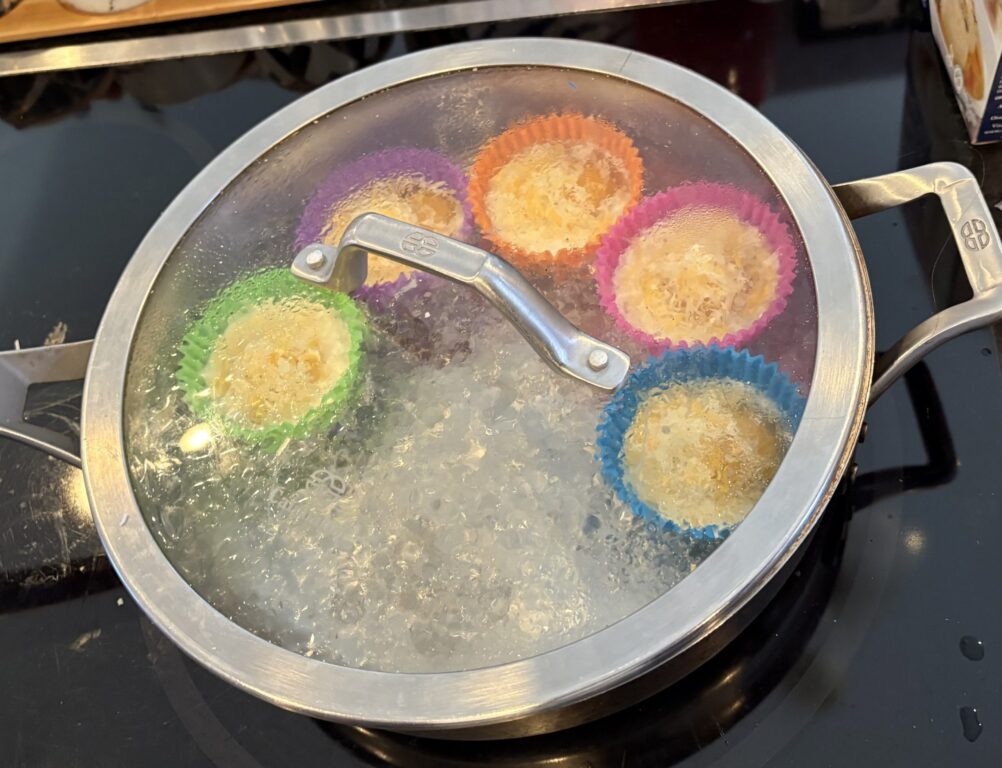
Bring water to a medium boil and cover for 5+ minutes. Photo credit: Harlan Levy

Carefully pour egg right-side up onto English muffin. Photo credit: Harlan Levy

Cut the poached egg and see that’s perfectly runny! Photo credit: Harlan Levy
Pesticide-tainted and the cleanest fruits and vegetables
Every weekday morning I eat some raspberries, strawberries, and blueberries – plus half a banana, spoonfuls of cottage cheese, some almonds, and a bowl of oatmeal.
So I was surprised to find out how many fruits and vegetables may be tainted with pesticides as described by nonprofit Environmental Working Group’s newly published Shopper’s Guide lists of the Dirty Dozen and Clean Fifteen. The two lists come from results of tests conducted by the Department of Agriculture.
Here they are:
- Spinach: Spinach has more pesticide residues by weight than any other type of produce.
- Kale, Collard, and Mustard Greens: More than half of the samples tainted by possibly cancer-causing pesticide.
- Strawberries: The average American eats about eight pounds of fresh strawberries a year – and with them, dozens of pesticides,
- Grapes
- Nectarines
- Peaches: Peaches pack a punch when it comes to pesticide contamination.
- Cherries
- Apples: Apples are doused with a chemical after harvest.
- Blackberries
- Pears: Pears among the most pesticide-contaminated fruit in EWG’s Dirty Dozen.
- Potatoes: The most consumed vegetable – yes, it’s a veg – in the U.S.
- Blueberries: Has traces of several pesticides. Uh oh! I eat a big handful every morning.
Here’s what EWG says about blueberries:
- Americans are eating three times as many blueberries as they did in the early 2000s.
- Pesticides were found on 90% of conventional blueberry samples.
- 80% of samples had two or more pesticides.
- A single sample of blueberries could have up to 17 different pesticide residues.
- The most troubling pesticides were phosmet and malathion. They kill many types of insects and are toxic to the human nervous system, especially children’s developing brains. Phosmet was detected on more than 12 percent of blueberry samples, with malathion at 10%.
The Environmental Protection Agency allows both for use on crops.
Other pesticides found on blueberries:
- Boscalid, a fungicide the EPA says may cause cancer, was found on 46% of the blueberries tested.
- Acetamiprid and imidacloprid, two neonicotinoids, were found on 36 and 14%of samples. Concerns exist about the link between these insecticides and harm to the developing nervous system.
- The pyrethroid insecticides cypermethrin and bifenthrin were found on 23 and 19% of samples. They may also harm children’s neurodevelopment and growth.
- The fungicide fludioxonil has also been found with increasing frequency. The recent tests detected it on 24% of blueberries, versus 17% in 2014. Recent studies suggest it may harm fetal development, cause change in the cells of the immune system, and disrupt hormone activity.
The Clean 15
The following had the lowest amounts of pesticide residues, according to the USDA’s most recent data:
- Pineapples
- Sweet corn – fresh and frozen
- Avocados
- Papaya
- Onion
- Sweet peas (frozen)
- Asparagus
- Cabbage
- Cauliflower
- Watermelon
- Mangoes
- Bananas
- Carrots
- Mushrooms
- Kiwi.
Advice: There is no one-size-fits-all solution to cleaning fruit and vegetables. Some produce is harder to clean than others, and some pesticides are more difficult to remove than others. Soaking and rinsing with water is a good way to reduce pesticide residue, but it may be more effective to add baking soda or vinegar.
Avoid soaps, detergents, bleach and produce washes due to safety concerns. The efficacy of such products for cleaning produce remains in question.
Now you know.
NOTE: If you have a consumer problem, contact me at [email protected] (“Consumer” in subject line), and, with the power of the press, maybe I can help.
Like what you see here? Click here to subscribe to We-Ha’s newsletter so you’ll always be in the know about what’s happening in West Hartford! Click the blue button below to become a supporter of We-Ha.com and our efforts to continue producing quality journalism.