
DPH Commissioner and Governor Discuss State’s First Measles Case, Tout Nursing Compact

Audio By Carbonatix

DPH Commissioner Manisha Juthani, MD, and Gov. Ned Lamont discuss Connecticut's first measles case in more than four years at a press conference at the University of Hartford, Dec. 11, 2025. Photo credit: Ronni Newton





Gov. Ned Lamont and Department of Public Health Commissioner Dr. Manisha Juthani spoke at the University of Hartford in West Hartford on Thursday morning, announcing the state joining the Nurse Licensure Compact and providing some additional details regarding the state’s first measles case in several years.
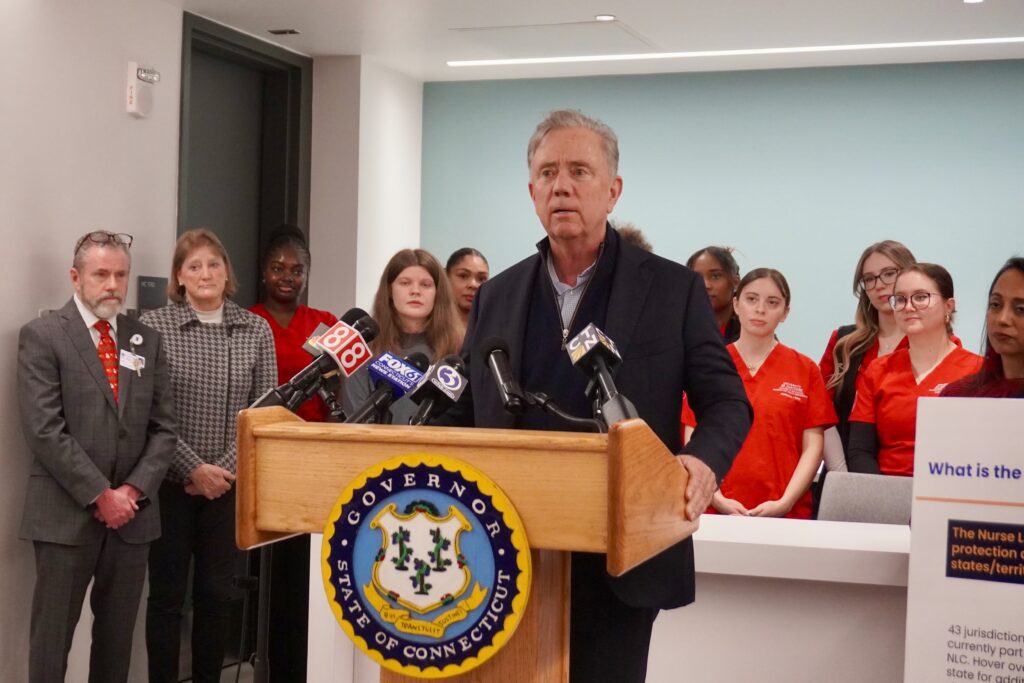
Gov. Ned Lamont speaks about Connecticut’s participation in the Nursing Licensure Compact and the state’s first measles case in more than four years at a press conference at the University of Hartford, Dec. 11, 2025. Photo credit: Ronni Newton
By Ronni Newton
The University of Hartford’s state-of-the-art Hursey Center for Advanced Engineering and Health Professions served as the backdrop for a press conference that focused on an advancement in health care, as well as a frightening step backward in the eradication of a highly-contagious disease – measles – that has now appeared to Connecticut.
Gov. Ned Lamont and Department of Public Health Commissioner Manisha Juthani, MD, scheduled Thursday morning’s press conference to tout the fact that Connecticut is now one of 43 U.S. states and territories to sign onto the Nurse Licensure Compact. The agreement allows Registered Nurses (RNs) and Licensed Practical Nurses (LPNs) to obtain one multi-state license to practice nursing in all participating locations, and gives state employers more support to respond to nursing shortages by increasing the pool of available professionals.
The majority of reporters’ questions Thursday morning, however, focused on the announcement late Wednesday of Connecticut’s first case of measles in more than four years.
Juthani reiterated information that was released in a press release Wednesday night indicating that the individual with measles is an unvaccinated child, under the age of 10, who lives in Fairfield County. The child recently traveled internationally, and the measles symptoms appeared several days later – symptoms that “included cough, runny nose, congestion, fever, and eventually a rash starting at the head and spreading throughout their body.”
An investigation is underway, Juthani said, “identifying what contacts they might have had, where they might have gone through an infectious window” which is based on symptoms, she said. They are working with the family on contact tracing in rapid fashion, she said, and will notify anyone who may have been in contact with the child.
Juthani did not say whether the child was male or female, the exact age, or whether the child attended school or was home-schooled.
While officials have not confirmed any further details about the child, and according to a spokesperson DPH is unable to “release any personally identifiable information in connection with a communicable disease investigation,” on Thursday the Town of Trumbull, CT, which is in Fairfield County, posted a notice on its website indicating that the town and health department “have been notified of a confirmed case of measles involving an unvaccinated child under 10 at Christian Heritage School. Local health officials are working closely with Christian Heritage School administration and the Connecticut Department of Public Health to ensure that all proper precautions are being taken to ensure the health and well being of all students, faculty and Trumbull residents.”
In a letter to parents of children who attend Christian Heritage School, Trumbull officials said that the infected student was last in school on Dec. 4, and stated that any unvaccinated or under-vaccinated children must stay out of school for 21 days from their most recent exposure, which would be until Dec. 25.
The letter also warned of potential life-threatening effects of measles and informed parents that children not in compliance with MMR (measles, mumps, rubella) vaccine schedule should get vaccinated “unless there is a valid, documented, medical reason why they cannot receive the vaccine.”
Juthani said Thursday that vaccination is the number one way that measles – which can result in hospitalization and have neurological effects that last for years – can be prevented.
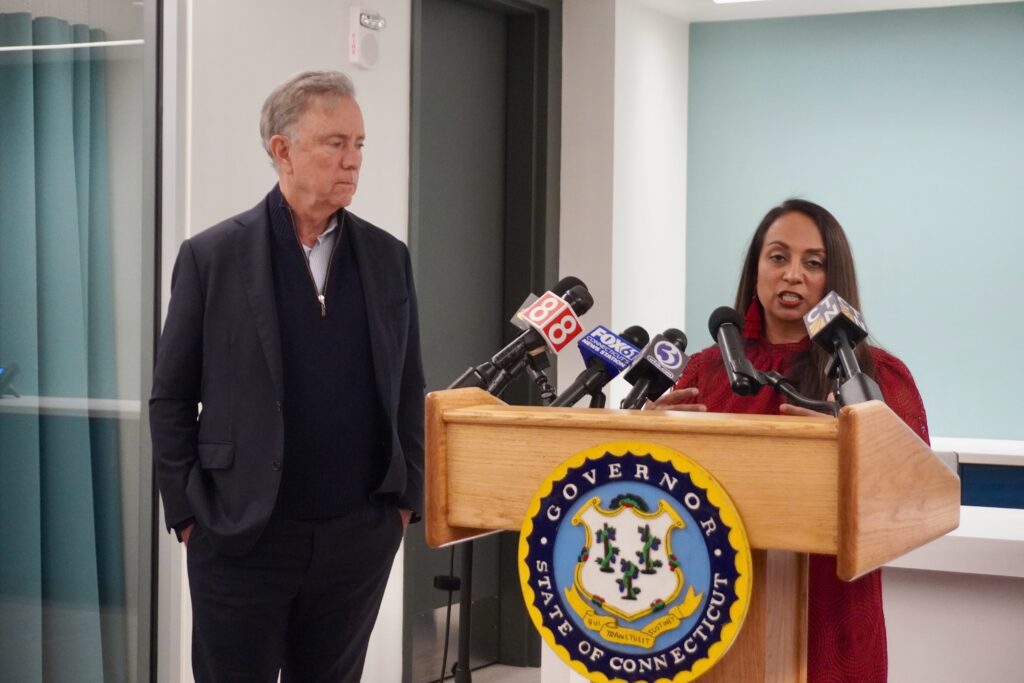
DPH Commissioner Manisha Juthani, MD, and Gov. Ned Lamont discuss Connecticut’s first measles case in more than four years at a press conference at the University of Hartford, Dec. 11, 2025. Photo credit: Ronni Newton
“One dose of measles vaccine is about 93% effective, while two doses are about 97% effective. We must ensure we continue to protect those who matter most – children and other vulnerable people – from vaccine preventable illnesses through on-time vaccination.” Connecticut’s MMR vaccination rate for children entering kindergarten in 2024 is 98.2% – among the highest in the nation,, where the average rate is 92.5%.
Measles was considered eliminated in the United States in the year 2000, Juthani said. “What that means is we did not have sustained transmission of measles,” she said, and although there was one case in Connecticut in 2021, it was an individual situation. While not yet declared by the Centers for Disease Control and Prevention, she said, “In the United States of America, 2025 is likely to be the hallmark year where we lost our elimination status of measles.”
More than 1,800 cases of measles nationwide have been reported in 2025 according to the International Vaccine Access Center – the most in more than 30 years.
Declining vaccination rates across the country are “most certainly part of what we’re seeing,” Juthani said, along with international travel that increases the chance of transmission of viruses. Nine out of 10 unvaccinated individuals who come into contact with someone with measles will become infected, according to the CDC.
“You should feel pretty good if you are vaccinated,” Juthani said, and should not worry living in Connecticut among a highly-vaccinated populace, but measles is a respiratory disease and the particles remain in the air for up to two hours. For those who are not vaccinated, an N95 mask is the best source of protection.
“Get vaccinated,” Lamont urged. “If you don’t want to have to worry, get vaccinated. … It works. It’s worked for many years.”
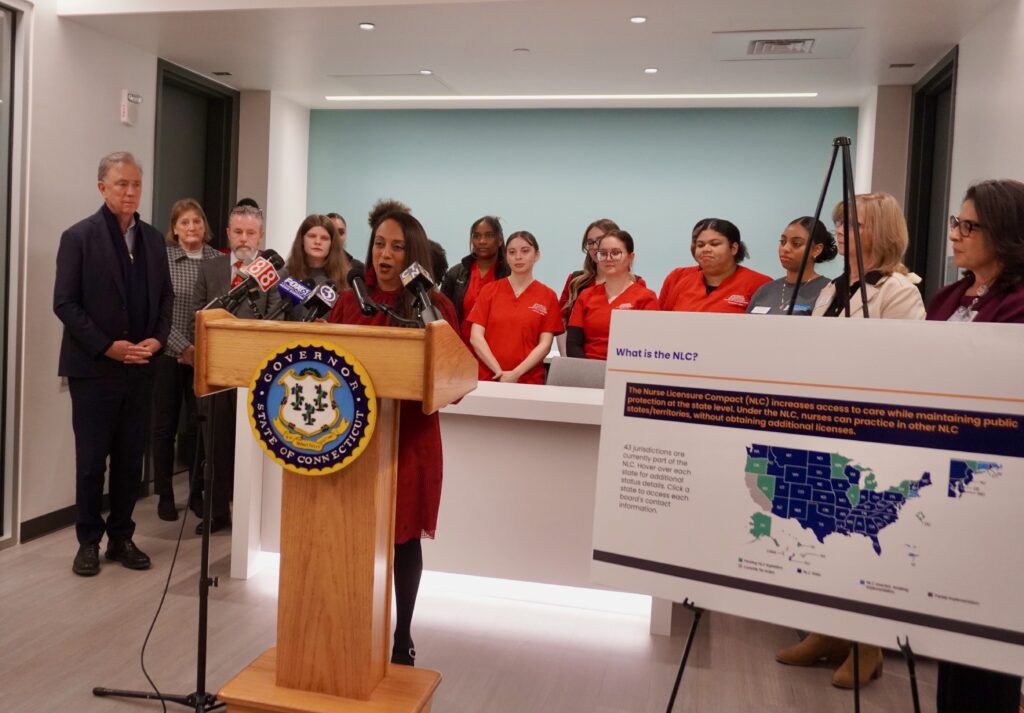
DPH Commissioner Manisha Juthani, MD, surrounded by nursing students and health care professionals, speaks about Connecticut’s participation in the nursing licensure compact at the University of Hartford, Dec. 11, 2025. Photo credit: Ronni Newton
Regarding the intended topic of the press conference, Juthani said since the Nurse Licensure Compact was authorized allowing Connecticut nurses to join effective Oct. 1, more than 3,500 nurses have applied. Being part of the Compact benefits new nurses – including the University of Hartford senior nursing students who stood behind her at the podium – as well as any nurses who want to work in the state. “That is a great thing for access in our state to jobs,” she said.
“This is showing us already right here and now how it is improving the ability for us to have people work in Connecticut and give flexibility, even for our new nurses who might be graduating from a program like this, to be able to enter the workforce,” said Juthani.
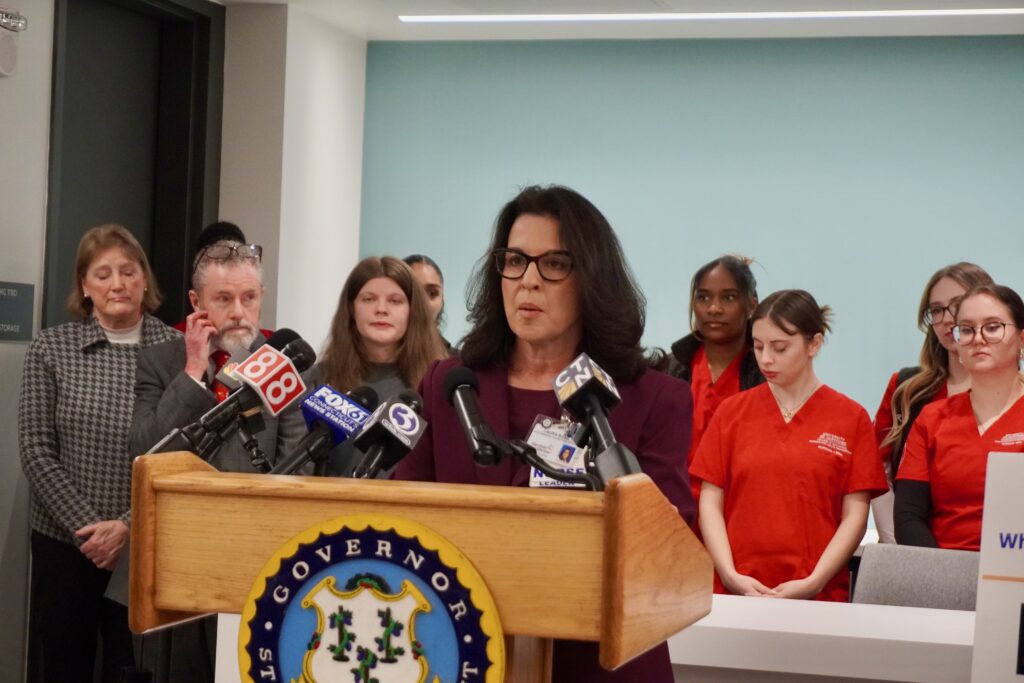
Laura Bailey, regional vice president of Patient Services for Hartford HealthCare speaks at a press conference regarding Connecticut’s participation in the nursing licensure compact at the University of Hartford, Dec. 11, 2025. Photo credit: Ronni Newton
Laura Bailey, the regional vice president of Patient Care Services for Hartford HealthCare, thanked the governor and Department of Public Health for championing the Nurse Licensure Compact and strengthening the health care workforce, allowing nurses to more easily transition to working across state lines – including supporting hospitals in other states that become overwhelmed during a crisis, disaster, or staffing gap.
During COVID, licensing restrictions delayed the ability to quickly respond to needs. “Nursing is not just a profession, it is a calling … and you removed a barrier that stood in the way of nurses answering that call,” Bailey said. “Thank you for addressing the issue and for recognizing the vital role nurses play in keeping our community safe and healthy,” she added.
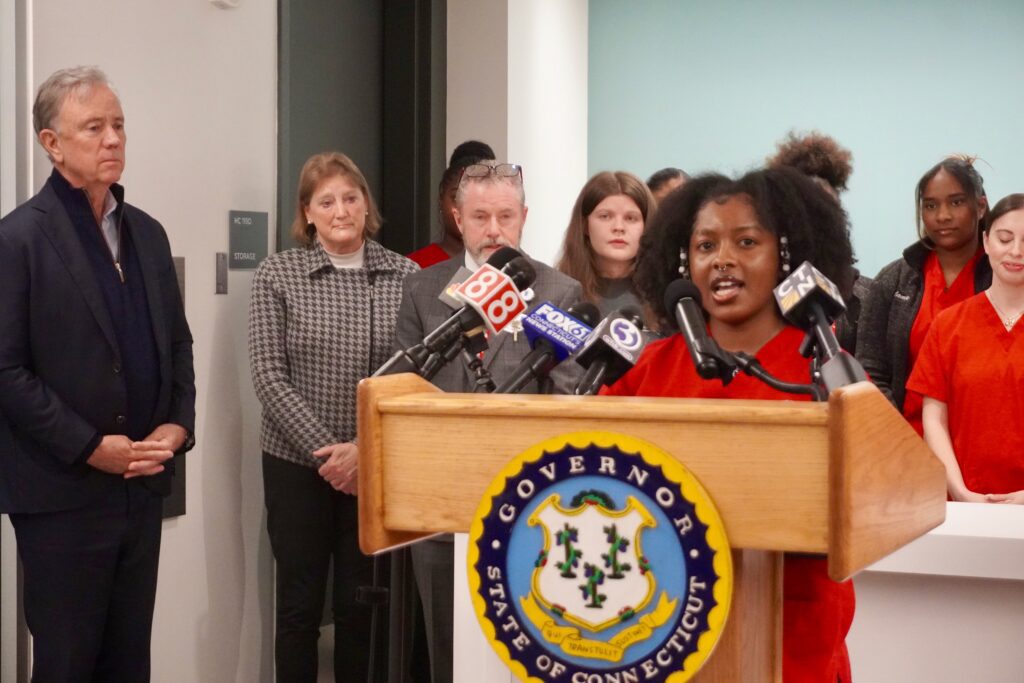
UHart senior nursing student Zaheerah Fuller speaks at a press conference regarding Connecticut’s participation in the nursing licensure compact at the University of Hartford, Dec. 11, 2025. Photo credit: Ronni Newton
Senior nursing student Zaheerah Fuller is originally from New York, and while she said she wants to settle in Connecticut once she graduates, “learning about the compact has made me realize how important it is that nurses have the ability to move around and go to different states and be able to help wherever they can and when they can,” she said.
Lamont said joining the compact increases access to care and allows for a mobile workforce that can respond to provider shortages or assist during disasters.
“I think it just makes an awful lot of sense,” he said, to allow Connecticut nurses flexibility to help out elsewhere while also responding to our own nursing shortage.
And, the governor added that he thinks the White House’s decision not to consider nurses as “professionals” for the purpose of scholarships and loans is “unconscionable. … I think it’s headed absolutely in the wrong direction.” Nurses are “incredibly professional,” he said, and the state will do what it can to protect and support nurses.
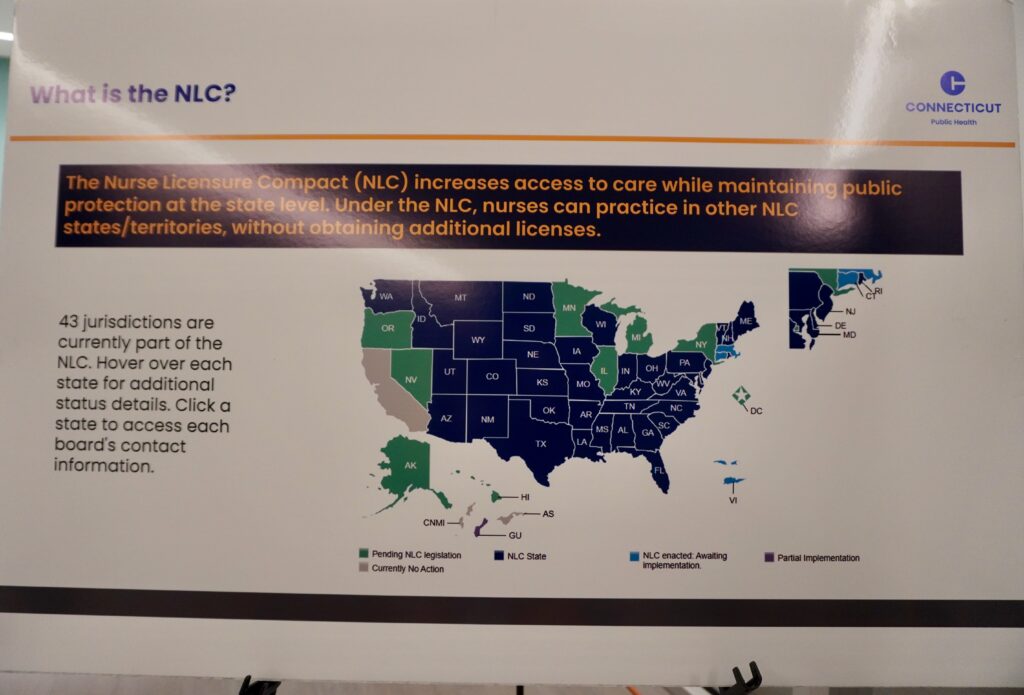
States and territories participating in the Nurse Licensure Compact. Photo credit: Ronni Newton
Nurses with Connecticut as their primary state of residence can now apply for a multi-state license – and don’t have to wait for their annual renewal period. To qualify, according to the state, nurses must meet uniform licensure requirements, including passing state and federal criminal history background checks. Applications are submitted online at www.elicense.ct.gov and there are no additional costs beyond the background check fee. More infroamtion can be found here on the state’s website.
The legislation authorizing Connecticut to join the compact was passed by the Connecticut General Assembly through Public Act 24-83 and signed into law by the governor.
A map of participating jurisdictions can be found here.
Like what you see here? Click here to subscribe to We-Ha’s newsletter so you’ll always be in the know about what’s happening in West Hartford! Click the blue button below to become a supporter of We-Ha.com and our efforts to continue producing quality journalism.