
Letter: A Win-Win Situation for our Students, our Schools, and our Budget

Audio By Carbonatix
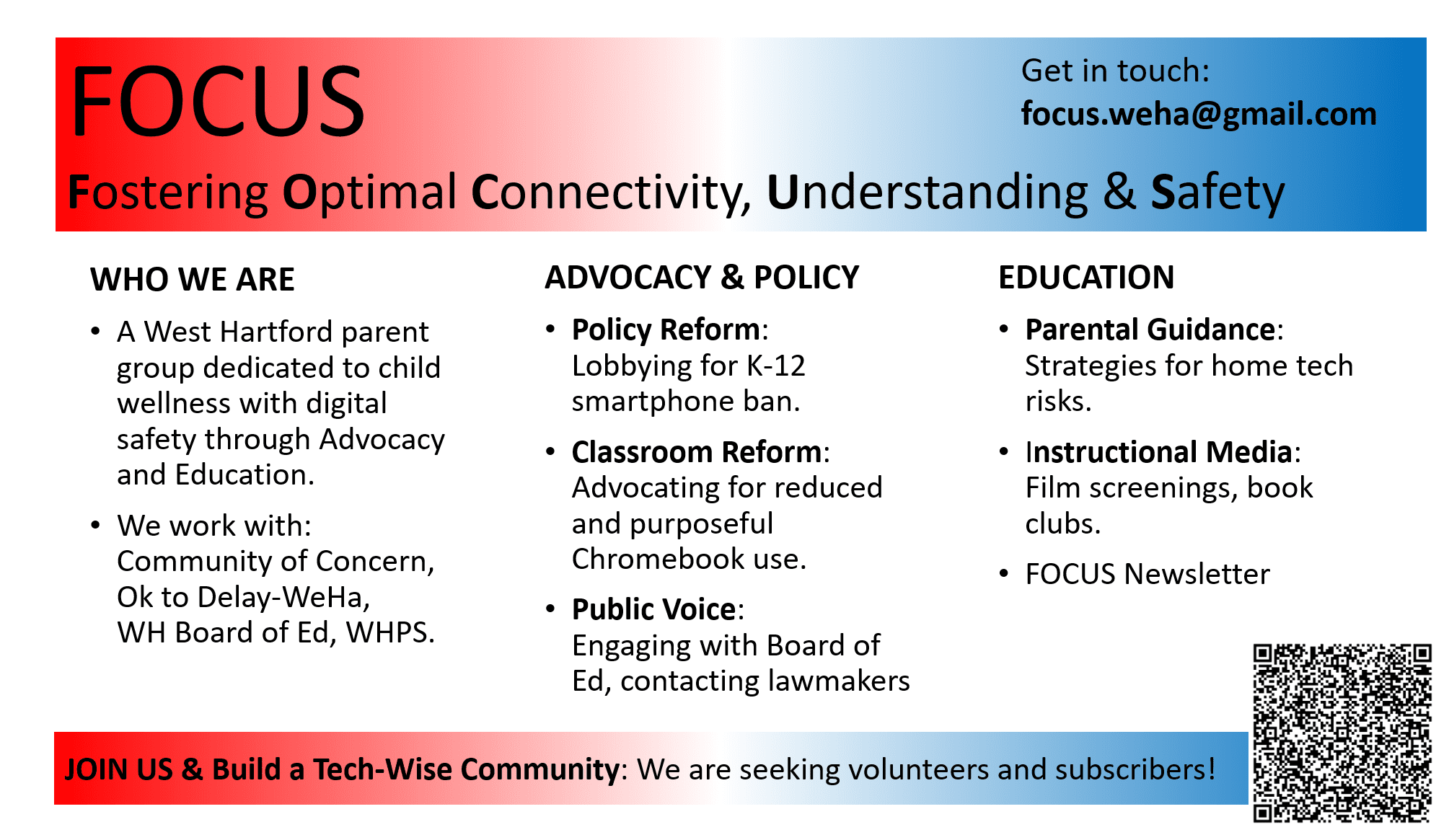
Image courtesy of FOCUS





We-Ha.com welcomes Letters to the Editor from the public, including endorsements. Letters submitted by political candidates will be considered for publication up to 14 days prior to an election and most will be published within 48 hours of receipt. Letters that contain personal attacks or include profanity of any type will not be published. Rebuttals to letters should be submitted as a separate document if possible. Please provide your full name and town, as well as your phone number at the end of the letter. Phone numbers will not be published but are required in case verification is needed. Please submit letters to [email protected].
To the Editor:
West Hartford’s education system is widely recognized as one of our greatest assets. During this challenging budget season, it is vital that every dollar is spent wisely to improve student outcomes. A close review of the town’s proposed Capital Improvement Plan reveals three separate expenditures totaling over $1 million to purchase Chromebooks and to update IT infrastructure. As members of West Hartford parent group FOCUS, we urge the Town Council to reexamine this spending.
FOCUS (Fostering Optimal Connectivity, Understanding & Safety) is dedicated to child wellness and digital safety through advocacy and education. We recently wrote a report that cites peer-reviewed studies on the distracting and detrimental effects of extensive reliance on Chromebooks and iPads in classrooms.
While we recognize and respect that assistive devices and specific educational technologies remain essential, non-negotiable tools for students requiring legally mandated accommodations under Individualized Education Programs (IEPs) and Section 504 plans, the ubiquitous, daily use of 1-to-1 devices for the general student population is actively counterproductive to learning. Laptops provide constant temptation for off-task behavior, and research consistently demonstrates that this digital distraction severely harms cognitive development.
The impact of educational technology on student achievement is clearest when examining high frequency of use. As illustrated in the figure, pre-pandemic national eighth-grade mathematics test scores (a standard benchmark for academic readiness) demonstrate a distinct threshold of efficacy. Infrequent, targeted use yields optimal outcomes. Beyond occasional use, academic performance reliably drops as digital integration increases. Most notably, daily classroom use – the foundation of the 1-to-1 device model in West Hartford Public Schools º correlates to the lowest overall academic achievement.
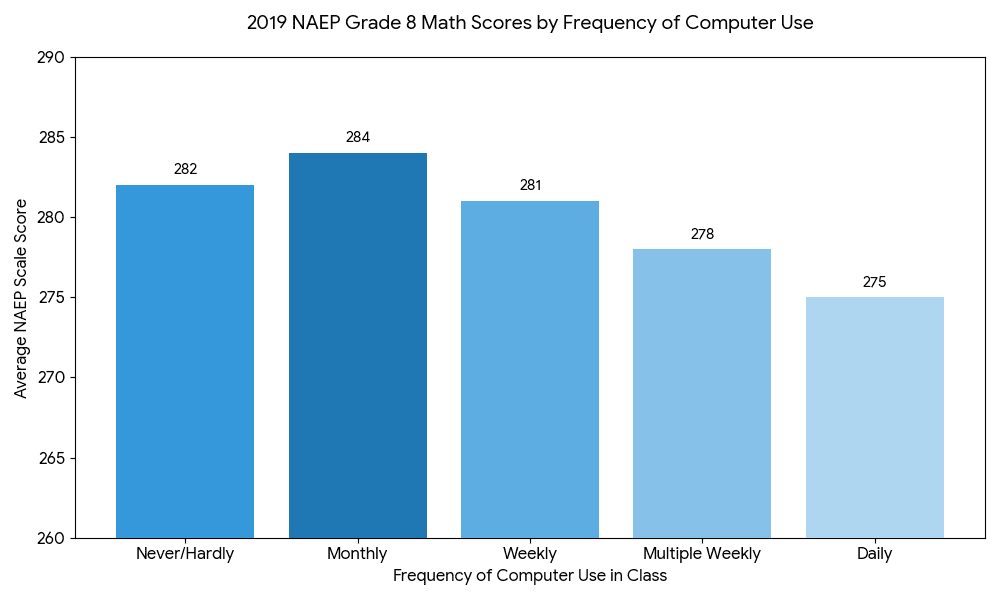
Figure: Pre-COVID (2019) National NAEP Grade 8 Math Scores by Frequency of Computer Use. [Source: National Center for Education Statistics. (2024). Courtesy image
To reverse this trend, FOCUS is advocating for a deliberate, phased transition back to paper-based studies. While maintaining robust exceptions for STEM and IEP needs, we propose beginning the transition with completely tech-free early elementary grades (K-2), followed by a more expansive adoption of paper curricula in higher grades. We aim to normalize waivers to opt out of digital technologies for families, to establish at least one tech-free classroom in each elementary grade, to create a tech-free track in our middle schools, and to revert back to physical textbooks and handwritten assignments in high school humanities.
With this roadmap in mind, the town should not proceed to spend the proposed $1 million over 3 years to purchase hardware including 1,500 new Chromebooks (est $300,000). These devices are no longer needed as we convert to paper-based instruction. In addition, Chromebooks are highly depreciable, rarely lasting more than a few years in the rough hands of students. During a challenging budget year, we should not be depleting our hard-earned town savings (CNRE) to continuously refresh short-term, disposable tech assets that actively distract our students.
Beyond the devices, the proposed expenditures also call for an extensive networking infrastructure investment. While we support necessary cybersecurity updates, the proposed infrastructure appears oversized. Currently, our high school systems are provisioned to supply free WiFi to nearly 3,000 high school students for both their personal cellphones in addition to Chromebooks. This oversized network capacity directly enables the digital distractions that are undermining our classrooms.
Therefore, we urge the Town Council to delay these capital expenditures until the district’s network infrastructure needs have been thoroughly reviewed. Before approving this funding, we must understand the true cost impact of maintaining a “right-sized” network – one provisioned strictly for necessary educational capacity that excludes distracting personal devices.
Other states are already leading the way. Florida, Indiana, Louisiana, New Jersey, New York, Michigan, South Carolina, and Virginia are advancing “bell-to-bell” (all day) bans on smartphones and personal internet-enabled devices such as laptops and smart watches. Here in Connecticut, the General Assembly is advancing HB 5035, a bill for Distraction-Free Learning, to achieve similar goals by 2027. Scaling back WiFi access this fall is a logical, fiscally responsible stepping stone toward this impending shift.
West Hartford boasts an enviable education system, and we can make it even better while making West Hartford more affordable. By modifying the Capital Improvement Plan to avoid unnecessary Chromebook purchases and by right-sizing our networking equipment, we can improve the educational environment, protect student mental health, and avoid diverting precious capital. Let us invest in what actually works: engaged students, physical books, and our exceptional teachers.
Submitted by Jonathan Rheaume on behalf of FOCUS
FOCUS is a parent group based in West Hartford that aims for children’s safe use of technology by advocating for healthy boundaries and by educating our community about the impacts and best practices of digital technologies in their monthly newsletter. Contact us at [email protected]