
West Hartford Superintendent Proposes $228 Million Budget for 2026-2027 School Year

Audio By Carbonatix
Courtesy of West Hartford Public Schools





Superintendent Paul Vicinus’ proposed budget for the West Hartford Public Schools’ 2026-2027 academic year includes a $14.1 million (6.6%) overall increase with salaries, medical expenses, and transportation as the most significant drivers.
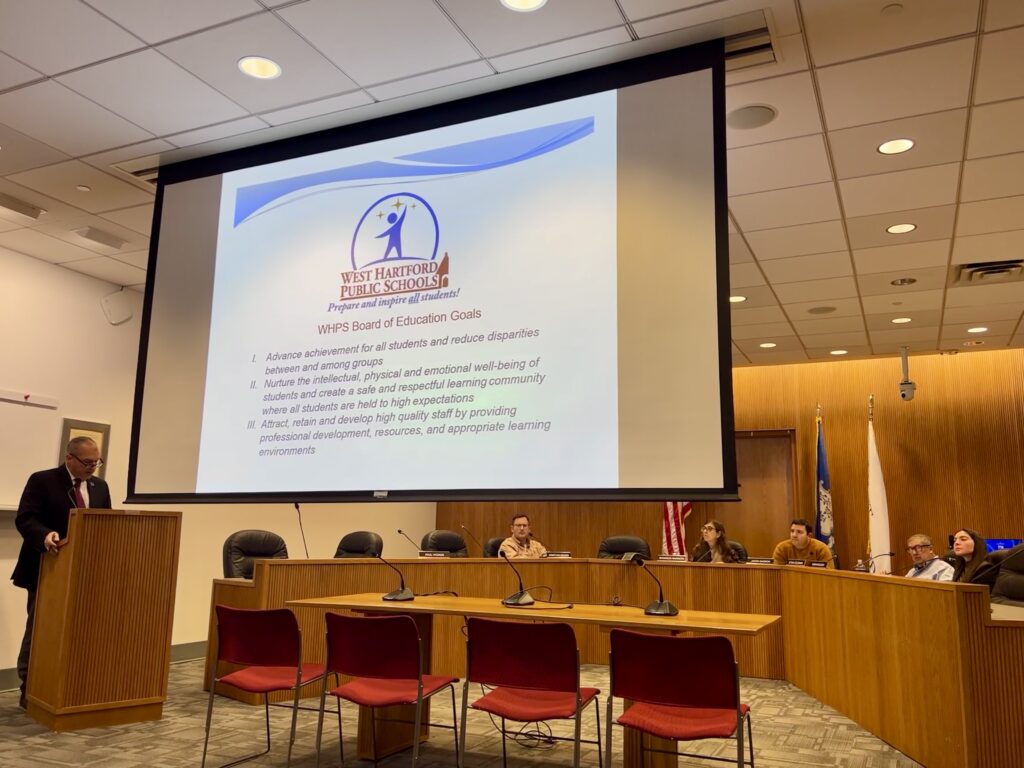
Superintendent of Schools Paul Vicinus (left) presents his proposed 2026-2027 budget to the Board of Education on March 3, 2026. Photo credit: Ronni Newton
By Ronni Newton
The West Hartford Board of Education will spend the next four weeks carefully scrutinizing specific details of the proposed 2026-27 school budget at workshops, and will also hold a public hearing and participate in several community conversations along with the Town Council before making recommendations and voting to adopt the budget on Tuesday, March 31.
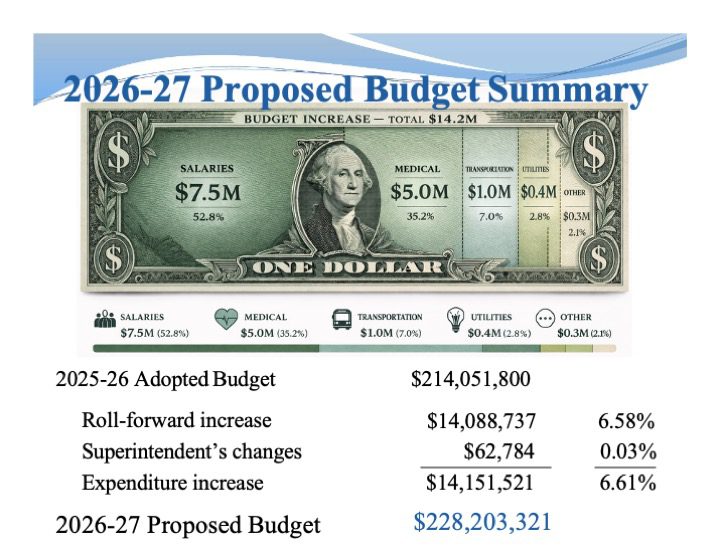
The proposed 2026-27 budget presented by Superintendent Paul Vicinus on Tuesday night totals $228,203,321, representing an overall increase of $14,151,521 (6.6%) over the $214,051,800 budget adopted for the 2025-26 academic year.
Vicinus, noted that the work of the Board of Education is crucial to maintaining the town’s reputation – which includes accolades like being cited as the No. 1 place to live in Connecticut and 19th in the country – and living up to the district’s mission and Vision of the Graduate.
“The budget proposal I am putting forward this evening is generally a maintenance budget,” Vicinus told the Board on Tuesday night. “Which is to say I am seeking to preserve our programming while not introducing any significant new initiatives.”
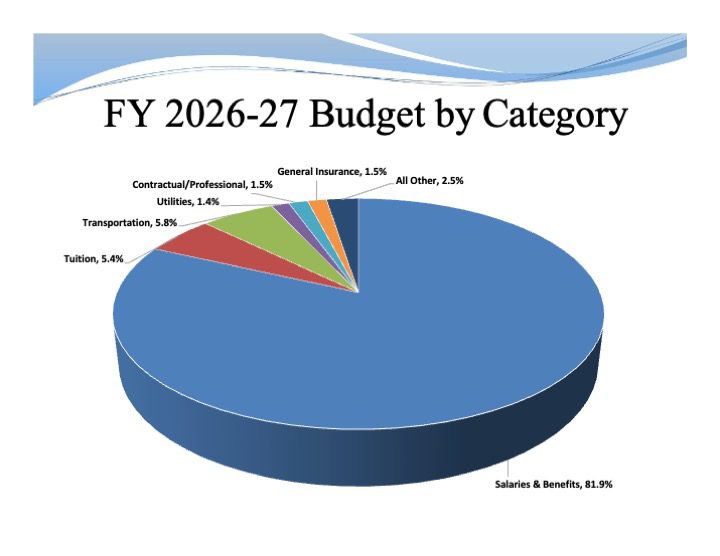
West Hartford Public Schools is a “people organization,” he said, and roughly 82% of the budget are for salaries and benefits – which this year are the major drivers of the proposed budget increase – accounting for 88% of the roughly $14.1 million being requested. Transportation costs – both for students in the district as well as for students who have out-of-district special education placements – are roughly 7% of the total increase, while the rest is based on utilities and other costs.
Tuition for out-of-district special education, which in the past has been one of the major budget drivers, is still a significant expense – and 5.4% of the overall proposed budget – but the dollar amount is not expected to change much this year. Current estimates are that the state will flat fund the excess cost reimbursement – and while it’s still underfunded and tuition rates have increased, efforts to bring more students back into the district’s own programs have been successful so fewer students are receiving outplacement services, Vicinus said.
Who are we?
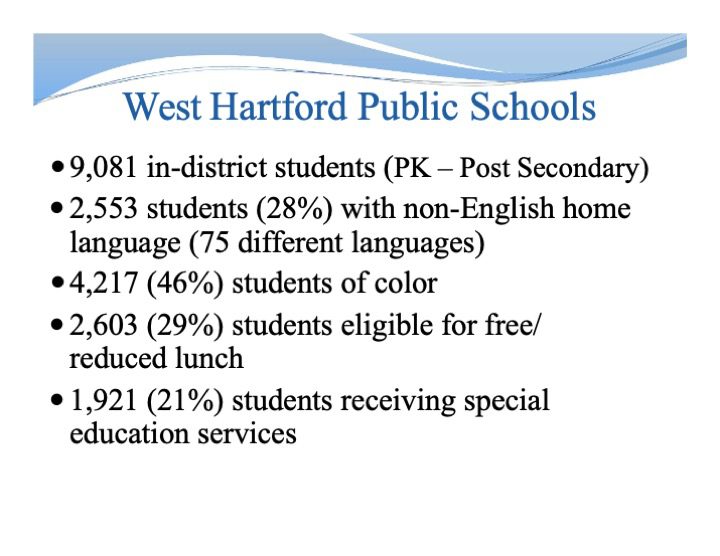
“We serve an incredibly diverse student body of almost 9,100 students from PK through post-secondary,” Vicinus said.
More than one in four students come from a home where a primary language other than English is spoken, “a tapestry of 75 different languages and cultures,” he said, and overall, nearly half are students of color.
“While many outside West Hartford think this is a community of privilege, nearly one in three have socio-economic need and one in five receive specialized programming through our Pupil Services Department,” Vicinus said. “No district within the state matches the pairing of our incredible diversity and our incredible achievement.”
West Hartford Public Schools 2026-2027 Budget Presentation
Vicinus said the district maintains its commitment to “every child, every day,” and the costs related to programming addresses those needs “and attainment of excellence without exception.”
The return on investment in the schools “is the envy of many, if not most, of the towns across the state,” Vicinus said, adding that it was impossible to condense all of the acclaim received by students and educators into one slide, but noting that programs from pre-K through post-secondary have all been recognized, there have been at least seven state or local educators of the year in the past two years, middle school students have won the national Kids Lit championship, and music students have performed at Carnegie Hall. “The accolades continue, whether academic, fine and performing arts, unified sports or theater, or athletics with many state titles and division-recognized athletes,” he said.

West Hartford Public Schools 2026-2027 Budget Presentation
How do we do it?
The district’s accomplishments exist within a legacy of excellence, Vicinus said. “What is more impressive is our ability to live up to this legacy amidst a long history of systemic efficiency and fiscal responsibility.”
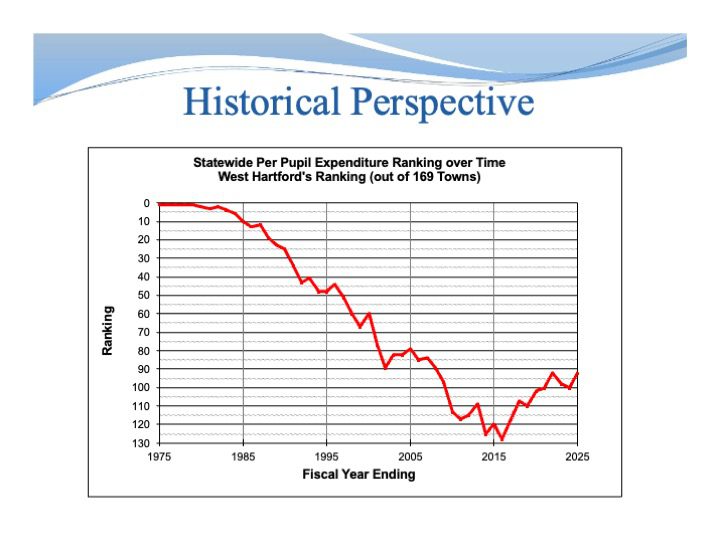
While in the 1970s and 1980s West Hartford was among the top districts in the state in terms of per pupil expenditure, in 2015, the district was in the lowest 10% in terms of per pupil spending statewide.
Last year’s per pupil expense of $22,442 was ranked 92nd statewide, well below the state median and within $74 per student of the DRG B average (the district reference group that includes Farmington Valley towns as well as Greenwich, Trumbull, Newtown, Cheshire, and others).
West Hartford Public Schools 2026-2027 Budget Presentation
If West Hartford’s per pupil expenditure was at the state median, it would add $6.3 million to the budget, Vicinus said Tuesday. He also noted that from a consumer perspective, the Advanced Placement (AP) and UConn Early College Experience (ECE) programs at the high schools are valued at providing $3.1 million of tuition costs.
West Hartford is a destination for families, as well as for educators – and although salaries are below many districts in DRG B, teachers value the programs and professional development opportunities, Vicinus said.
The largest piece of the budget pie is salaries and benefits (81.9%), followed by transportation (5.8%), and tuition (5.4%). Utilities, contracted professional services, and general insurance are roughly 1.5% each, and “all other” costs, which include textbooks and testing software, are roughly 2.5%.
West Hartford Public Schools 2026-2027 Budget Presentation
In addition to salaries, which are expected to increase by $7.5 million (5.6%) due to step and general wage increases negotiated as part of collective bargaining agreements for the roughly 1,600 employees, medical expenses are also a significant driver for the second year in a row, Vicinus said.
The most current estimate is a 12.5% increase in premiums through the State Partnership Plan, but based on comparisons to what it would have cost to be self-insured or to procure alternative insurance, the plan “remains a good value for the district,” Vicinus said. Based on current staffing and other factors – impacted by employee participation based in single vs. married vs. family plans – overall benefits costs are expected to increase by nearly $5 million or 16.9%.
Utility expenses are estimated to rise by 13.3% ($371,615) based on heating costs and increased electricity rates.
Transportation costs are another significant driver, budgeted for a nearly $1 million and nearly 8% increase overall in 2026-2027. “These costs are driven by contract rate increase and out-of-district special education busing,” Vicinus said.
The budget proposal is initially presented on roll-forward basis – today’s programming with tomorrow’s dollars – and often there are significant modifications suggested by the superintendent. While he presented some modifications on Tuesday night, the dollar amount is not significant for the 2026-2027 proposed budget.
Vicinus said enrollment is essentially flat across most grades, with a small decline at the high school level. Overall, he is proposing a reduction of 3.0 FTEs – two at the high schools as well as the reduction of a TA at Bugbee who was hired due to a section exceeding class guidelines this year. “We are projecting all sections within class size guidelines for next year,” he said.
He is proposing some additions to Pupil Services, including two more teachers in the Intensive Academic program, and increasing a currently part-time occupational therapist and a social worker to full-time. Incorporating some other staffing modifications result in a recommended addition of 2.9 FTEs in Pupil Services.
Other suggested modifications total a reduction of just under $165,000 and include changing the ESOL curriculum specialist to a department supervisor “intended to provide systemic and programmatic improvements for multilingual learners,” Vicinus said, at a cost of $35,000. Adding a 0.5 FTE by making a counselor full-time at Bristow will be offset by the reduction of a TA at Wolcott who has been providing additional supervision during the construction. Changes under the category of Support Services include eliminating a clerical position in the IT office and creating additional revenue streams by offering paid tuition in the IB program.
The net effect of the proposed modifications to the roll forward budget is an overall decrease of 2.6 FTEs, and an overall increase of $62,784.
In the past two years, Vicinus noted, “based on changes to enrollment and program efficiencies, the district has had a net decrease of over 20 positions.” Temporary positions added during the pandemic are not included in that figure, he said.
“This budget seeks to preserve what defines West Hartford Public Schools while responding to the growing complexity of student needs,” he said. The requested 6.6 % increase will “sustain our mission and maintain services provided directly to children” and “represents a steady investment in our students, our schools, and our community’s future.”
West Hartford Public Schools 2026-2027 Budget Presentation
What’s next?
Board members will hold workshops over the next several weeks where they will be able to review each line item in detail and recommend changes to the budget.
There will be forthcoming updates to the insurance costs, Vicinus said, and following discussions taking place in Hartford, an update from the state Department of Education regarding excess cost reimbursement for special education is also expected.
The community is invited to share comments at the public hearing (March 25, 7 p.m., in Town Hall Room 314), as well as via email at [email protected]. The detailed budget is available on the West Hartford Public Schools website.
Town Manager Rick Ledwith will incorporate the Board of Education budget into his overall proposed 2025-26 general fund budget which will be presented to the Town Council next Tuesday, March 10, at 7:30 p.m.
While the Board of Education decides what to spend, it is ultimately up to the Town Council to allocate the funding. The Council, however, cannot alter specific line items but only the overall district budget.
Upcoming public meetings related to the Board of Education budget include:
- Budget Workshop No. 1, Wednesday, March 11, 7 p.m.
- Board Public Hearing, Wednesday, March 25, 7 p.m.
- Budget Workshop No. 2, Wednesday, March 25, following Public Hearing
- Board Budget Adoption, Tuesday, March 31, 7 p.m.
- Town Council Budget Adoption, Wednesday, April 22, 7:30 p.m.
In addition to the workshops and public hearing listed above, the Town Council and Board of Education will again host a listening tour, as was introduced last year, providing an additional opportunity for community conversation regarding the budget. Those sessions are scheduled for Monday, March 16 from 2 to 4 p.m. at the Bishops Corner Senior Center; on Wednesday, March 18, from 6 to 8 p.m. at the Faxon Library; and on Monday, March 23, from 6 to 8 p.m. at the Noah Webster Library.
Like what you see here? Click here to subscribe to We-Ha’s newsletter so you’ll always be in the know about what’s happening in West Hartford! Click the blue button below to become a supporter of We-Ha.com and our efforts to continue producing quality journalism.
 Loading...
 Reload document
  Open in new tab


