
College Bound: Is Early Decision the Right Decision For You?

Audio By Carbonatix

Photo credit: Ronni Newton (we-ha.com file photo)





We-Ha.com will be publishing a series of essays/blogs/reflections on the issue of going to college – primarily a set of thoughts and musings, along with some practical advice, intended to support students and parents as they embark on this journey. While many of our readers are experts in this topic, many others are less knowledgeable and have little outside support. We hope this is helpful to all readers as they go through the various stages of getting into and getting something out of college.

Adrienne Leinwand Maslin. Courtesy photo
By Adrienne Leinwand Maslin
In the 2024-25 academic year, Northeastern University in Boston “took 54 percent of its entering class via early decision.” Prior to joining Northeastern University, their Chief Enrollment Management Officer, Satyajit Dattagupta, was the Dean of Admissions at Tulane University in New Orleans. During his time at Tulane he helped increase the percent of students admitted under the early decision plan from 40% to 68% That is huge!!
In October, November, and December of 2025 the New York Times printed four articles and two letters to the editor pertaining to early decision. Why this sudden, new interest in early decision? Let’s take a closer look at this practice, along with the related policy of early action, so you will be better able to determine if either is right for you.
Early decision is the policy that allows students to be considered for admission and then learn of an admissions decision early – typically in late December rather than March or April – in exchange for submitting their applications early – around Nov. 1 – and committing to attend the college if accepted. Upon acceptance, if students have already submitted applications, via regular decision, to other colleges they are expected to withdraw them. Most colleges with an early decision program are quite selective and are generally private institutions. Public universities comprise only a small group of early decision institutions.
The benefits that accrue to the college by having an early decision program are numerous.
- Colleges can start building their incoming freshman class early in the admissions cycle which allows them to better judge the size of their incoming class.
- Early decision programs help colleges increase their yield rate because close to 100% of the admitted students enroll. A high yield rate, in turn, helps the colleges achieve greater prestige and possibly achieve a higher ranking in such publications as U.S .News and World Report or The Princeton Review. (See my Aug. 28, 2024 article, College Rankings and Ratings.
- Colleges know they are admitting highly motivated, academically outstanding students.
- Colleges have the opportunity to fine-tune their incoming first-year class by selecting committed students who have particular skills or talents the college might need. This might include a bassoon player for the orchestra, a talented diver for the swim team, or a student who wishes to major in a less popular program.
- Some institutions will withhold merit aid for early decision admits because they know that many of the students will be able to afford attendance anyway.
Some admissions professionals believe that early decision programs will help them admit a more racially diverse class which is especially important in light of the Supreme Court’s decision nearly three years ago to end affirmative action. According to Inside Higher Education, “Christoph Guttentag, Duke’s dean of admissions, said he sees early decision as a key tool for building a class that’s diverse along multiple axes: socioeconomic, racial, geographic, even extracurricular. Admissions officers have more freedom to admit a virtuoso violinist or star basketball player early, he said, and the same goes for applicants from underserved communities who stand out despite lacking the resources of many of their peers.”
Many people believe early decision primarily benefits affluent students who can afford the steep tuition of the most elite universities. Others, like Robert Massa, former vice president of enrollment management at Dickinson College and co-founder of the consulting firm Enrollment Intelligence Now, believes “that the narrative around early decision – that it’s exclusively for rich students – has been something of a self-fulfilling prophecy. For middle-income families looking to shop around for the best financial aid or scholarship offer, Massa said, early decision would close off some options. But for low-income students, tuition is almost sure to be highly discounted at the selective colleges that offer ED – and if it isn’t cheap enough, they can always bow out.
Does early decision benefit the student? Possibly. If a student has an overwhelming preference for a particular institution, applying early decision might be the right thing to do. If a student is accepted, it relieves the student of a good deal of stress; the student knows he has been accepted to his first choice school which precludes the need to submit additional applications, and the need to put additional time, effort, and application fees towards the college admissions process.
Should you apply early decision? Certainly, students who are unsure of their first choice college should not feel pressured into applying early decision just because their friends are or because a college is seriously courting them. The choice of college is most likely the first major decision most 18 year olds make and it should not have to be rushed. Additionally, the National Association of College Admissions Counselors (NACAC) “advises families not to use ED if they need to compare financial aid packages or are uncomfortable with a binding commitment” (response to personal inquiry I made to NACAC).
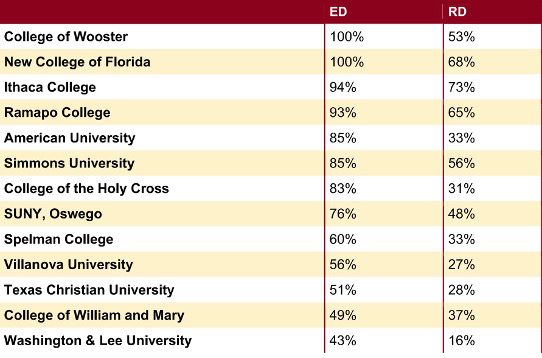
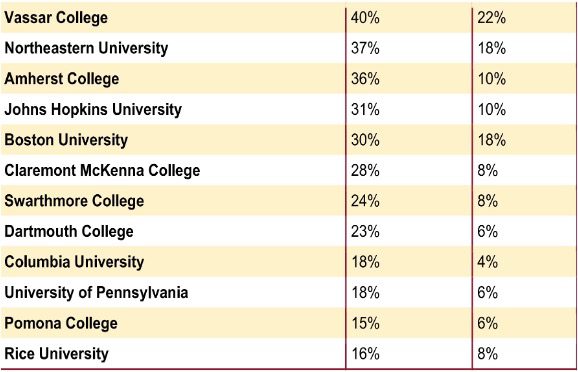
Many students, however, believe that applying early decision will give them an advantage. This may or may not be true. Below is a table prepared by Alpha Financial Partners that will give you a sense of the percentage of students who are admitted to various colleges under their early decision plan as opposed to their regular decision program.
Again, from Inside Higher Ed: “In 2021, Bates College admitted 81 percent of its incoming class through early decision, and it continues to be among the most reliant on the practice; last fall, 67 percent of the incoming class were admitted early. Sixty-nine percent of Middlebury College’s Class of 2027 were early-decision admits, as were 67 percent at Grinnell College and 66 percent at Emory University.”
“At these colleges, the strategic advantage of applying early is obvious. Bates’s overall acceptance rate in 2022 was about 14 percent; for early-decision applicants, it was 47 percent. At Emory, an applicant’s chances of admission double when they apply early decision.”
There continues to be a question as to the conditions under which an institution will release a student from the binding early decision commitment. Numerous articles explained that if a student applies early decision, is admitted, but is not given enough financial aid the student can request to be released from the commitment. However, again citing my email from NACAC: “NACAC’s ethical practice guidance says colleges using Early Decision should respond to a student’s financial aid application at or near the time of the admission offer and before a deposit is required. That same guidance lists specific situations where colleges should release students from the Early Decision agreement (denied, deferred to a different admission date, or offered a different program/major than applied for). (Being unable to) afford it after aid is reviewed is not explicitly listed in that release language in the NACAC guide excerpt provided.
So, a bit about early action. Early action is similar to early decision in that students must apply by a November deadline and they learn of the college’s decision on their application much earlier in the process – around December. The biggest difference is that it is non-binding; a student does not have to commit to attending. So, are there any drawbacks? The only ones that I can see are that a student will have to make sure her application is polished and ready to go – similar to early decision – and she will not have senior year grades to submit with her application. This may be consequential if junior year grades were not stellar.
Perhaps it’s because I still wear my former admissions counselor hat but I am not ready to eliminate early decision as some people believe should occur. Colleges are overwhelmed this time of year with thousands of applications to be reviewed. If some students take advantage of early decision plans, the admissions staff can attend to the regular admissions applicants in a more relaxed and attentive way. That is a win-win.
Adrienne Leinwand Maslin recently retired from a 45-year career in higher education administration. She has worked at public and private institutions, urban and rural, large and small, and two-year and four-year, and is Dean Emerita at CT State-Middlesex. She has held positions in admissions, affirmative action, president’s office, human resources, academic affairs, and student affairs. Adrienne has a BA from the University of Vermont, an MEd from Boston University, and a PhD from the University of Oregon. She is presently writing a series of graphic novels on life skills and social issues for 8-12 year olds believing that the more familiar youngsters are with important social issues the easier their transition to college and adulthood will be. Information about this series as well as contact information can be found at www.adrienneleinwandmaslin.com.
Like what you see here? Click here to subscribe to We-Ha’s newsletter so you’ll always be in the know about what’s happening in West Hartford! Click the blue button below to become a supporter of We-Ha.com and our efforts to continue producing quality journalism.