From the West Hartford Archives: 1976 Bicentennial Celebration

Audio By Carbonatix
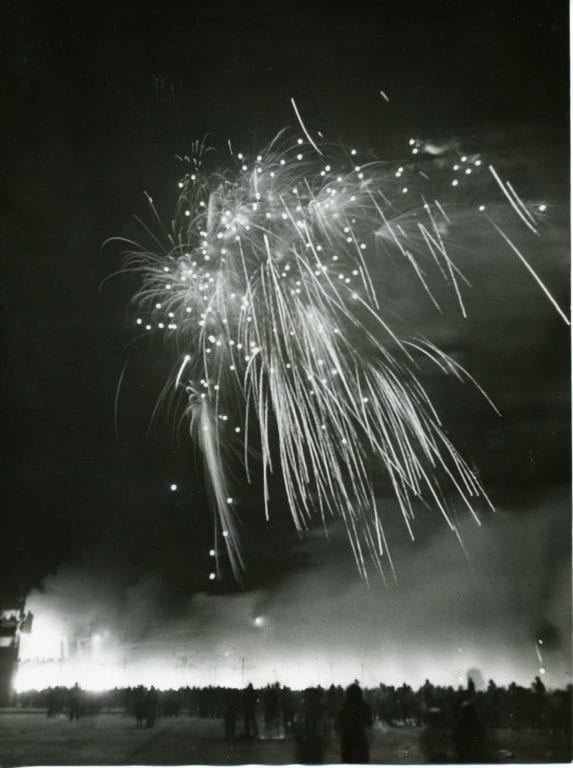
West Hartford fireworks, July 4, 1976. Courtesy of Noah Webster House & West Hartford Historical Society





Historian Jeff Murray takes a look into West Hartford’s past to uncover some surprising information, stir up some memories, or reflect on how much life has changed – or hasn’t changed at all. Enjoy this week’s ‘From West Hartford’s Archives’ …
By Jeff Murray
As we hope for warmer weather, it’s nice to look back at the notable summer events in West Hartford. This is a photograph from the 1976 bicentennial celebration at Rockledge Golf Course on the Fourth of July. A half century ago, the United States celebrated her 200th anniversary with a fireworks and arts show and a military exhibition sponsored by the West Hartford Bicentennial Committee.
The summer of 1976 was shaped by recent turmoil as much as national pride. The nation had endured the Watergate scandal and the resignation of President Nixon less than two years before. Trust in government was low and under President Ford, the bicentennial was framed as an opportunity for healing.
The mid-1970s were also marked by economic unease as inflation, unemployment, and the aftermath of the 1973 oil crisis weighed on everyday life. As with most anniversaries, it sparked an explosion of popular culture and programs: historical reenactments, commemorative medals, and other consumables. For example, a minuteman pin could be bought for $1.76. A bicentennial calendar was released in West Hartford, featuring local artists’ pieces of landmarks around town with notable events etched into significant days in our history. Genevieve A. Morgan was one of the contributors, drawing the Noah Webster House and other iconic old homes around the area. Morgan was the supervisor of art for the Hartford Public School System and former teacher at the University of Hartford.
Like the 250th anniversary occurring during 2026, 1976 was rich with programs and other events showcasing local talent and social contributions.
West Hartford, like other municipalities across the country, treated the bicentennial as a months-long civic project. It started on Feb. 12, 1976 with a lecture series at Hall High School by Dr. Richard L. Bushman of Boston University. A few months later, the second lecture was held at King Philip Junior High School by Dr. Willard Wallace of Wesleyan University. His lecture was entitled “The Declaration of Independence, Triumph of Rationalization, Paradox, and Rhetoric.” This seemed quite fitting, for West Hartford’s educational system has always been considered supreme. What better way could a town like ours celebrate the bicentennial than a lecture at a school?
The spring 1976 events included a concert by the Hartford Symphony Orchestra, dinners, and a preparation week to dedicate to “paint-up, clean-up, and fix-up.” Commemoration was turned into physical labor that could allow our citizens to take responsibility for shared spaces.
A golf tournament was held at Wampanoag Country Club and an interfaith service was held at First Church of Christ Congregational. From April 29 to May 2, the West Hartford Armory hosted “Futures Days,” in which local inventors, representatives from companies, town units, and hospitals displayed technological advances and ideas for the future.
Rather than exclusively linking back to the past, West Hartford organizers framed the anniversary as a way to connect to the future. One may read into it further as a desire to reclaim confidence after a difficult decade. A few weeks later, at the end of May, a grand bicentennial ball was held at the same armory, which was dressed in a colonial style and required “formal attire of any era.” Preceding the ball was a model airplane show at Hall High School and a model boat show (both radio-operated) at Reservoir #1.
The next morning, May 30, was an art show in the Center, followed by the Memorial Day parade, which brought together 27 musical units plus the local school bands and 41 marching units with floats. The parade began at Bishops Corner and proceeded south on North Main Street to West Hartford Center, where the reviewing stand at the center park was located.
The late afternoon closed off West Hartford Center for a massive block party that began at 4:30 p.m. According to the advertisement, this kickoff had “adult and children’s games; ethnic foods; square and folk dancing; puppet shows; carnival rides; rock dance; art show.” It also included sidewalk cafes and strolling minstrels. Regardless of how things turned out, the schedule was meticulous and orderly, a way to strengthen town cohesion and pride at a divisive time.
June started off strong. June 12 was a Day of Living History, held at Saint Joseph College. “Step back in time to 1776 and bring your family and friends to an authentic country fair.” There were craftsmen’s exhibits, colonial children’s games, needlework and quilt displays, food and baking contests, kite flying, hay rides, pony rides, the fife and drum corps, and the Inter Elementary choir.
It’s also important to recognize that the past was carefully curated to become more accessible. The colonial demonstrations were presented as domestic and communal, with baking, butter churning, candle-making, dances, and games. Understandingly, there would be no emphasis on political conflict, slavery, or revolutionary violence. Of course, it wasn’t intellectually dishonest as much as it was incomplete and selective. It wouldn’t have been very nice to honor Merrill’s Tavern, the 1840s saloon in West Hartford Center where Hartford workers came to get drunk and fight in the streets.
Americans in 1976 were disillusioned by political scandal, economic stress, and social conflict. Shared rituals in a colonial world genuinely offered a kind of social glue, a common ground where people could participate together without opening wounds. We do similar things today.
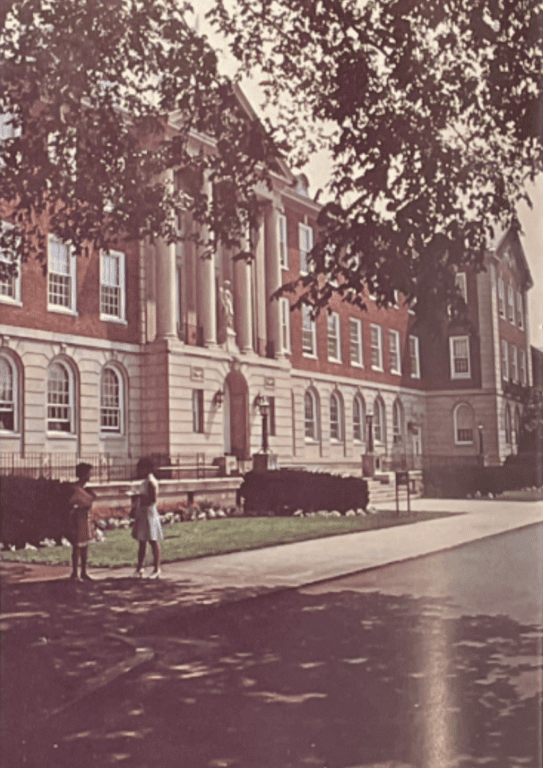
Saint Joseph College in 1976, the year the bicentennial was held. Photo courtesy of Noah Webster House & West Hartford Historical Society
The bicentennial program also allowed tours of historic homes in West Hartford from June 18-19, followed by the Spelling Bee held at the Noah Webster House a week later. Much of the past still remained to allow people to literally stand where history was made.
That brings us to the climax: the Fourth of July. A time capsule was installed at the Talcott Mountain Science Center. Placing it in a science building linked American continuity to knowledge, progress, and education. The program for the Fourth of July at Rockledge was packed from morning to night, but every piece had a purpose. At 9:45 a.m., the Star Spangled Banner was played by the drum corps, followed by the opening of the craft fair at 10 a.m. The National Guard launched a military exhibition alongside children’s games, rides, novelty booths, and pony rides.
It’s obvious that patriotism was present but not overwhelming. It was treated more like a Labor Day fair rather than a display of militarism or overt nationalism. In fact, the musical lineup was notably diverse and reflected the evolution of the eras more than any single colonial concoction: folk, Dixieland jazz, country and western, Bobby Kaye’s Big Band, and the Governor’s Foot Guard band.
A parachutist jumped into the crowd at 2 p.m. After dancing at 7:30 pm, the National Anthem was sung by Arthur Koret at 9:30 p.m .and the fireworks, seen in the photograph, went off for about 45 minutes.
In total, the crowd was estimated at between 60,000 and 100,000 people throughout the day, depending on who you asked (some sources were understandably quite biased). Pheasant Hill Drive had been closed to traffic and parking was packed on side streets beyond, heading straight to the snack bar at the entrance. The Rockledge clubhouse was considered the best place to view the parachute jump and the fireworks, and spectators were told to remain off the greens to protect the golf course.
All in all, everything went off fine … except when it didn’t. This wouldn’t be as fun without some controversy. Spectators were quite disappointed with the fireworks in particular, which fell much shorter than planned. There were long pauses in shells and failed to deliver the spectacle that people expected. Even Parks and Recreation Director Ernest St. Jacques openly criticized the display directly to the newspaper.
The Town withheld payment from the fireworks company LFI industries of Westbury, New York, demanding a written explanation for the disappointment. St. Jacques said: “The last 15 minutes were the best and even that was a disappointment to me.”
I find it quite ironic that after months of carefully selected programming, the climactic grand symbol of American independence misfires.
After the celebration events closed out with that Fourth of July, the bicentennial committee wound down its office on Steele Road, $10,000 in debt after three years of planning and more than $135,000 in the budget. West Hartford declined to submit a bid to host the state VFW Loyalty Day parade, citing economic constraint during tough times, especially combined with the Bicentennial-related deficit. Patriotism still mattered, but it had to compete with school costs, operational deficits, and voter sensitivity to taxes (some things never change).
Overall, the bicentennial provides us a fascinating glimpse into the world 50 years ago. It really did function as a sort of pressure valve, absorbing the national anxieties post-Vietnam, post-Watergate, and during inflation. The disappointment of the fireworks was vastly overshadowed by the pomp of months of cultural events that kickstarted a drive to renovate historic buildings, improve town parks, and preserve landmarks. Preserving and celebrating the American story unlocked volunteer labor, public cooperation, and investments that would last many years.
As we move forward with this year’s events, there are some lessons to take from this. The 1976 bicentennial did not achieve emotional unity or national consensus (which faded almost immediately), but it produced incremental practical effects that at least aligned civic energy around achievable goals. National anniversaries don’t resolve crises of the public, but they can redirect attention and resources toward incremental, tangible improvements to our town. We don’t need a bigger fireworks show, but we do need to make some of our own.
Jeff Murray was born and raised in West Hartford and has been involved with the Noah Webster House & West Hartford Historical Society since 2011 when he was a high school student and won the Meyer Prize for his essay on local history. Jeff routinely volunteers as local history researcher uncovering information for numerous museum programs such as the West Hartford House Tour and West Hartford Hauntings. Jeff works as a data analyst at Pratt & Whitney.
Like what you see here? Click here to subscribe to We-Ha’s newsletter so you’ll always be in the know about what’s happening in West Hartford! Click the blue button below to become a supporter of We-Ha.com and our efforts to continue producing quality journalism.