Gerald Saladyga’s Rwanda Series featured at the Art Museum University of Saint Joseph

Audio By Carbonatix
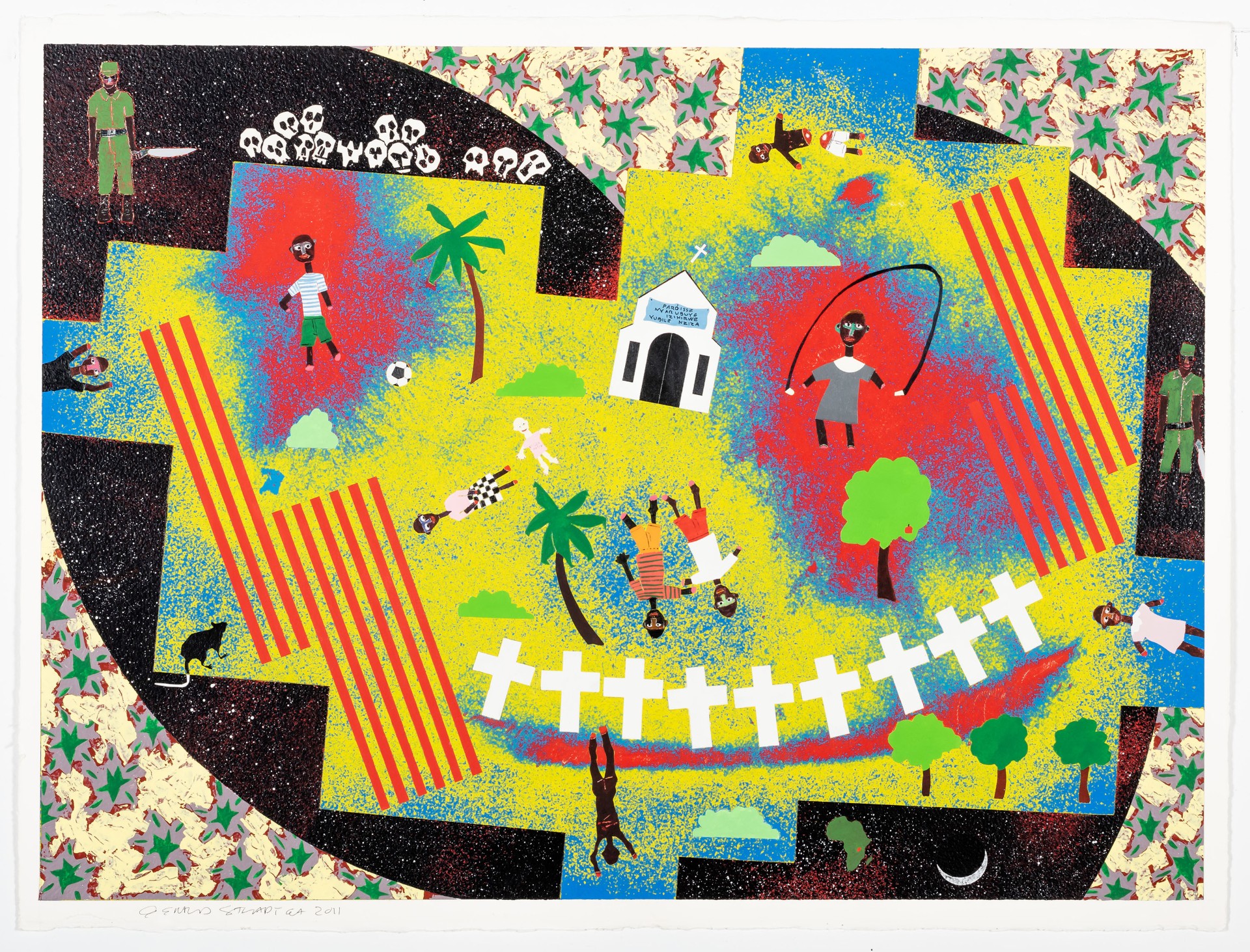
Gerald Saladyga (b. 1945). 100 Days In Eden, 2011. Latex paint, 76.2 x 55.88 cm (30 x 22 in.). Gift of Gerald Saladyga and Daniel Pardy, 2025. Courtesy image





The Art Museum at the University of Saint Joseph will exhibit ‘100 Days in Eden’ beginning Sept. 24, 2026.
Submitted
In fall 2026, the Art Museum at University of Saint Joseph will present 100 Days in Eden: Gerald Saladyga’s Rwanda Series, a suite of 34 works on paper created in 2011 and 2012. The exhibition opens with a reception on Thursday, Sept. 24 from 5-7:30 p.m. and continues through Dec. 12.
100 Days in Eden offers viewers an opportunity to reflect upon the roots of genocidal violence and contemplate the necessary conditions for conflict resolution, reconciliation, and peace. The series was Saladyga’s response to the 1994 genocide in Rwanda in which Hutu government forces, militias, and civilians massacred more than 800,000 Tutsi and moderate Hutus over the course of 100 days. Thoughts of the genocide conjured Saladyga’s own lifelong terror of being trapped in a sudden violent confrontation in which he realizes his death is imminent. His attempts to come to terms with the events in Rwanda led to his creation of a series of 34 works.
The challenges he confronted were how to create works that “pulled viewers into paintings depicting horrific violence rather than repelling them” and “how to imply an unknowable and deep sorrow, which I have never experienced – and then, perhaps, a sudden hope of redemption.”
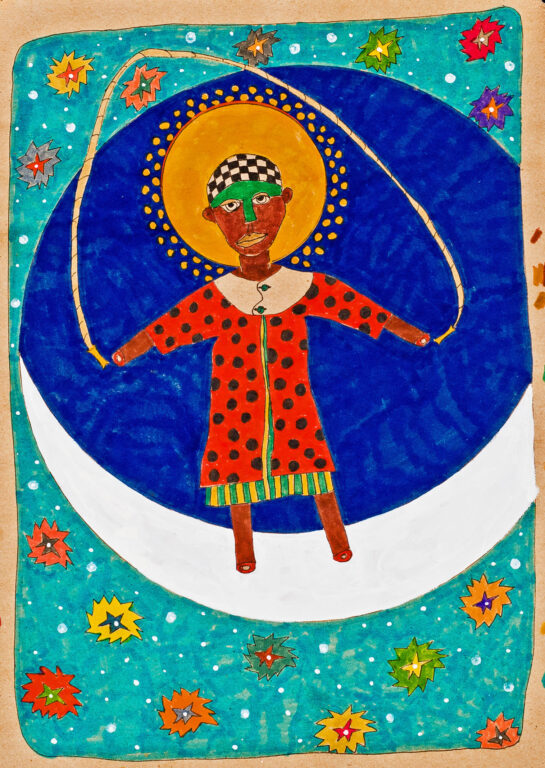
Gerald Saladyga (b. 1945). Jump Rope, 2011. Ink and marker on brown wrapping paper, 34.29 x 25.4 cm (13 1/2 x 10 in.). Gift of Gerald Saladyga and Daniel Pardy, 2025. Courtesy image
The series’ title, 100 Days in Eden, not only references the natural beauty of Rwanda, but also links the Biblical Garden of Eden to Africa, the birthplace of human life. It asks us to consider our common origin and shared humanity, the very things that are denied by genocides.
An award-winning artist based in Connecticut, Gerald Saladyga studied at the Art Students’ League in New York. He has shown his work extensively in Connecticut, Massachusetts and New York City and has received grants from the Connecticut Commission on Culture and Tourism and the Commission on Arts and Culture as well as a grant from the Weir Farm Trust Visiting Artist Program.
The current exhibition, drawn from a recent gift to the Museum, also includes the single work from the series that is in a private collection. It is supported in part by the Karen L. Chase ‘97 Fund.
Like what you see here? Click here to subscribe to We-Ha’s newsletter so you’ll always be in the know about what’s happening in West Hartford! Click the blue button below to become a supporter of We-Ha.com and our efforts to continue producing quality journalism.