
State Awards Brownfield Grant for Former UConn West Hartford, 15 Other Properties

Audio By Carbonatix
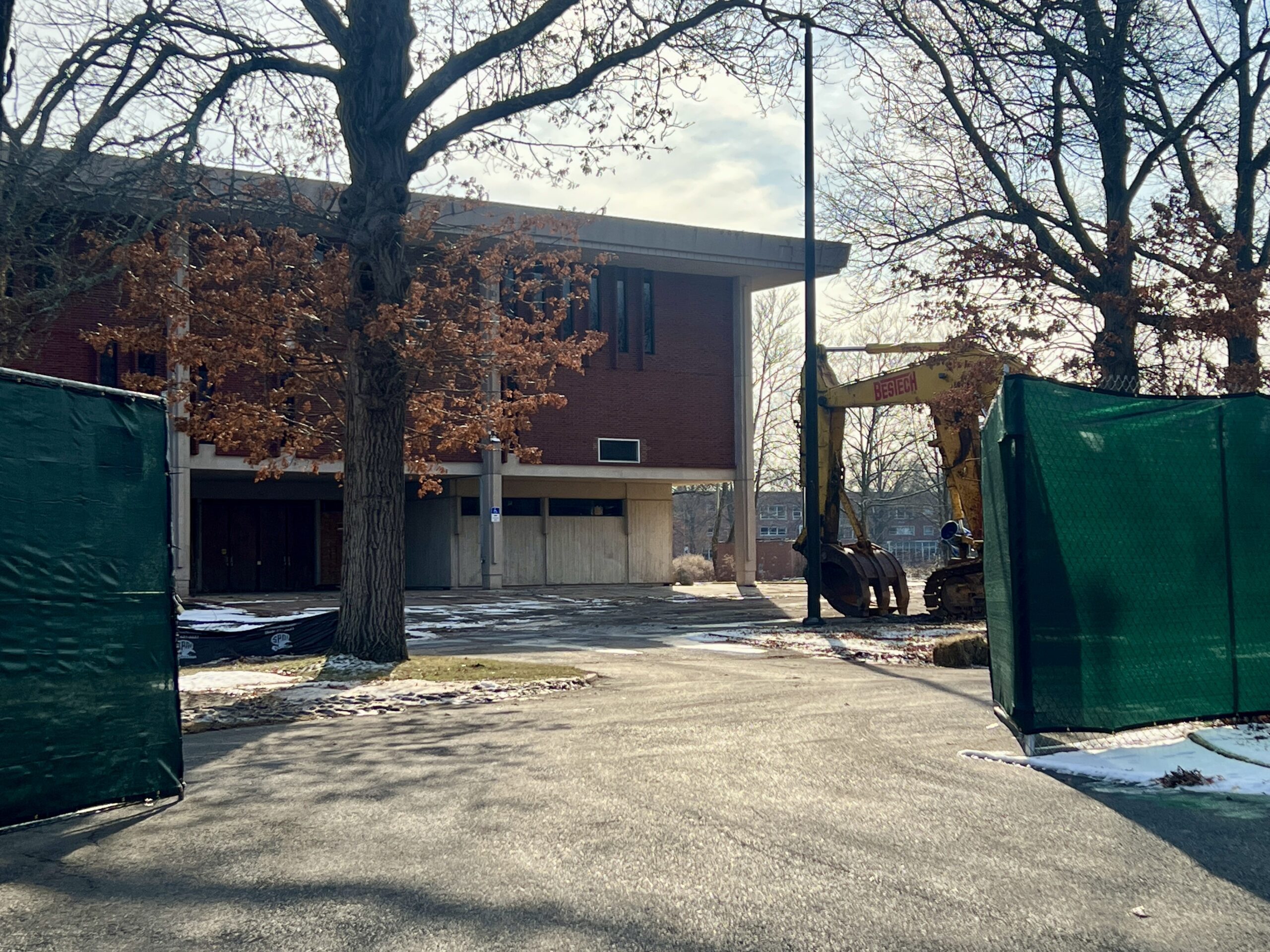
Demolition of the remaining buildings on the former UConn campus will begin shortly, and remediation should take 6-9 months. Photo credit: Ronni Newton





Gov. Ned Lamont, Lt. Gov. Susan Bysiewicz, and other officials unveiled the awards at a press conference at the University of Saint Joseph in West Hartford on Wednesday morning.

Lt. Gov. Susan Bysiewicz speaks at a press conference about the awarding of brownfield remediation grants at the University of Saint Joseph in West Hartford. Dec. 17, 2025. Photo credit: Ronni Newton
By Ronni Newton
The remediation of the former University of Connecticut West Hartford campus – a required first step prior to the development of Heritage Park – is set to move forward with support from the State of Connecticut announced Wednesday as part of the latest round of grants in the Connecticut Department of Economic and Community Development’s (DECD) Brownfield Remediation and Development Program.
West Hartford applied in September and received a grant of $6 million through the program – the largest grant given thus far – and is one of 16 blighted properties in 13 municipalities to share in a total of $28.2 million in grant funds in the latest round.
“This is a big day. We have been working on this property for 10 years,” West Hartford Mayor Shari Cantor said Wednesday, expressing her thanks to the state, the governor and lieutenant governor, and DECD for recognizing how a program like the Brownfield Remediation and Development Program can revitalize communities throughout the state, particularly now that larger grants are being awarded.

Mayor Shari Cantor speaks at a press conference about the awarding of brownfield remediation grants at the University of Saint Joseph in West Hartford. Dec. 17, 2025. Photo credit: Ronni Newton
“We are grateful,” said Cantor. The former UConn campus totals more than 57 acres, and the portion that needs environmental remediation – 1800 Asylum, on the west side of Trout Brook Drive – is roughly 33.5 acres. “This was state-owned property. It was contaminated during that time period, when the state owned it,” she said. The contamination includes polychlorinated biphenyls (PCBs) and asbestos, commonly used in construction during the time period when most of the campus was built. Studies of the property have indicated that PCBs have also leached into the soil.
“This contamination has been a real barrier to development of this property,” said Cantor. “The neighbors have really been staring at a very derelict property that has really deteriorated year after year. … None of the neighbors around here deserve this.”
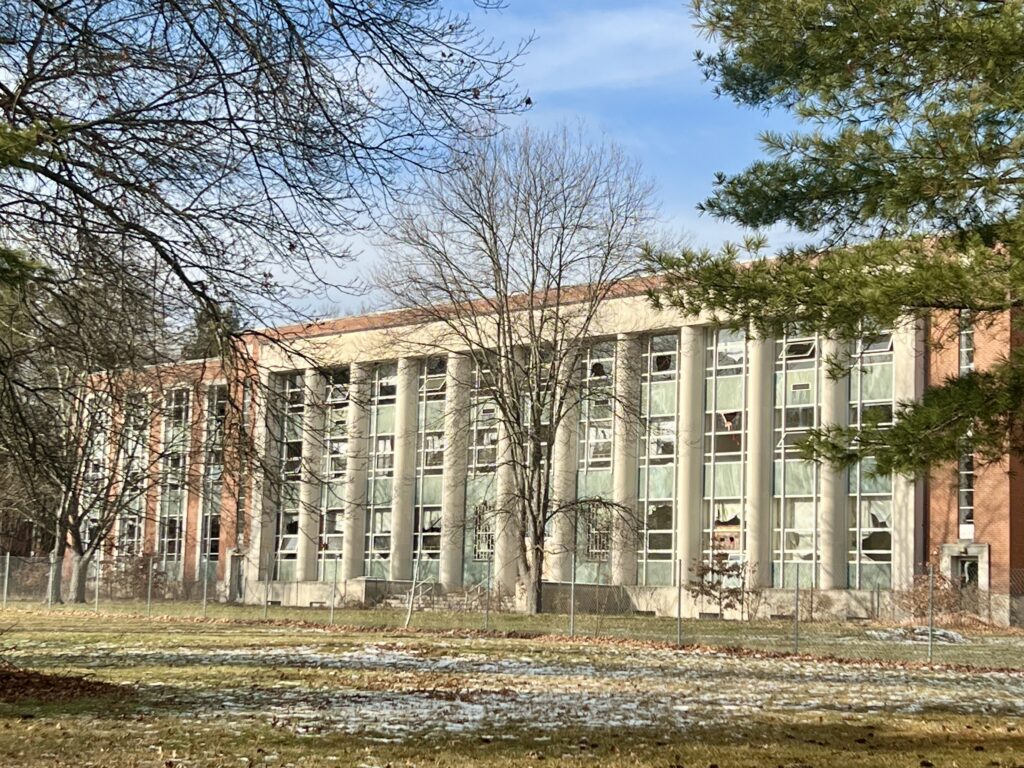
Demolition of the remaining buildings on the former UConn campus will begin shortly, and remediation should take 6-9 months. Photo credit: Ronni Newton
In February 2025 the Town Council approved the plans by West Hartford 1 LLC for creation of a Special Development District and redevelopment of the 33.5-acre western portion of the former campus for commercial and residential use as Heritage Park.
The developer has “true vision,” Cantor said Wednesday, and will transform the decayed, dormant property into a “mixed-use village, anchored by housing, retail, and community amenities,” creating hundreds of jobs, homes, and adding to the tax base. The developer will extend the Trout Brook Trail to the north end of town where it will ultimately connect to the East Coast Greenway.
Included in the plan for Heritage Park are 93 one- and two-bedroom residential rental apartments, including 24 that will be deed-restricted as affordable housing for those earning 80% or less of the Area Median Income (AMI). When the project is completed, West Hartford will have a total of 10.1% of its housing designated as affordable – an increase of 2.5% over the past several years, which Cantor said is unique in the state.
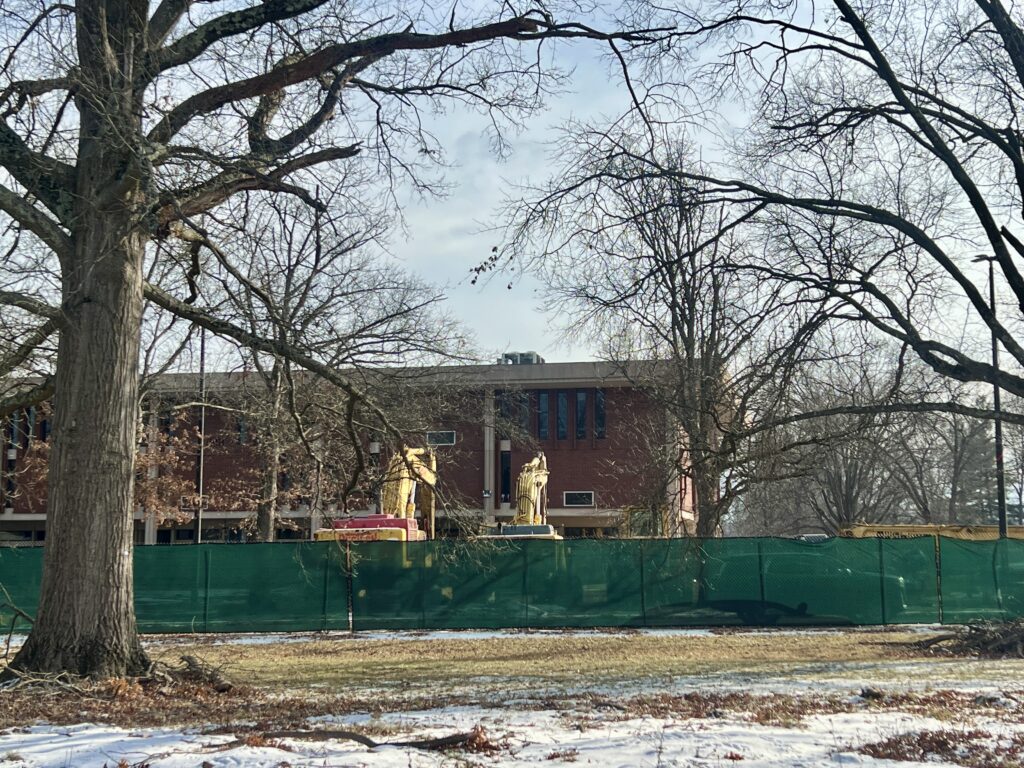
Demolition of the remaining buildings on the former UConn campus will begin shortly, and remediation should take 6-9 months. Photo credit: Ronni Newton
“The legislature and the governor listened to us,” she said, when the town asked for more help to revitalize the property, and she thanked the governor and legislature for increasing the amount of grant award available. “The partnership with the state and this particular property is really transformational, and I am really so grateful. Remediating contamination unlocks incredible potential, delivers affordable housing, and home opportunities.”
“West Hartford has waited a long time for the old UConn campus to re-emerge in a way that enhances the surrounding neighborhood and this town,” Domenic Carpionato, developer of Heritage Park, said in statement. “Today’s Brownfields grant will help us bring our walkable neighborhood village to life. We thank the governor and Mayor Cantor for their partnership.”
The plans for Heritage Park also include a total of 28 townhomes available for purchase, six of which are duplex townhomes along both Lawler Road and Asylum Avenue, 87 units of assisted living, a 26,488-square-foot organic grocery store, and commercial space for restaurants, retail, and a spa.
Lt. Gov. Susan Bysiewicz congratulated the Town of West Hartford and Cantor for “leadership in showing our cities and towns across the state what it means to focus on bringing in more affordable housing,” and on the successful use of brownfield grants.
The grant announced Wednesday is the sixth grant West Hartford has received through the Brownfield Municipal Grant Program over the past three years – most recently for The Jayden and Playhouse on Park.
Through the program, the grant monies are applied for by towns or other municipal authorities to support returning blighted or contaminated properties to productive use, and implemented through a public-private partnership with the property owner/developer.
“This is an incredible opportunity and an incredible program,” Bysiewicz said of the Brownfield Remediation and Development Program, a win-win on so many levels, she said – for developers, for the state, and for the public which will gain amenities such as expansion of walking trails.

Lt. Gov. Susan Bysiewicz speaks at a press conference about the awarding of brownfield remediation grants at the University of Saint Joseph in West Hartford. Dec. 17, 2025. Photo credit: Ronni Newton
“Because our administration has made this signature program for helping to promote affordable housing, she said, there will be 835 new units of housing created, 157 of which will be affordable. “It’s going to take 200 acres of land that was just sitting there, unused, back into good use,” and will encourage private investment that wouldn’t otherwise happen due to the environmental remediation burden.
The brownfield program, which is needed by towns large and small, “dovetails incredibly well with the new housing bill that has been passed,” she said. “We have said in that bill, ‘Communities, take a look. See what derelict properties there are out there and build housing,’” said Bysiewicz.
Connecticut has many older structures – mills, shopping centers, manufacturing facilities – and the brownfield grants are important for the remediation and redevelopment of those properties, Gov. Ned Lamont said.

Gov. Ned Lamont speaks at a press conference about the awarding of brownfield remediation grants at the University of Saint Joseph in West Hartford. Dec. 17, 2025. Photo credit: Ronni Newton
“By cleaning up blighted and vacant properties, we can put this land back into productive use in smart ways that support the growth of businesses and new jobs, and also to build new housing, which is significantly needed,” said Lamont. “Through the remediation of these properties, we are creating new opportunities to revitalize neighborhoods and transform otherwise unusable lots into new spaces where businesses can thrive and residents can live.”
DECD Deputy Commissioner Matt Pugliese said that more than $354 million in private investment will be leveraged through the program. Under the program, the state also awarded grants for assessment of brownfields and for feasibility studies to determine the scope of contamination. The grants impact urban, suburban, and rural communities, and “are not just about cleaning up land,” he said. “They’re about unlocking opportunities, revitalizing neighborhoods, creating new housing, jobs, commercial, and public spaces.”
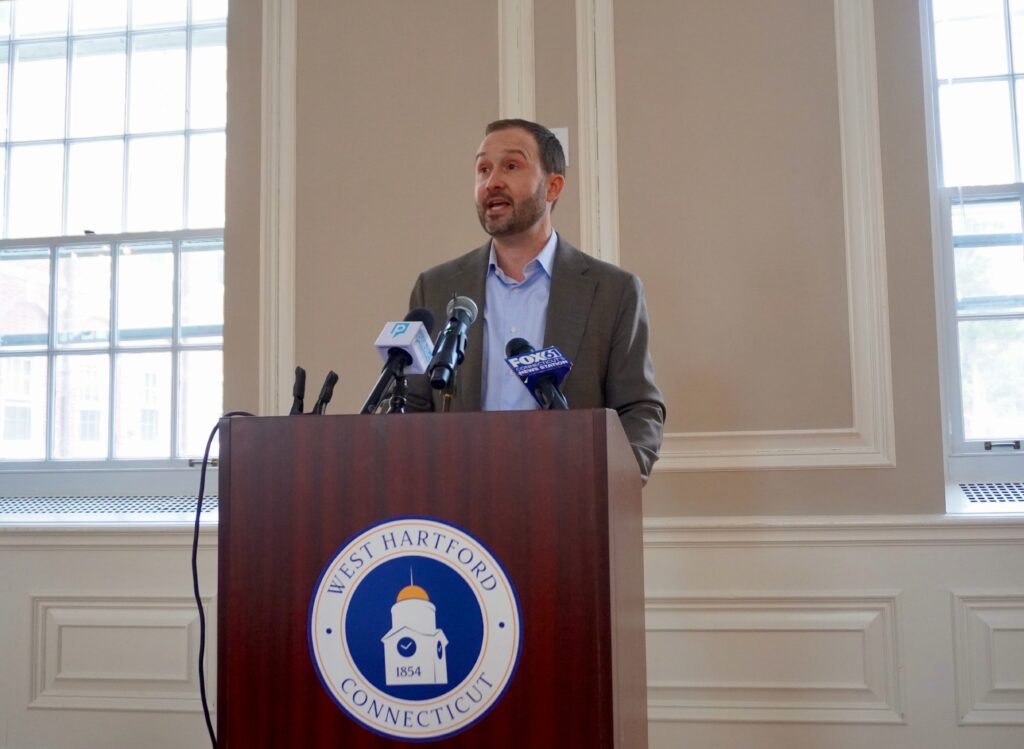
DECD Deputy Director Matt Pugliese speaks at a press conference about the awarding of brownfield remediation grants at the University of Saint Joseph in West Hartford. Dec. 17, 2025. Photo credit: Ronni Newton
Other large brownfield remediation grants announced Wednesday include $3 million for Bridgeport, $4 million for Enfield, two $4 million grants for Greenwich, and $4 million for Shelton.
Ashford First Selectman Cathryn Silver-Smith and Willington First Selectman Mike Makuch thanked the state on Wednesday for the $200,000 granted to their towns “for environmental assessment, market analysis, and other planning activities at the Cadlerock property, a 338.55-acre, 12-parcel area straddling the town lines. These activities will help identify future reuse options and development path for the property,” according to the state.
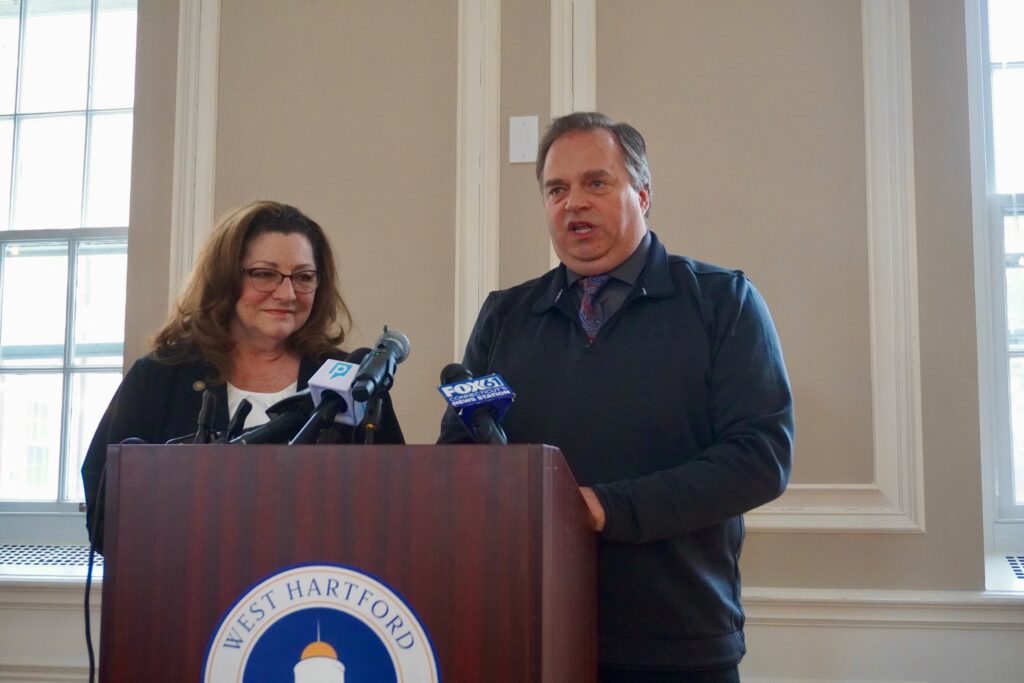
Ashford First Selectman Cathryn Silver-Smith and Willington First Selectman Mike Makuch speak at a press conference about the awarding of brownfield remediation grants at the University of Saint Joseph in West Hartford. Dec. 17, 2025. Photo credit: Ronni Newton
Northeastern Connecticut Council of Governments Executive Director Jim Rivers also praised the impact of the Brownfield Remediation and Development Program on properties throughout the state, including the assessments grants which “really starts that process to give more certainty to developers to bring forward that investment that you want from the private sector.” NECOG received two grants, including $150,000 for the assessment of the 0.92-acre site of the Old Killingly High School to enable the town to remediate the site for potential use for housing, childcare, or vocational services; and $50,000 for the assessment of the 1.2-acre site of the Former Chaplin Post Office to enable the town to remediate the site for potential commercial use.
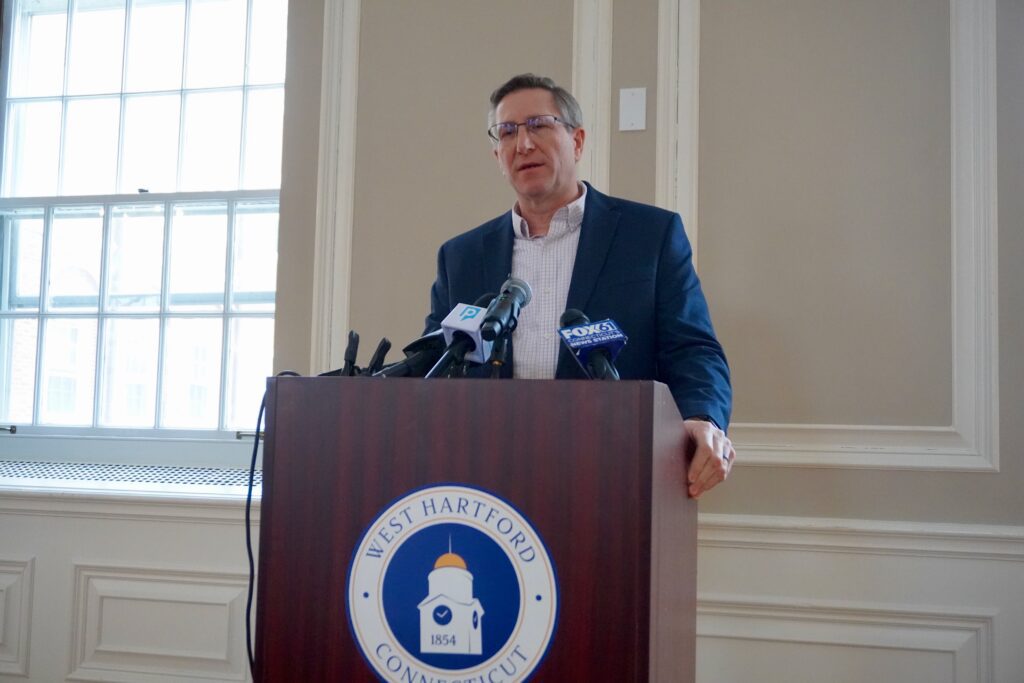
NECOG Executive Director Jim Rivers speaks at a press conference about the awarding of brownfield remediation grants at the University of Saint Joseph in West Hartford. Dec. 17, 2025. Photo credit: Ronni Newton
It’s been nearly four years since West Hartford 1 LLC finalized the purchase of the former UConn campus property, on an “as is” basis, from then-owner Ideanomics, for $2.75 million, on Dec. 29, 2021. WeHa Development Group’s plans for 1800 Asylum – an investment of several hundred million dollars – call for demolition of the remaining buildings that were part of the former UConn campus and environmental remediation of polychlorinated biphenyls (PCBs) and asbestos, followed by construction of 11 new buildings of one to four stories.
Demolition of the remaining UConn campus buildings should be getting underway shortly, and will take six to nine months, Cantor said, and development of Heritage Park will follow.
Plans for the roughly 23-8-acre eastern portion of the former campus were approved in April 2024 – with 14.87 acres set to become the four-building, 322-unit Residences at Heritage Park, now owned and being developed by Garden Homes. The rest of the property on the east side of Trout Brook Drive is now owned by the Town of West Hartford, and will be remaining ballfields and a playground.
Construction is well underway on the Residences at Heritage Park.
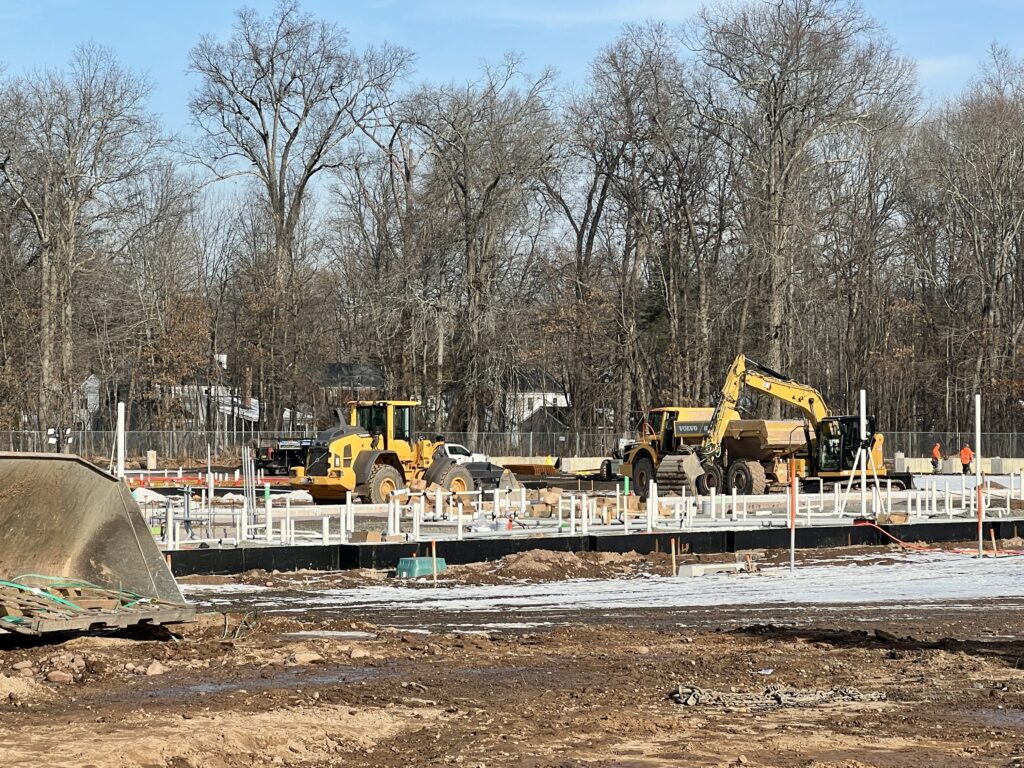
Progress on construction of The Residences at Heritage Park, 1360 Trout Brook Drive. Dec. 17, 2025. Photo credit: Ronni Newton
Like what you see here? Click here to subscribe to We-Ha’s newsletter so you’ll always be in the know about what’s happening in West Hartford! Click the blue button below to become a supporter of We-Ha.com and our efforts to continue producing quality journalism.




Concerning the large state grant that has been awarded to West Hartford for brownfields remediation at 1800 Asylum Avenue.
I haven’t thought about this property in a couple of years, after many people in the community devoted a huge amount of time to to try to get their concerns heard by the Town Council. The outcome was painful, but so was my new understanding of the Town Council’s discrepant behavior towards well-heeled developers, in contrast to town residents.
But I ask you: A large developer was given the 1800 Asylum Ave. project largely because of a promise to take on the costs of mitigating existing contaminants. If they vowed to do the mitigation, why would West Hartford now apply for a large state brownfields grant? That is, if the private sector developers can take it on, as they said they could, why would West Hartford apply for state resources? There are plenty of urban brownfields in this state that that grant could have been given to. And it’s not like the state doesn’t need to continue to husband its money to help with health care and shelter for those who have been cut off federally.
Governor Lamont also spoke of housing for young families, in relation to this project. Really? Only 11% of the housing will be affordable housing at Heritage Park. West Hartford is turning into a high income town with high housing costs. I loved last week’s article about how the million-dollar condos in the Center are flying off the shelves, even before any building has commenced. At the very least, if the developers are being given the grant after they promised to do the remediation, the developers can now afford to make all the new units “affordable”. That would be a public good, in a town that is less and less affordable.