West Hartford Receives State Approval for Red Light Running Enforcement Cameras

Audio By Carbonatix
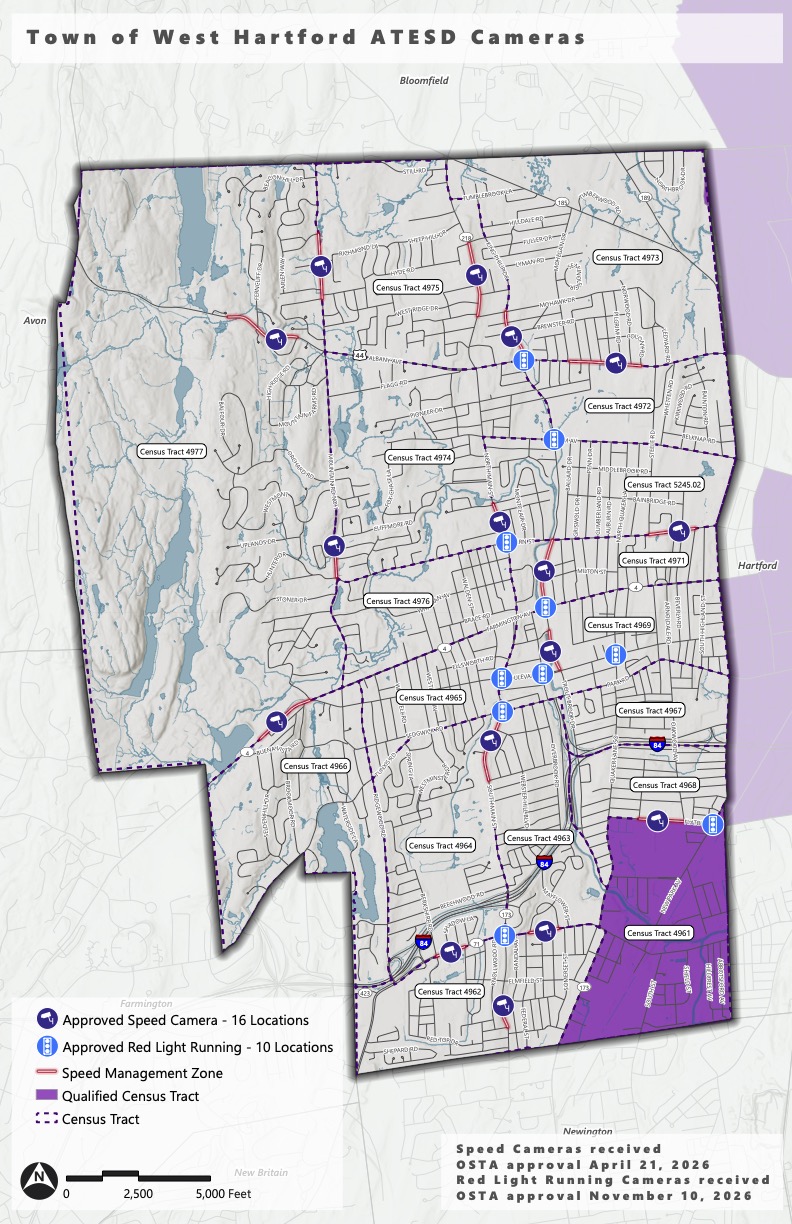
Approved locations for speed enforcement and red light running cameras in West Hartford. Courtesy of Town of West Hartford





Connecticut’s Office of the State Traffic Administration has approved an update to West Hartford’s Automated Traffic Enforcement Safety Device program to include 10 locations for Red Light Running cameras.
By Ronni Newton
The Town of West Hartford received approval from the Office of the State Traffic Administration (OSTA) last week for an amendment to its Automated Traffic Enforcement Safety Device (ATESD) program, which now includes the Red Light-Running Camera Program, following approval earlier this year for its submitted Speed Enforcement Camera Program.
OSTA, which is part of the Connecticut Department of Transportation, approved 10 of the town’s proposed red light camera locations, after approving speed cameras at 16 locations on April 21. Town Manager Rick Ledwith said the goal is to move ahead to have the enforcement cameras in place as soon as possible.
The town began the bid process with an RFP seeking a vendor to install and administer both the speed and red light enforcement cameras in June, and the contract is currently being finalized. “The vendor is ready to go,” Ledwith said, as soon as the contract is awarded and a few more approvals are granted. Implementation is expected to begin in the next few months.
“We are planning on moving forward with our speed and red light-running programs,” Ledwith said, noting that these tools are very different from automated license plate reader (ALPR) cameras, such as those owned and operated by Flock Safety, that have been the subject of well-publicized protests.
The approved locations for speed cameras are shown on the map featured above, which has also been attached below as a PDF. The 10 approved red light camera locations (each will include cameras in all four directions) in West Hartford are at the following intersections:
- Albany Avenue (Route 44) at Trout Brook Drive/King Philip Drive
- Asylum Avenue and Trout Brook Drive
- Farmington Avenue and Trout Brook Drive
- New Park Avenue and Flatbush Avenue
- North Main Street and Fern Street
- Raymond Road and Boulevard
- South Main Street and Boulevard
- South Main Street and New Britain Avenue
- South Main Street and Park Road/Sedgwick Road
- South Quaker Lane and Boulevard
Speed cameras will be installed at 15 of the 16 approved locations, and red light-running cameras will be installed at eight of the 10 approved locations, Ledwith said, and the final locations will be announced in advance. Below are the approved speed camera locations, which are also identified on the map.

Speed camera locations. Town of West Hartford website
As part of the process, the Town Council adopted an ordinance in April 2025 to permit ATESD cameras in West Hartford, and setting the framework for enforcement and fines.
CT.gov image (we-ha.com file photo)
Many of the parameters of the town’s automated traffic enforcement device ordinance are dictated by state statute – as part of House Bill 5917, legislation passed by the general assembly in 2023 – allowing the use of such devices in Connecticut. The selection of the locations for both types of cameras followed the process required by the state, including multiple public information sessions and hearings, and the submission of data indicating why certain locations were chosen.
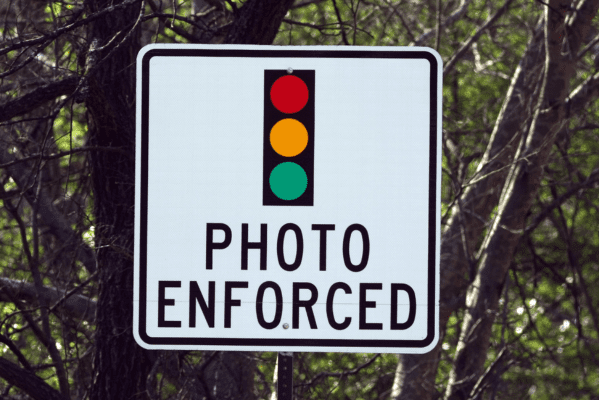
The town must inform the public in advance of the implementation of the ATESD cameras, which will likely take part in phases, Ledwith said. Signs will be posted informing drivers of the cameras, and services that provide GPS such as Google Maps and Waze must also be informed and will warn users of the camera locations.
The automated traffic enforcement program allows for a citation to be issued when a driver exceeds the posted speed by 10 or more miles per hour, or fails to stop for a steady red light. The cameras activate only when a violation occurs, but a human – either a sworn police officer or other official designee – must review the images prior to issuance of a citation.
“Our data is 100% ours,” Ledwith said of the images produced by the cameras. And not every license plate is captured, he stressed – only those of vehicles that violate the speed limit by at least 10 mph or run a red light.
Once the cameras are operational, there is a 30-day grace period after the program begins when violators will receive a warning. After that, first offenses will result in a $50 fine, and subsequent violations will be $75. The amount of the fines are set by the state, but unlike the fines associated with speeding tickets which other than a small percentage go directly to the state, the town keeps the money under this program. A $15 per citation processing fee is also permitted.
Both West Hartford’s Speed Management Camera Program and the Red-Light Running Camera Program are 18-month pilots, and both ATESD programs are funded through separate Safe Streets and Roads for All (SS4A) grants from the U.S. Department of Transportation. Because of the federal funds, West Hartford needs approval from the Federal Highway Administration (FHWA), which has been granted for the speed cameras and is in process for the red light cameras.
West Hartford had announced plans to implement an ATESD plan three years ago, and applied for and received a $669,007 federal Safe Streets and Roads for All (SS4A) grant in 2023 to support implementation of an 18-month pilot of the speed management program, as a component of its Vision Zero initiative, adopted in January 2023.
The town received a second SS4A grant in 2024 – a total of $3,178,100 for the “Vulnerable User Safety Program” – which includes funding for the red-light enforcement program pilot as well as many other Vision Zero Action Plan items.
Community Development Director Duane Martin said that he and engineer Parker Sorenson have attended meetings with officials in other towns that have already implemented their ATESD programs. While there is not hard data to report, they have been told anecdotally that the existence of the cameras has had an overall positive impact on safety, and “driver behavior has changed overall,” Martin said.
State law requires that funds from the fines – which are expected to be significant in the early stages of the program – be invested back into the community to support transportation safety and mobility improvements, infrastructure enhancements, or costs associated with the ATESD program.
Like what you see here? Click here to subscribe to We-Ha’s newsletter so you’ll always be in the know about what’s happening in West Hartford! Click the blue button below to become a supporter of We-Ha.com and our efforts to continue producing quality journalism.
 Loading...

 Reload document
 Open in new tab