
West Hartford Town Council Adopts Budget, Mill Rate to Increase 4.4%

Audio By Carbonatix
West Hartford Town Hall. Photo credit: Ronni Newton





The West Hartford Town Council voted 7-2 Monday night to adopt the FY27 budget, which has been amended from the Town Manager’s original proposal.
By Ronni Newton
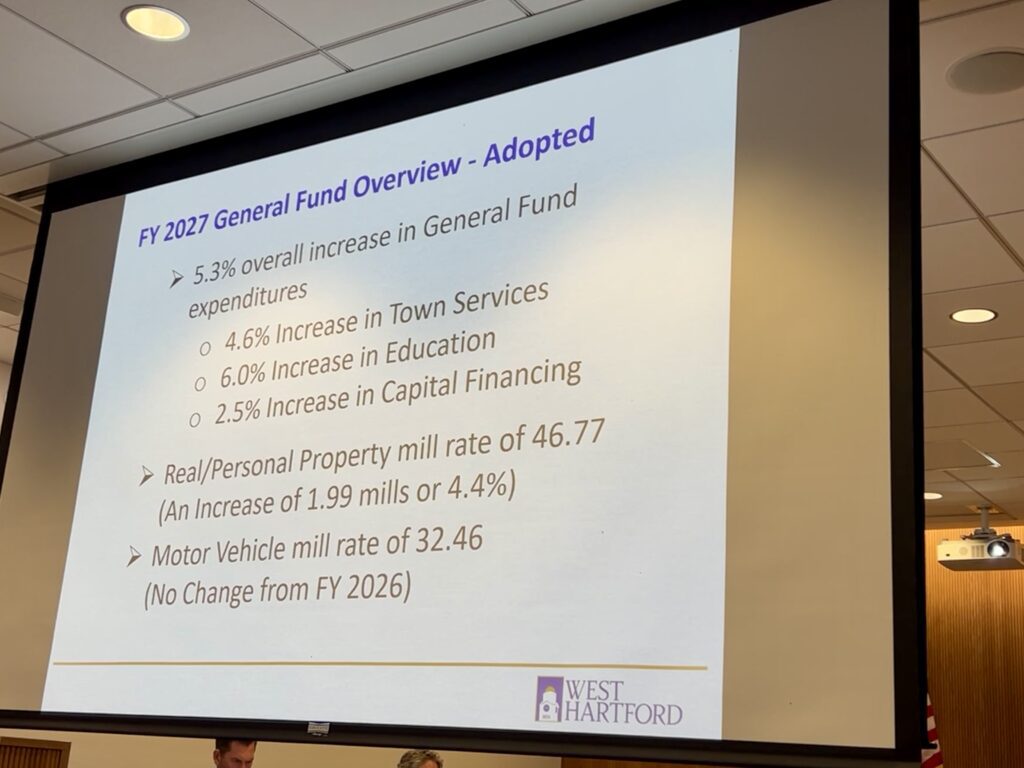
West Hartford’s FY27 budget has been modified from what was proposed by Town Manager Rick Ledwith on March 10, and the resulting $387,312,715 spending plan adopted by the Town Council in a 7-2 vote Monday night represents an increase of $19,580,649 (5.3%) over the current fiscal year’s budget.
All six Democrats – Mayor Shari Cantor, Deputy Mayor Deb Polun, and councilors Tiffani McGinnis, Lisa Lazarus, Ben Wenograd, and Barry Walters – voted in favor of the budget, along with Minority Leader John Lyons. Republicans Jason Wang and Gayle Harris cast the two “no” votes.
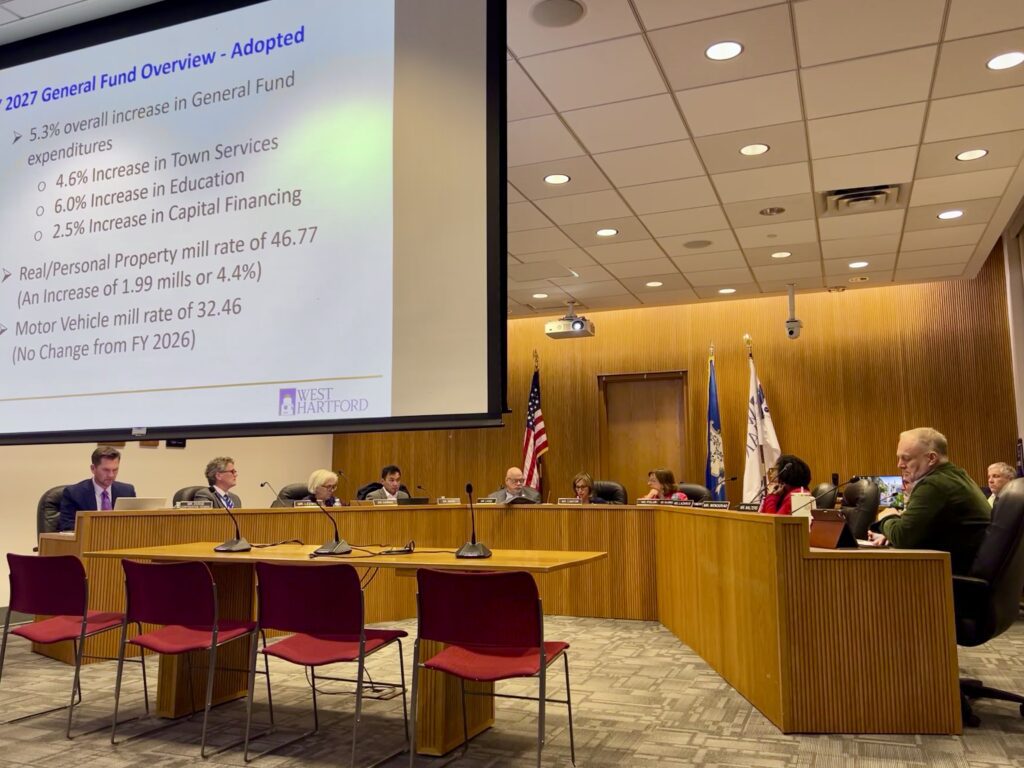
The mill rate will be 46.77 mills – an increase of 4.4% – for real and personal property for the upcoming 2026-2027 fiscal year, up 1.99 mills from the current 44.78 mills.
Ledwith’s original FY27 proposal had a mill rate of 47.69 mills for real and personal property. The motor vehicle mill rate, which is capped by the state, will remain 32.46 mills.
“Tonight as we know marks the culmination of several weeks of deliberate work,” Ledwith said. Working in partnership with the superintendent of schools, he said, “Together we put forward a proposal that sought to balance the critical services our residents rely on, the educational excellence our community expects, and the fiscal discipline required to maintain our long-term financial strength.”
During the past six weeks, there have been 12 public meetings – committee meetings, community conversations, and public hearings. “Our Council took a hard look at both the drivers behind this budget and the opportunities to reduce its impact. That work was not easy but it was necessary, and reflects the kind of transparent governance that our community deserves and expects.”
The original budget proposed a tax increase of 6.5%, and that has been trimmed to 4.4%, “while continuing to fund the essential services and investments that keep our community strong,” Ledwith said.
The original March 10 proposal would have increased spending by 6.6% overall, while the spending plan increase in the adopted budget is now 5.3%. Included is a 4.6% increase in town services (down from the proposed 4.8%), a 6% increase in education spending (down from 7%), and a 2.5% increase in capital financing (down from 16.4%).
The West Hartford Town Council adopted the FY27 budget on April 20, 2026. Photo credit: Ronni Newton
Modifications were made to both expected revenues and expenses.
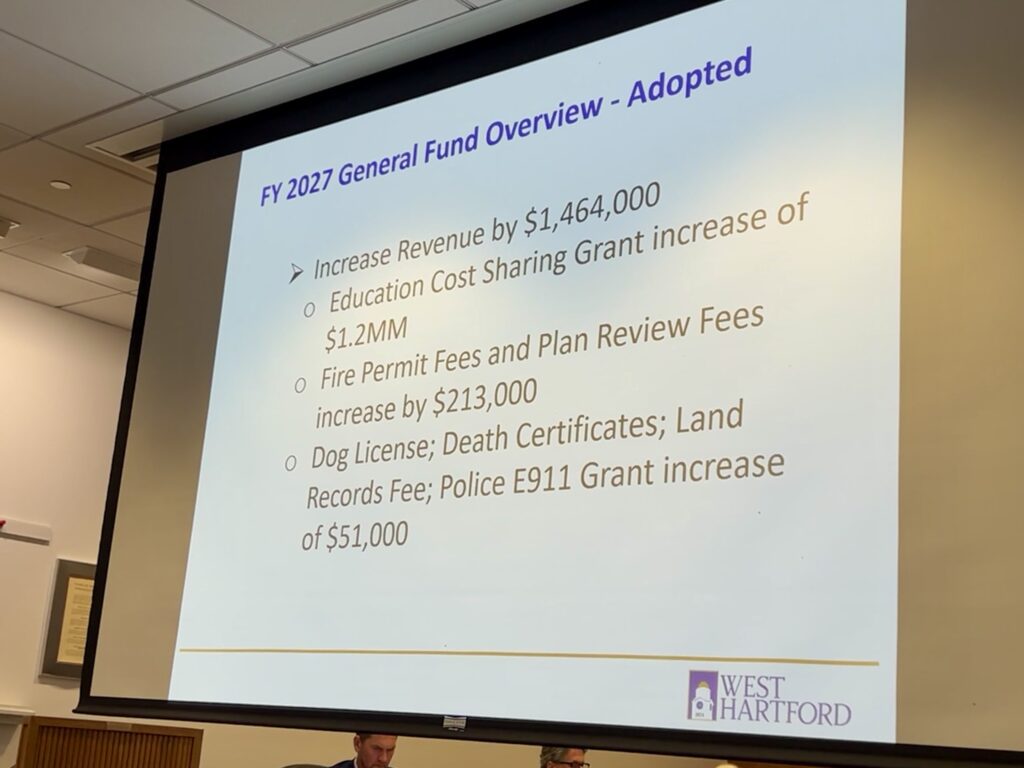
On the revenue side, the town is anticipating a $1.2 million increase in Education Cost Sharing grant funds from the state. Earlier on Monday, Ledwith said that he, Mayor Shari Cantor, and Deputy Mayor Deb Polun were at the capitol along with representatives of many other cities and towns of all sizes, advocating for the need for the state to adjust the base rate used in ECS funding – which has been unchanged since 2013 – which is “critical to maintaining the strength and stability” of public education. The town will continue to closely monitor developments in Hartford, and if the increase in ECS doesn’t come through, Ledwith said, “We are prepared to return to the Council to address any resulting gap.”
In addition, under the adopted budget, estimated revenue from fire permit review and plan review fees has been increased by $213,000, and revenues from other sources such as dog licenses, death certificates, and land records are expected to increase by $51,000.
The West Hartford Town Council adopted the FY27 budget on April 20, 2026. Photo credit: Ronni Newton
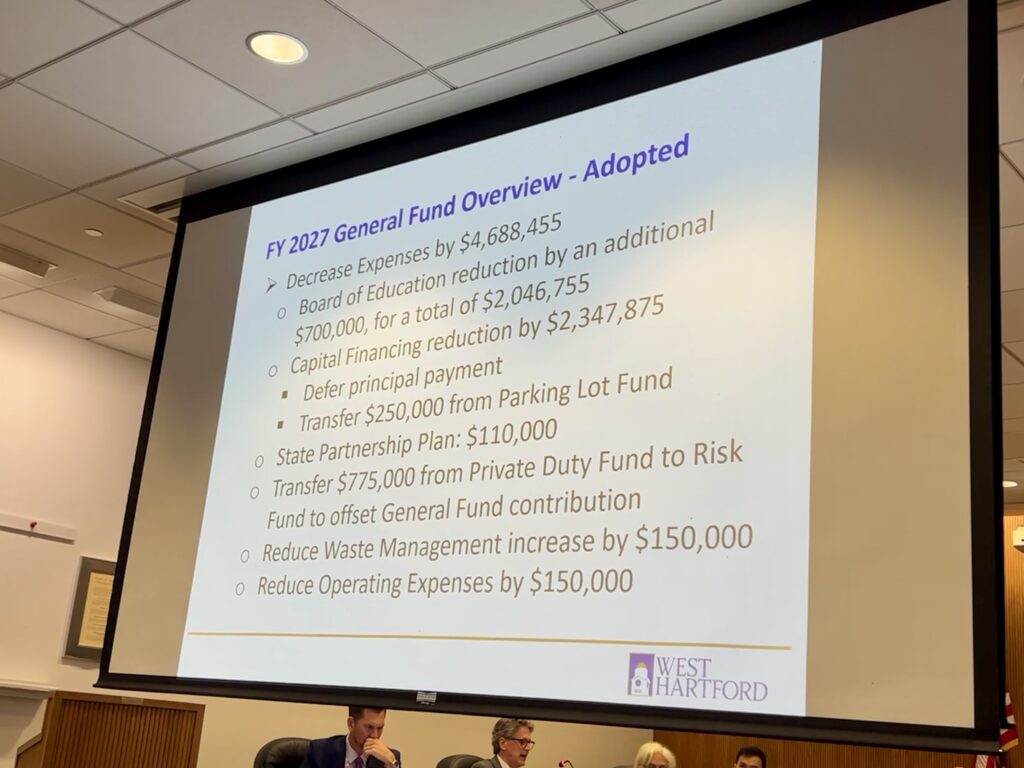
Expenses have been reduced by a total of $4,688,455 from the original proposal. While the Council is unable to make line item adjustments to the education budget, the total allocation has been reduced by $700,000 from what the Board of Education adopted on March 31. Combined with with the adjustments already made by the Board of Education, the school budget is being reduced by $2,046,755 from the original proposal.
Capital financing costs have been reduced by $2,347,875 in the adopted budget because the town is able to take advantage of a statute allowing deferral of principal payments. “It is important to know that this will not impact our commitment to maintenance of our infrastructure in important projects like our street resurfacing, elementary school air quality program, our fire training tower, and Veterans Rink improvements, among many others,” Ledwith said.
In addition, the town was able to transfer $250,000 from the Parking Lot Fund to the general fund, transfer $775,000 from the Private Duty Fund to risk-related costs for an offset to the general fund, and has incorporated savings of $110,000 in health insurance premiums to the State Partnership Plan. Waste management is out to bid, and costs have been reduced by $150,000 from the original estimate, Ledwith said. Operating expenses on the town side have been reduced by $150,000 overall as well.
The West Hartford Town Council adopted the FY27 budget on April 20, 2026. Photo credit: Ronni Newton
Before the roll call vote on resolutions for budget appropriations and the tax levy, each Council member shared their comments, and thanks to all who participated in the budget process.
“Preparing the town’s budget is one of the most important responsibilities we have as a Town Council,” said Polun, who also serves as chair of the Finance and Administration Committee, noting that the process is transparent and provides ample opportunity for residents to share their views.
The budget has been reviewed line-by-line, she said. “Crafting the budget is always about finding the right balance.”
The town regularly touts the recognition it receives and placement at the top of “best places to live” lists, and “these well-deserved accolades are the result of our town’s commitment to schools, our neighborhoods, our programs and services, our collaboration with businesses, and our residents,” Polun said. “We want to protect and grow what makes our town a great place to live, work, and visit,” and are also proud of the town’s 50-year AAA rating, and to maintain that there must be fiscal responsibility and long-term planning. “That is exactly how we faced this year’s budget … to ensure that today’s decisions do not compromise tomorrow’s flexibility,” she said.
The majority of the budget, she said, is about the people who make the community it is, and they must be properly compensated, but with “86% of the budget coming from property taxes, we are mindful that every dollar in this budget represents real contributions from our residents.”
Grand List growth, expected to continue, will spread the budget responsibility over more people, and the addition of speed cameras later this year will add a revenue stream – much of it likely to come from people passing through, said Polun. In addition, she is hopeful about additional revenue from the state through the hospitality tax and an increase in the ECS grant.
“We have aimed for responsible cuts that will allow for continued excellence in our schools and town. Although we do not have line item authority, we expect that our colleagues on the Board of Education will be able to achieve these savings without laying off teachers or increasing class sizes,” Polun said.
The budget adopted Monday night will increase taxes an average of $573 per family, said Polun. “We recognize that any increase is challenging. … This budget does not represent an easy answer but rather the result of careful deliberation and a sincere effort to find the right balance between supporting the programs and services that define our community and acknowledging the financial challenges that many of our residents face.”
Lyons said the 4.4% increase in the mill rate sounds like a lot, and while he ultimately decided to vote in favor of the budget, “coming to my decision on my vote was not easy.” He said he analyzed the overall budget in three parts: town, education, and state mandates and control of revenue streams.
“In my opinion, the town is managing their budget as well as they possibly can. While nothing is perfect, some of the lingering concerns I have with this part of the budget I am confident will be addressed in the coming months,” said Lyons. Those include the fee structure for parking and permit costs.
On the education side, “we want West Hartford schools to continue to be the beacon of learning” and remain top-ranked and offer excellent special education services. He is concerned, however, that “our ratio of teachers to non-teacher employees is lower than just about any town I can find,” including a higher number of administrators since the curriculum specialist role was converted to a higher-paid assistant principal position several years ago.
The town has the least amount of control over what happens at the state level. “I have been astounded learning about the number of underfunded and unfunded mandates that are demanded of the town by the state,” Lyons said, and many are related to the education budget. This includes the requirement to pay for nurses at the town’s private schools and special education funding not keeping up with inflation.
And on the revenue side, he noted that the town does not receive any of the 1% hospitality tax that is already being collected from our restaurants, and which could generate more than $3 million annually. “We get none. We collect special fees on cannabis sales and are extremely restricted on what those funds can be used for. We will be rolling out speed enforcement and other traffic management measures as part of the Vision Zero initiative and are limited on what those funds can be used for. Bottom line is none of these funds can be used for general fund purposes and lots of it is taken by the state and not invested back into our community or returned in any manner.”
Lyons said he made the decision to vote for the budget because it flattens the curve on tax increases and addresses Board of Education spending. He added that the town will address opportunities for additional fair revenue collection, the increase is in line with neighboring communities, and there is strong momentum to address the un- and under-funded state mandates.
“We have challenges, but we also have absolute gifts to our community. Our police and fire departments are the incredible with response times that are industry bests, our DPW also is the best in the industry and does lifesaving work often for many hours without a break. Our town staff takes time to offer all the services a community like our could need. West Hartford has incredible parks, Trout Brook Trail, ever increasing bike friendly neighborhoods, Vision Zero progress and a center dining experience that is the envy of New England. That is just scratching the surface,” Lyons said.
Wang said he panicked when the budget was first presented, and while the final proposal is more in line with peer towns, “it’s still a significant increase and we are still above inflation.” In deciding to vote against it, he said he’s concerned that some of the cuts are one-time transfers, and that structural problems like the staffing ratio of teachers to non-teachers, increases in software costs, and parking fees not covering costs have not been addressed.
“I think there is a lot more opportunity to save our taxpayers money,” said Wang. “I’m hopeful for the future. I think we’ve really had a meaningful conversation. … More savings and more revenues are coming and I think we have identified a lot of structural opportunities that can be addressed.”
Harris said that while “West Hartford is considered one of the most desirable places to live in the country … however, West Hartford is quickly becoming a place where the few are able to live and most people can’t afford to live here except for the very wealthy.” She said she has received many emails from people who are being priced out of town.
“Budgets require increasing revenue and decreasing costs,” said Harris. “I do believe that we could have tightened this budget more than we did,” she said, stating that she could not support it.
Wenograd chairs the Human and Community Services Committee – and the associated costs represent a small part of the overall budget, and are often funded by grants and fee revenues. He said, however, “these departments are a vital element of what makes this town so special.”
Leisure Services, Social Services, and the library “nurture and grow the social capital or personal interconnectedness that defines a true community” including providing much needed “third places,” he said. “With this budget we will continue to work on restoring the tree canopy along with other sustainability efforts, conduct a community-wide needs assessment as part of the AARP age-friendly community initiative, and increase the impact of Community Development Block Grant Investments through the Housing Rehabilitation Program, Food Pantry, and improvements in low and moderate income neighborhoods.”
Wenograd said the budget as a whole “is a reasonable increase that reflects a thoughtful analysis of our community’s needs and a fair effort to limit an additional strain on household finances.”
“There’s no other town like West Hartford. We offer an amazing quality of life,” including a sense of safety and vibrant neighborhoods, said Lazarus. She said the budget reflects our values, but “rising costs cannot simply be passed on to taxpayers.”
Lazarus said shifting money from one bucket to another is a tool to cut the budget, but called on the public to “get in the arena with us” and help advocate for what they think is important.
“You have heard my colleagues that this has been a difficult year,” Walters said, but not unlike last year. “Municipalities are reliant more than ever on property taxes.” He said it’s more important than ever to look for a more balanced and sustainable approach and additional revenue streams.
Walters suggested hiring a lobbyist which would have an upfront cost but potentially save millions. “We brag that West Hartford is for everyone. We must ensure it is and that we keep it that way.”
McGinnis, who chairs the Community Planning and Economic Development (CPED) Committee which covers the departments that have a major effect in how the town grows, said the budget reflects the town’s values and priorities: “commitment to safe neighborhoods, strong schools, and reliable services that make our community work for everyone.”
The system is flawed and limited, however, she said, and Connecticut is one of only 11 states that don’t allow cities or towns to collect any type of sales tax. “The state determines what revenue tools we are allowed to use. Year-after-year we’re forced into the same conversation.” She said we need the authority to relieve the pressure on the budget, and to be able to do so in ways that meet the community’s needs.
“West Hartford has managed its finances responsibly but we cannot continue addressing a structural problem with short-term solutions,” McGinnis said. “We need the state to be a partner. Give us the tools and we’ll do what we’ve always done which is deliver for residents and continue to make West Hartford a great place to live.”
Cantor shared her comments last, thanking her colleagues for their commitment to the budget process and the thoughtfulness they all brought to the table. “This really felt like a real, genuine Council-wide effort where everyone was participating, asking questions, real dialogue.” She also thanked Ledwith, the town’s directors, Town Clerk Leon Davidoff, the finance team, Superintendent of Schools Paul Vicinus, and the Board of Education for their serious and hard work on the budget – and thanked the residents who spoke at hearings and asked questions. “We are listening, and your engagement is what makes this process worthy of the community that it serves.”
Budget increases are difficult, Cantor said. “Unless we’re decreasing taxes, I think we’re never happy where we are.” Decisions need to be made about investing in the community we want, “and also being honest about the real cost that places on people who live and work here. This has taken rigorous deliberation and meaningful adjustments, and as you all know we’re at a 4.4% tax increase, which is high. And it is too high.”
Cantor said property taxes, “are not designed to carry the full weight of municipal government … and yet in Connecticut they carry nearly all of it.” And in West Hartford, much of the tax base is residential as opposed to other towns, including Farmington and Windsor, that have a bigger commercial base.
In addition, Connecticut education spending is in the top 10% nationally, and the schools are ranked in the top 10%, “but the state itself funds the bottom 10% in the country.” The ECS formula base has used a per pupil cost of $11,525 since 2013, she said. “Adjusted for inflation, this should be $16,424. “That gap didn’t disappear. It’s landed on local taxpayers. Special education reimbursements also cover about 67% of our excess costs.” Plus revenues are restricted, she said, so the town really has just one lever – the mill rate – to fund what’s needed.
While she applauded Gov. Ned Lamont signing an executive order establishing a blue ribbon panel on K-12 education funding, “communities cannot wait for a commission to conclude. We’re urging the governor and the legislative leaders to direct significant funding from the proposed $500 million affordability fund to local school districts now.”
She also mentioned the 1% hospitality tax that was imposed in 2019, which generated much more than expected – close to $100 million statewide – in the first year, but was swept into state funds that year in exchange for not passing teacher pension costs to the towns, which would have been roughly $8 million at the time. Now the 1% tax generates about $120 million, and the state is in better financial shape, “so we are really urging that the 1% tax go back to the communities” as some means of revenue diversification. The full share would now generate $3.3 million to West Hartford, but there is also a suggestion for half of that to go to the underfunded state tourism budget.
“At a time when we’re making really, really hard, and frankly impossible budget decisions to fund our schools, public safety, and the burden that we’re imposing on our taxpayers … this directly impacts housing affordability,” Cantor said. “So we think this unfairness really does need to change. It needs to go back to the towns where it was originated, where we are spending infrastructure, parking structures, public safety, public works to clean our streets – all of those things that we invest in, in this very vibrant community.”
The budget is not just line items, she said, noting that “public safety is the foundation of everything we do” and the bedrock on which the community’s strength is built. “Our schools are the heart of this community,” she added, and integral factors in the town’s top ratings.
“None of this is by chance … It is not a coincidence. It is the direct result of sustained, deliberate investments in our schools, our neighborhoods, our services, our people, and that’s exactly what is at stake,” Cantor said.
In the coming year there will be a comprehensive review of town fees and contracts, which is done every year, but after the infrastructure construction is done there will be an additional review of parking rates and violations “to ensure they reflect actual costs, remain competitive and comparable to other communities. This is responsible governance. Fees should cover what they cost to administer.” The use of revenues from speed cameras, and eventually red light running cameras and school bus cameras, are subject to tight parameters set by the state, but the town will be investing where it can.
Cantor noted that next year is a revaluation year, and because home values are up 30-40%, the mill rate will come down and costs may shift. She said that luckily, in West Hartford commercial values have risen as well, and the Grand List will increase due to new development.
“The tax burden will only be helped by revenue increase in real revenue, and controlling our costs,” Cantor said, and by “having a partnership with the state to fund costs that are mandated and imposed, and also be a partner in the affordability of our state.”
West Hartford is well-positioned, Cantor said. “West Hartford has made excellence its habit. Tonight, as we make these really hard choices, we recommit to it by not doing less, but by doing more with what we have, and by demanding that our partners at the state level meet us where we are.”
Like what you see here? Click here to subscribe to We-Ha’s newsletter so you’ll always be in the know about what’s happening in West Hartford! Click the blue button below to become a supporter of We-Ha.com and our efforts to continue producing quality journalism.



We need new leadership!
West Hartford is now unaffordable. The property taxes are beyond outrageous combined with the price of electricity, etc. CT has the highest tax rates in the country. #3 behind NJ and Illinois !
We need change!