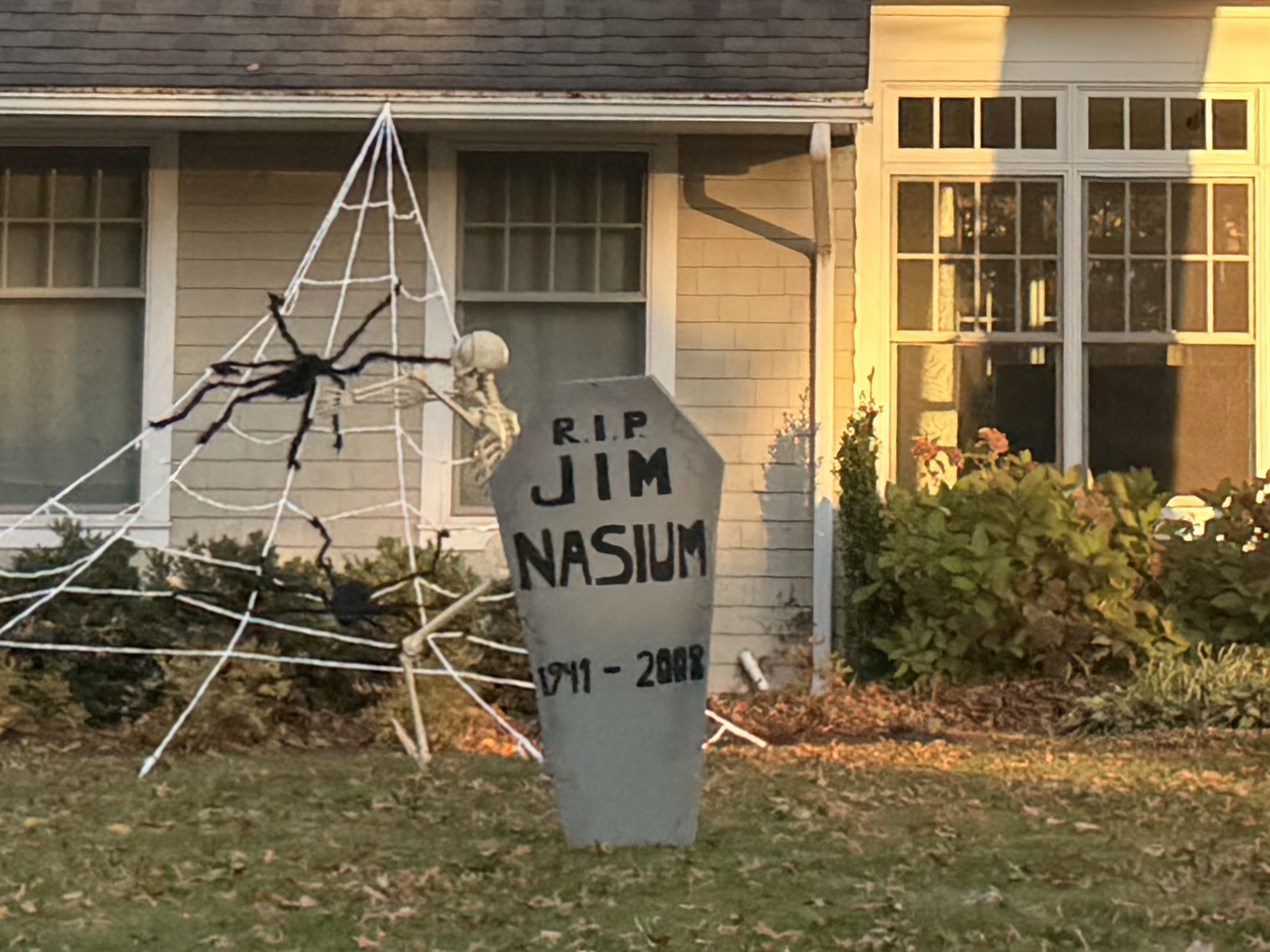
While Awaiting Action in Courts, West Hartford Town Council to Consider Temporary Licensing of Short-Term Rentals

Audio By Carbonatix
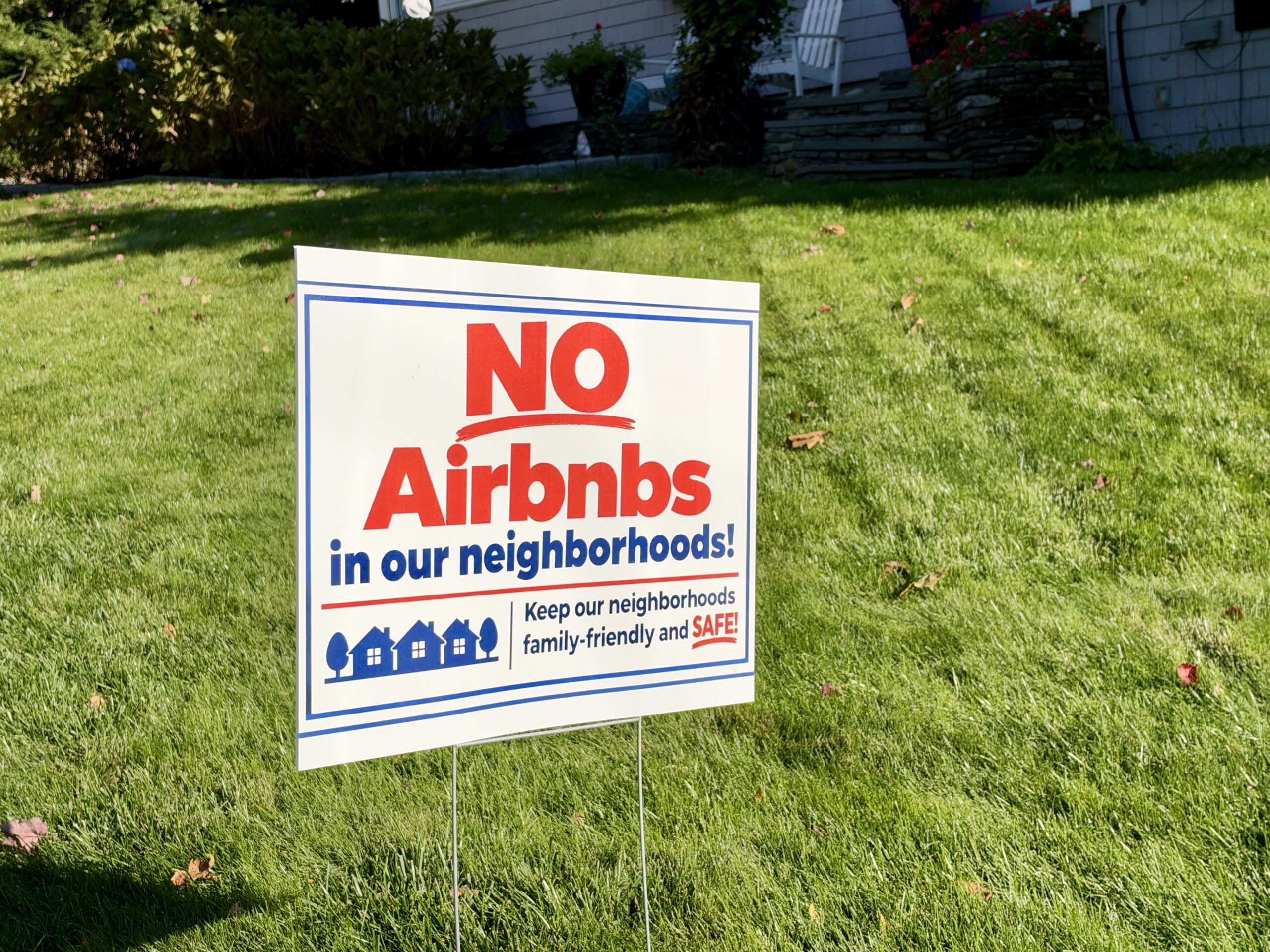
Signs against Airbnbs are posted along Pheasant Hill Drive. Photo credit: Ronni Newton





The Town of West Hartford is looking to issue ‘Unauthorized Short-Term Rental Property’ licenses to owners of properties currently being used as short-term rentals.
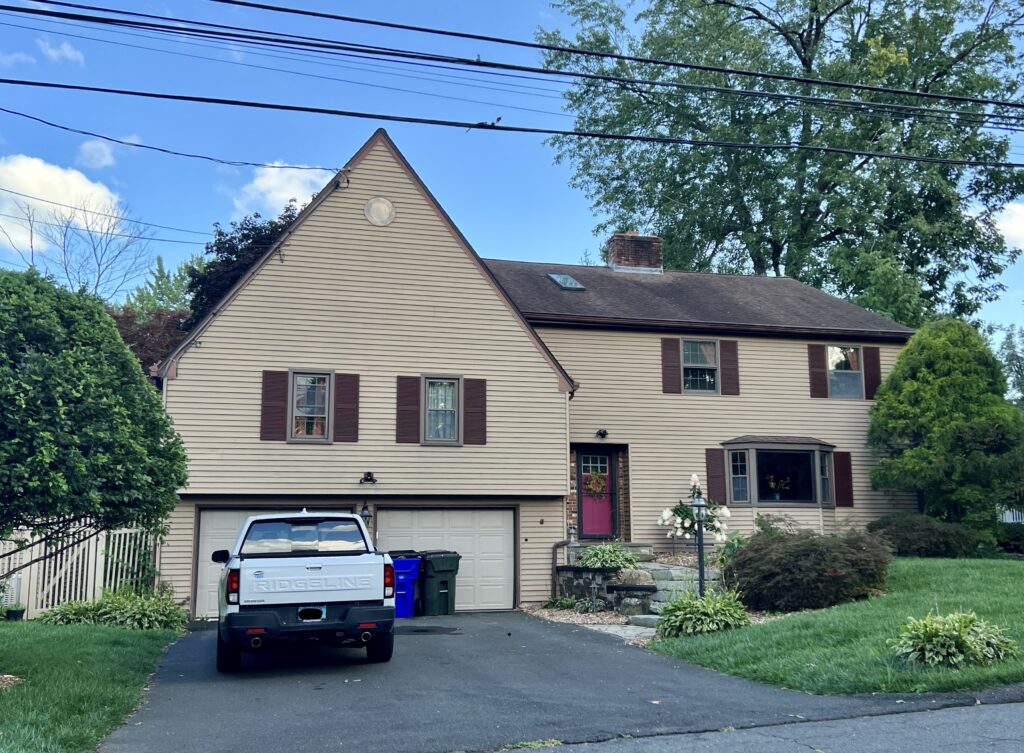
39 Pheasant Hill Drive is listed on Airbnb. Photo credit: Ronni Newton (we-ha.com file photo)
By Ronni Newton
The West Hartford Town Council’s Community Planning and Economic Development Committee (CPED) reviewed the draft of a unique zoning ordinance at its Wednesday morning virtual meeting. Although the town firmly maintains that short-term rentals are unauthorized under current zoning, the proposed ordinance would create a process for licensing short-term rentals as a stopgap measure while litigation of two separate cases is pending.
“The Town of West Hartford remains confident that its zoning regulations prohibit short-term rentals in residential neighborhoods and will continue to defend that position in court,” Corporation Counsel Dallas Dodge said in a statement to We-Ha.com following the CPED meeing, which also included an executive session to “discuss strategy and negotiations” regarding the two pending legal cases – Instant Property Solutions, LLC v. Town of West Hartford Zoning Board of Appeals, pending before the Connecticut Appellate Court; and Rolak, LLC, et al. v. Town of West Hartford Zoning Board of Appeals, pending before the Connecticut Superior Court.
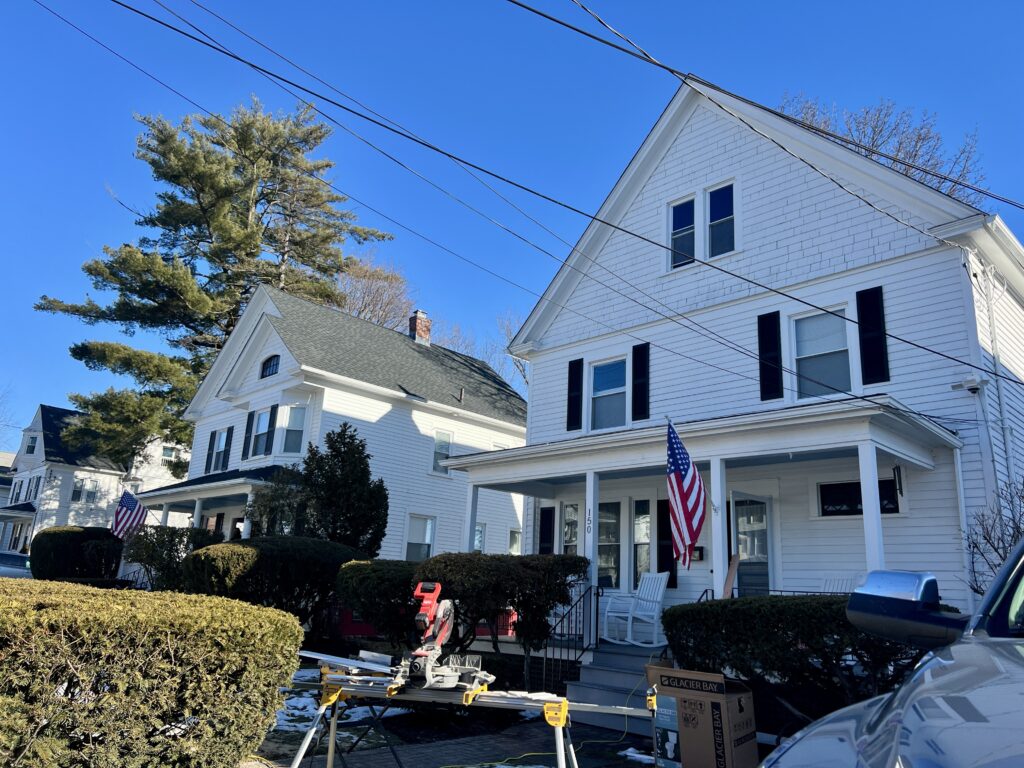
Mark Chu, a Farmington resident and principal of Instant Property Solutions LLC, owns a group of homes located from 136-154 Raymond Road which are being used as short-term rentals. Photo credit: Ronni Newton (we-ha.com file photo)
“While the litigation plays out, the proposed ordinance establishes a temporary licensing process to protect public safety and neighborhood quality of life,” Dodge said.
The proposed ordinance would apply to any properties that are already in use as short-term rentals (defined as for less than 30 days) – and require the owners to submit proof that the property was offered or used as a short-term rental before the ordinance takes effect.
The proposed ordinance will be introduced to the entire Town Council at its next meeting, on Nov. 10. Because it’s a zoning matter, the ordinance will be referred to the Town Plan & Zoning Commission for review and set for public hearing. While the dates are subject to changes depending on when the Council votes on the measure, the draft ordinance indicates that “the owner of any Unauthorized Short-Term Rental Property who intends to continue operating it as a short-term rental shall apply for a temporary license no later than February 1, 2027.”
“Temporary licenses will be available only to properties already operating before the ordinance takes effect and will not legalize short-term rentals or create any grandfathered rights. We expect the Town Council to act before the end of the year, and property owners currently engaged in this unauthorized use should begin preparing now to meet the ordinance’s licensing requirements and application deadline,” Dodge said.

Screenshot of Airbnb search for West Hartford, Jan. 8, 2026 (we-ha.com file image)
Town Manager Rick Ledwith told CPED that the ordinance not only reaffirms the town’s prohibition of short-term rentals, but also requires “the temporary licensure of unauthorized short-term rentals during pending litigation.” It’s intended to address the uncertainty due to the pending litigation on a interim basis “without the town conceding that short-term rentals are a permitted use,” Ledwith said, and the “Unauthorized Short-Term Rental License” would require those short-term rental operators “to comply with minimum safety standards, local contact requirements, parking rules, and other operating conditions.”
Enforcement provisions and penalties are also established in the draft ordinance – a copy of which is attached below as a PDF.
“Importantly, we think this is is intended to be an interim approach that protects the health and safety and quality of life in our residential neighborhoods, while preserving our position in the ongoing legal proceedings,” said Ledwith. He noted that the proposed ordinance is a “creative solution to a challenging legal issue.”
West Hartford’s zoning regulations are “permissive, meaning that any use of land or buildings not expressly permitted is prohibited,” the proposed ordinance states. Dodge noted that while online platforms such as Airbnb and VRBO – which are among those that advertise short-term rentals – did not exist when the original zoning was established, the town maintains that the definition of “dwelling” that already is part of the zoning regulations for residential districts (single and multifamily) does not allow short-term rentals because it specifically excludes “hotels, motels, boarding houses, tourist homes,” and other transient lodging.
Dodge noted that platforms like Airbnb and VRBO have moved beyond traditional home-sharing or swapping by families renting out their homes while on vacation, and many of the properties are owned by commercial entities and turn over guests frequently.
The shift to the current environment for short-term rentals raises three major concerns, Dodge said: neighborhood quality of life, availability of housing, and economic development.
“Most of the guests peaceably occupy their property and don’t bother their neighbors, but unfortunately some don’t, and when a house turns over every weekend with people with no connection to the street, neighbors are left with deal with the noise, the parking, and the traffic,” Dodge said. “And we heard about much of that during our recent Zoning Board of Appeals [hearing] regarding the Pheasant Hill property.”
The purchasing of homes for the purpose of operating them as a short-term rental strains the already low stock of available housing. “At a time when homeownership is harder and harder to achieve and housing stock is limited, every house run as a full-time commercial short-term rental is a house that isn’t available to someone who wants to live here and be a full-time member of our community,” said Dodge.
He also noted that West Hartford “made a real investment through a public-private partnership in bringing a hotel to Blue Back Square,” and he said the economic development staff would like to attract another hotel. “Unregulated short-term rentals undercut the businesses that have played by the rules and will play by the rules in the future and make the next hotel harder to land and also really undermine the investment that the existing hotel has also made in the town.”
The Town Council had earlier this year started discussion of a short-term rental ordinance, but consensus could not be reached and there was no further action after a very rough draft was reviewed by the Finance and Administration Committee in January 2026.
At the time, many of the concerns raised regarded equity and determining possible neighborhoods where STRs might be allowed. The town chose to step back while awaiting court action on the Instant Property Solutions case, but now the Pheasant Hill property “is in a residential neighborhood, very close to an elementary school [Duffy], where I think it is very unlikely the Council would ever want to allow that use in that particular neighborhood,” said Dodge.
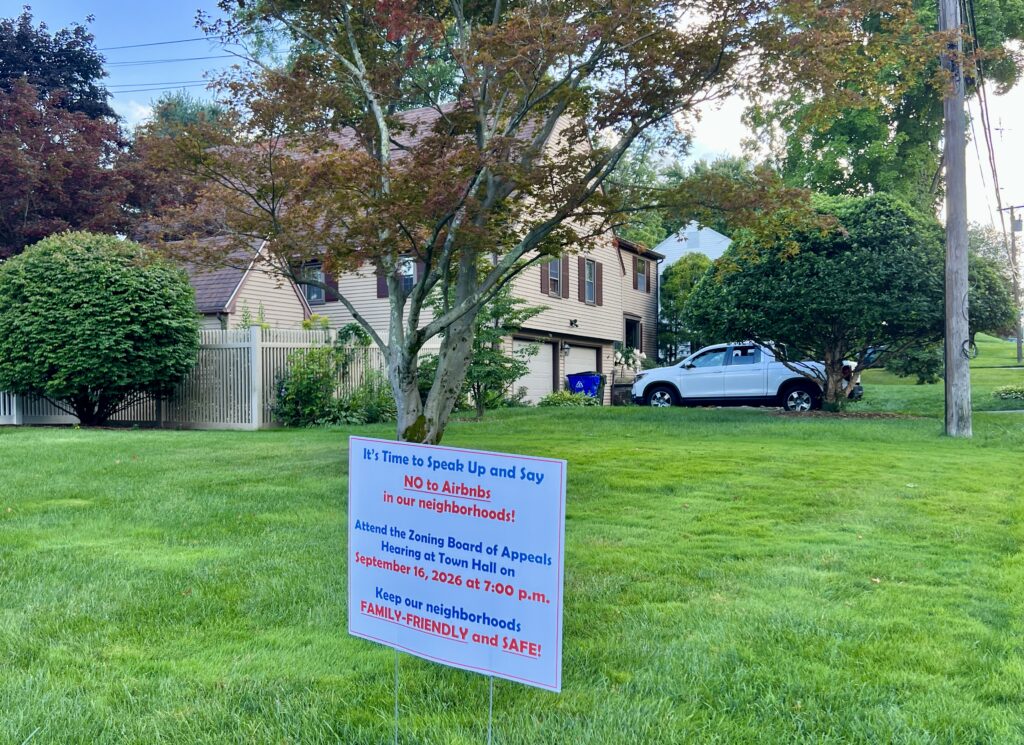
A sign posted earlier this year calls for neighborhood support at the West Hartford Zoning Board of Appeals meeting on Sept. 16, 2026. The house at 39 Pheasant Hill Drive that has been operating as an Airbnb can be seen in the background. Photo credit: Ronni Newton (we-ha.com file photo)
Waiting no longer works because appeals take time, “possibly years,” Dodge told CPED. During the appeals process the properties involved are permitted to operate, “and we’re still getting complaints, particularly about the one operating in the Duffy neighborhood and about other properties that are owned by the same operator,” he added.
“Right now, apart from our zoning enforcement that is itself tied up in the litigation I just described, we have very few tools to make sure these properties are operated safely and responsibly in the meantime while that process plays out,” said Dodge.
In addition, the town is concerned that new operators could set up shop during the time the current cases are being appealed. “If the town were to lose on appeal, those operators could argue that they have grandfathered, nonconforming rights even if we decided to update our language after the decision to prohibit it. Waiting doesn’t freeze the status quo. It actually invites it to grow,” said Dodge.
Dodge said that if the Council adopts the ordinance it could stabilize the situation, hold the line during court proceedings, protect neighbors, and eventually provide the Council with the ability to make a policy decision on short-term rentals.
The proposed ordinance confirms the existing prohibition, and without noting any district adds “short-term rentals” to the code’s schedules of main and accessory uses, and defines “non-transient roomer as someone who stays 30 days or more.”
Perhaps most importantly, Dodge said, “The ordinance calls this license what it is … an interim measure for the period while the litigation is pending, and says in so many words that issuing a license is not an acknowledgment that the short-term rentals are permitted. It isn’t a permit to operate a short-term rental. It’s a set of rules for operators who are already out there choosing to oerate in violation of our zoning ordinance while the courts decide the issue.”
The ordinance does not allow new short-term rentals to become licensed.

136 Raymond Road is one of the properties owned by Mark Chu, a Farmington resident and principal of Instant Property Solutions LLC, being used as a short-term rental. Photo credit: Ronni Newton (we-ha.com file photo)
What the ordinance does and doesn’t do
As proposed, existing operators must apply to the Town Planning department for a license by Feb. 1, 2027, and must have a license by March 1. The fee is $250, and the license would be subject to annual renewal.
The application requires proof (through photos and floor plans and a sworn affidavit) of safety measures in place, including smoke and carbon monoxide detectors, fire extinguishers, and sufficient means of egress. There must be a local (within 25 miles) contact person available whenever guests are on-site, a guest registry must be maintained and kept for at least six months for the purpose of complaint investigations, and the license number must appear on all listings. Licenses will be posted on the town’s website to ensure transparency. Booking services will not be allowed to process reservations for unlicensed properties.
Parking is also specifically addressed under the ordinance, and while several CPED members raised questions regarding this provision, as currently stated “every vehicle of the licensee, or of any user, occupant, or guest of the short-term rental, shall be parked in a lawfully established off-street parking area, such as a driveway, garage, or parking lot. No such vehicle shall be parked on any public or private street during the rental period, except in a metered town parking space in compliance with all applicable parking regulations.” Violations would count against the operator’s license, and the vehicles can be ticketed.
“License is a privilege,” Dodge said, and in addition, any owner who is behind on taxes or other financial obligations to the town will have their license suspended.
Enforcement of violations include graduated tools, ranging from a written warning, order to correct, addition of conditions or other restrictions, 90-day suspension, and revocation, Dodge said. “Operating without a license, or violating its terms, would carry a civil penalty of $250 per day, on top of any penalty that we might apply under the zoning regulations. If a license is revoked, the property cannot be re-licensed for up to one year.”
Appropriate due process procedures are also provided.
Dodge noted what the ordinance does not do. “I want to be absolutely clear: This ordinance does not make any short-term rental legal. It is expressly a temporary license and not a zoning approval and is not evidence that the use was ever permitted, it creates no grandfathered or vested rights, and does not waive any enforcement action that the town might bring under its zoning code,” he said.
“It also ties itself to the outcome of the litigation,” said Dodge, and is fully intended to be a stop-gap measure.
“If the courts confirm what the town has always maintained, that short-term rentals are prohibited, every temporary license would automatically be revoked, with no further action being required by the Council,” Dodge said. “If the courts rule otherwise, though, no new short-term rentals would be able to start once this ordinance takes effect. The existing operators, however, would remain subject to the licensing requirements and also to any limitations that the court may impose,” he said.
“Either way, we come out of the litigation in a better position than we go in,” Dodge said, that confirms what the town has always maintained regarding short-term rentals, keeps new operators from claiming additional rights, and puts accountability on the existing operators.
“Most importantly I think it returns the decision to the Council,” to decide after the litigation is over whether they want to allow short-term rentals, and where and under what terms, Dodge said.
Like what you see here? Click here to subscribe to We-Ha’s newsletter so you’ll always be in the know about what’s happening in West Hartford! Click the blue button below to become a supporter of We-Ha.com and our efforts to continue producing quality journalism.
 Loading...

 Reload document
 Open in new tab