
West Hartford Officials Review Flock Camera Program Amid Privacy Concerns

Audio By Carbonatix
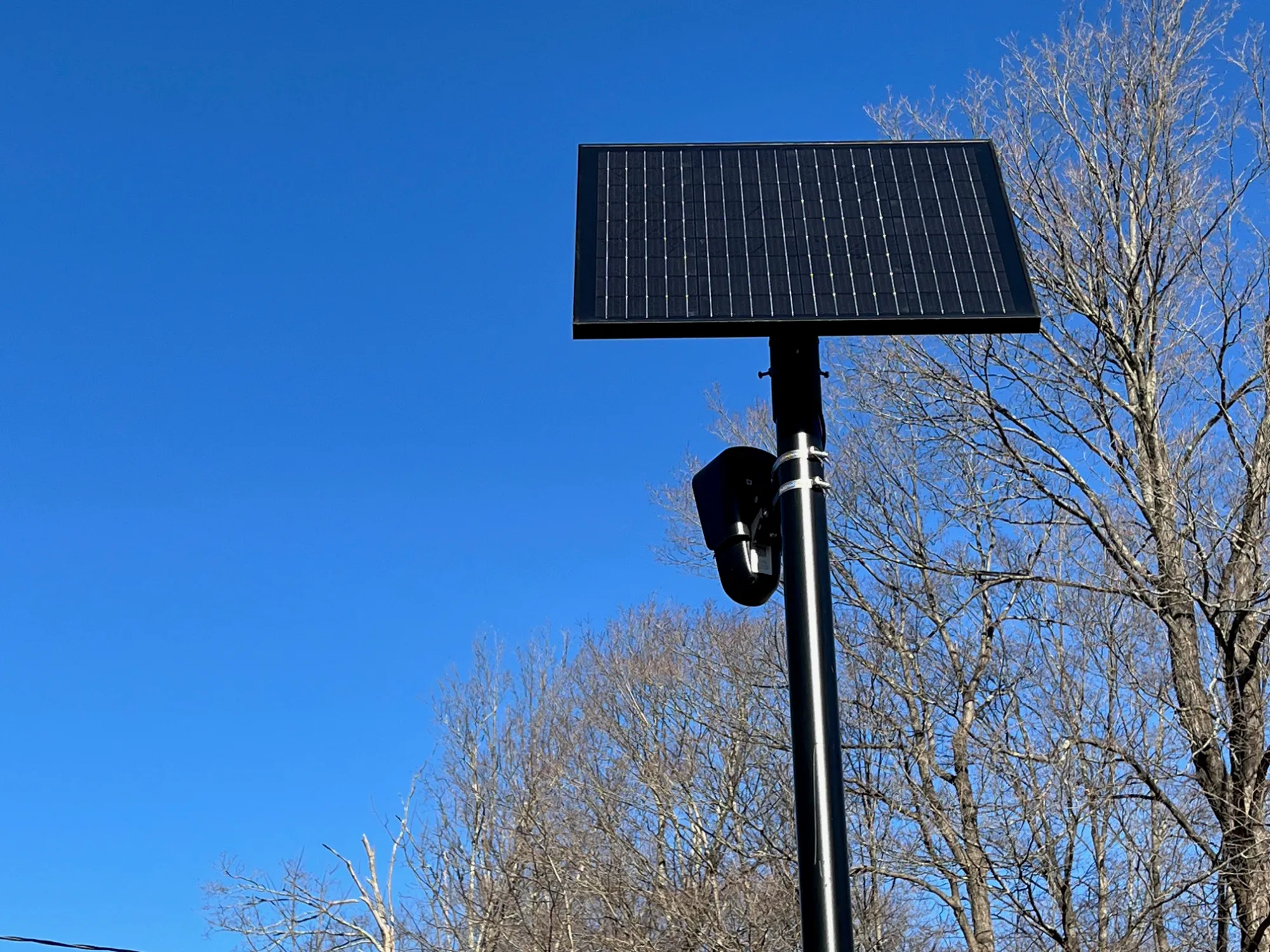
A Flock Safety systems camera mounted on a pole with a solar panel. Photo credit: Viktoria Sundqvist, CTNewsJunkie (file photo)





The West Hartford Town Council’s Public Safety Committee received an overview of the police department’s license plate reader program at its Aug. 4 meeting.
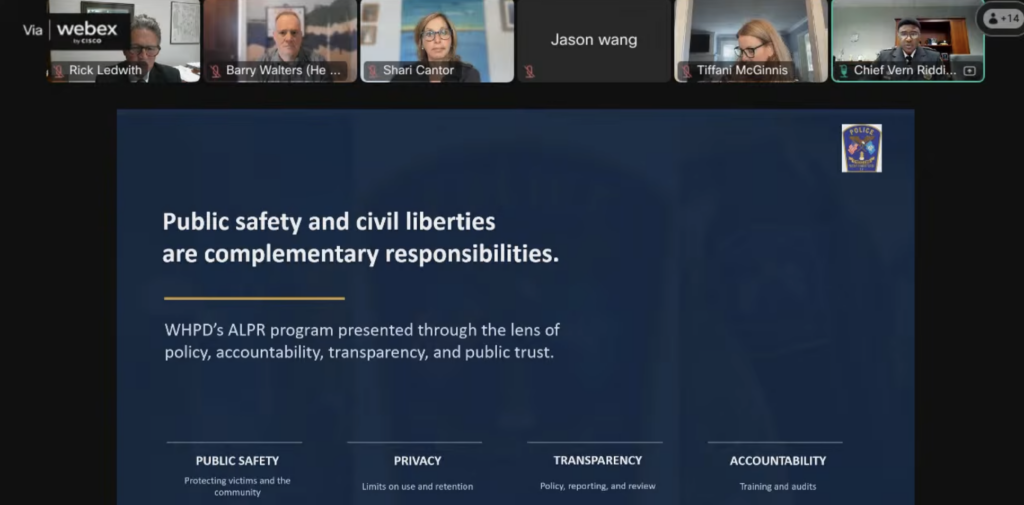
West Hartford Town Council Public Safety Committee discussed the police department’s Flock Safety program on Aug. 4, 2026. Screenshot
By Mia Jaworski
With 34 Flock Safety cameras operating throughout West Hartford, town officials this week reviewed the technology’s use, effectiveness, and privacy implications during a Town Council Public Safety Committee meeting.
The discussion brought together Town Council members, West Hartford Police Chief Vern Riddick, as well as Max Weinstein, who is Flock Safety’s director of public trust and technology and as a Hall High School alumnus is very familiar with the town. While no policy changes were approved, Council members examined how the camera system is used, the safeguards in place to protect residents’ privacy, and concerns surrounding the program’s future in West Hartford.
Described by Chief Riddick as the “Kleenex” of automated license plate recognition because of its prominence in the industry, Flock Safety has drawn increased public attention amid nationwide debates over privacy, surveillance, and public safety.
Flock Safety cameras are motion-activated devices that capture vehicle information as cars pass through their field of view.
The cameras record license plate numbers and distinctive characteristics of the vehicle – including make, model, color and body type – along with the date, time and general location of each detection. The information is stored in a cloud-based system that law enforcement agencies use to assist in criminal investigations and locating stolen or wanted vehicles.
West Hartford currently operates 34 cameras and retains collected data for 21 days before it is deleted. Flock Safety says its technology is used in more than 6,000 communities across 49 states.
Officials noted that automated license plate recognition, or ALPR, technology is not new, having been used for roughly two decades in settings such as parking garages and toll booths before becoming more common in law enforcement.
Balancing Public Safety and Privacy
Throughout the hour-long discussion, officials emphasized the need to balance public safety with civil liberties.
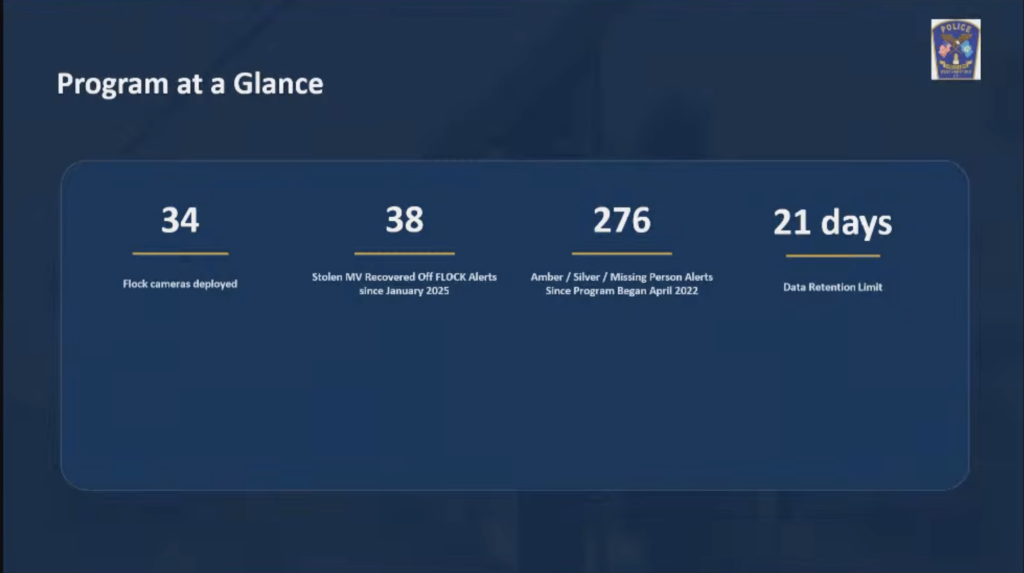
West Hartford Flock camera program overview. Screenshot from Town of West Hartford website
“Successes are very important,” Riddick said. “But not at the expense of civil liberties,” he said.
“So no matter how successful a program is, if we were violating laws, we cannot do it,” Riddick said.
Riddick said West Hartford’s ALPR program is built around transparency and oversight.
“With our ALPR program, public safety is important,” said Chief Riddick, “privacy is extremely important, transparency is paramount and of course accountability through audits and training.”
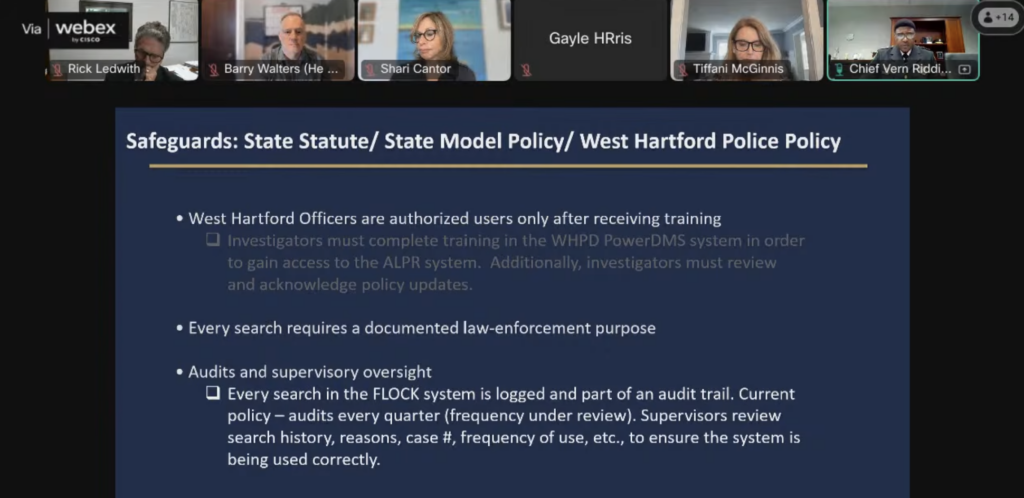
West Hartford Town Council Public Safety Committee discussed the police department’s Flock Safety program on Aug. 4, 2026. Screenshot
Camera Locations Raise Questions About Equity and Privacy
Council members also raised questions about camera placement, including locations near sexual health facilities. Mayor Shari Cantor questioned those placements, referencing privacy concerns raised in other communities and a lawsuit filed in Texas involving the potential collection of sensitive location data.
Responding to concerns over camera locations, Riddick said placements were determined using crime trends, crash data and the same criteria used for West Hartford’s red-light and speed camera programs.
Council members also questioned whether camera placement could disproportionately affect certain neighborhoods.
“Being a person of color,” Riddick said, “understanding how different communities can be impacted and perceptions, we were not going to do that and have not done that.”
Who Controls the Data?
Weinstein addressed concerns over data privacy and explained how access to camera information is controlled. He said municipalities, not Flock Safety, own the collected data.
“The town owns the data,” Weinstein said. “We are the custodian of the data, but the town owns the data.”
The discussion also addressed concerns about potential access by outside agencies, including Immigration and Customs Enforcement.
Responding to questions about federal requests for data, Weinstein said Flock refers those requests directly to the agency that owns the information.
“If a federal agency or any agency comes to Flock with a subpoena or a request for customer data, it is Flock’s position and contractual obligation to refer that entity to the data owner,” Weinstein said.
Riddick added that Connecticut’s updated data-sharing rules, approved by the state legislature this spring as part of SB 397, are effective Oct. 1, limit routine sharing to Connecticut, Massachusetts, New York, and Rhode Island. He said departments can impose additional restrictions on sharing data outside those states.
West Hartford Town Council Public Safety Committee discussed the police department’s Flock Safety program on Aug. 4, 2026. Screenshot
“It is not a question of choosing between public safety and privacy,” said Town Manager Rick Ledwith.
Riddick said vendor contracts prohibit the sale of camera data and that while sharing with neighboring states is allowed, West Hartford can decide whether to participate.
“Vendor contracts prohibit the selling of data,” said Riddick. “Even though we’re allowed to share with New York, Massachusetts and Rhode Island, we can decide not to if we wanted to.”
Weinstein said Flock would not release customer data directly to another agency without the involvement of the municipality that owns the information. He said Flock would support the data owner through any legal process unless a judge ordered the release of the data.
The West Hartford Police Department’s transparency portal states that Flock cameras are “used for law enforcement purposes only,” and that data is owned by the department and is not sold to third parties.
As another measure of protection, police officers must complete PowerDMS online training before accessing Flock data, according to Riddick.
Weinstein also addressed concerns about protests, including demonstrations involving immigration or government actions, saying individuals present would not be tracked or pursued solely based on their participation. He also said that the data cannot be “daisy-chained” and passed along from one party to another.
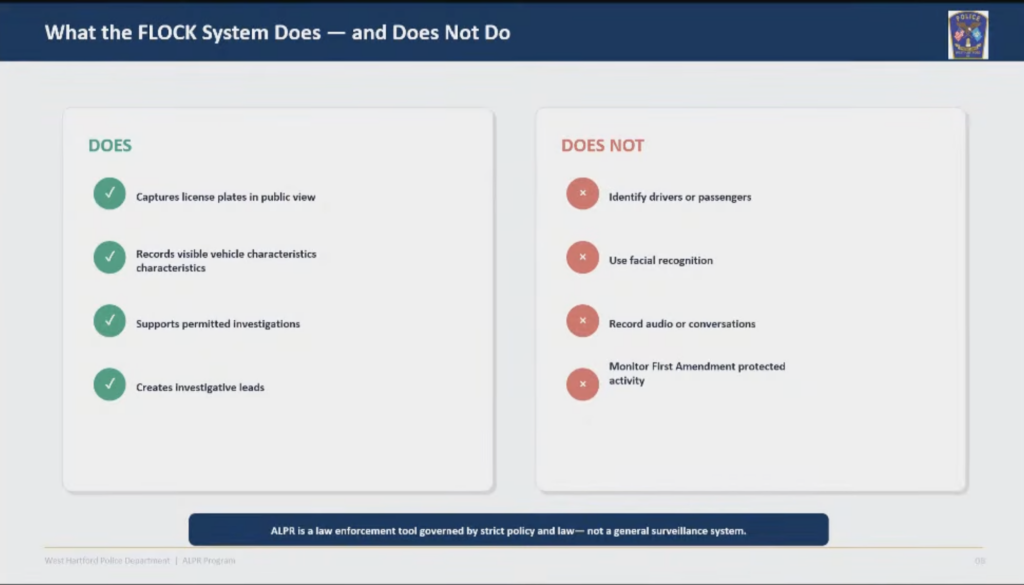
West Hartford Flock camera program information. Screenshot from Town of West Hartford website
Flock’s Role in Criminal Investigations
Council members also reviewed the program’s impact on public safety.
Riddick pointed to several investigations in which Flock cameras helped officers identify suspects, saying the technology has become an important investigative tool for the department.
Officials emphasized that a hit on a license plate reader camera is not, on its own, considered probable cause to stop a vehicle.
Riddick highlighted a 2025 fatal hit-and-run involving a pedestrian in which the suspect fled before officers arrived. After investigators determined the probable make and model of the suspect vehicle from evidence left at the scene, they entered the information into the Flock system, which identified a matching vehicle through license plate detections.
Police arrested a suspect within 13 hours of the crash. Riddick said the case demonstrated how Flock technology can assist investigators in quickly identifying suspects in serious cases.
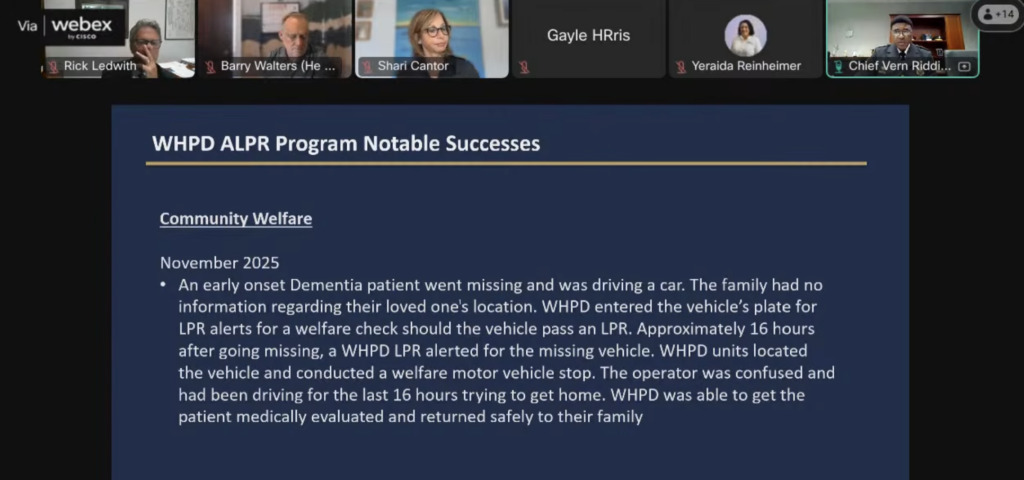
West Hartford Town Council Public Safety Committee discussed the police department’s Flock Safety program on Aug. 4, 2026. Screenshot
For more information about West Hartford’s Flock Safety program and the department’s transparency policies, visit the West Hartford Police Department’s Flock Safety transparency portal. (https://transparency.flocksafety.com/west-hartford-ct-pd#community-impact)
West Hartford Police began using the Flock Safety cameras in 2022, using funding from the American Rescue Plan Act. According to Riddick, the current cost is roughly $64,000 per year to operate the program.
West Hartford is also planning to use license plate reader technology for its automated speed enforcement camera program – which has received town, state, and federal approval and should be implemented this fall – as well as its red light running automated enforcement program, which is currently awaiting final approval by the state and Federal Highway Administration.
Like what you see here? Click here to subscribe to We-Ha’s newsletter so you’ll always be in the know about what’s happening in West Hartford! Click the blue button below to become a supporter of We-Ha.com and our efforts to continue producing quality journalism.



The concern that did not seem to be directly asked by a town council member, and that is most concerning, is when a police officer uses Flock technology to track a former significant other, or their new love interest, across several jurisdictions – i.e. stalking. This misuse has been widely reported and there are at least 50 cases nationally. Add to this abuse the tendency of the police to protect their own. What are the specific in place to protect the public from the misuse of this data by local law enforcement?
None of the concerns raised by the council were adequately addressed by the company rep nor Chief Riddick. Just more platitudes about following the law. We all know that training cops does not stop them from violating the law. We all know that if this program continues, it’s just a matter of time until we see a headline that says something like “License plate data stolen by hackers.” We all know that eventually AI will be used to analyze all of this data and footage, with the predictable errors that arise when that monstrosity is given free rein.
The Council should put our civil liberties first by putting in place a moratorium on the use of these cameras until all of these concerns have been addressed. Deploying them first and asking questions later is a recipe for disaster.
[…] Support for Lamont in August PrimaryAug 8: West Hartford Cleaning Up After Friday Night ThunderstormAug 7: West Hartford Officials Review Flock Camera Program Amid Privacy ConcernsAug 6: Lamont Visits West Hartford to Announce Next Year’s Minimum Wage […]
I am willing to believe that the town officials are sincere in their claim that they are concerned with our privacy, but, if the last couple of years have taught us anything, it should be that depending on the moral rectitude of our public officials is foolish and dangerous. In the wrong hands, the tradeoff between privacy and security disappears completely, making us less secure precisely because we have less privacy. I want the police to enforce the laws fairly. I do not want to live in a surveillance state, even one created by sanguine and well-intentioned officials.